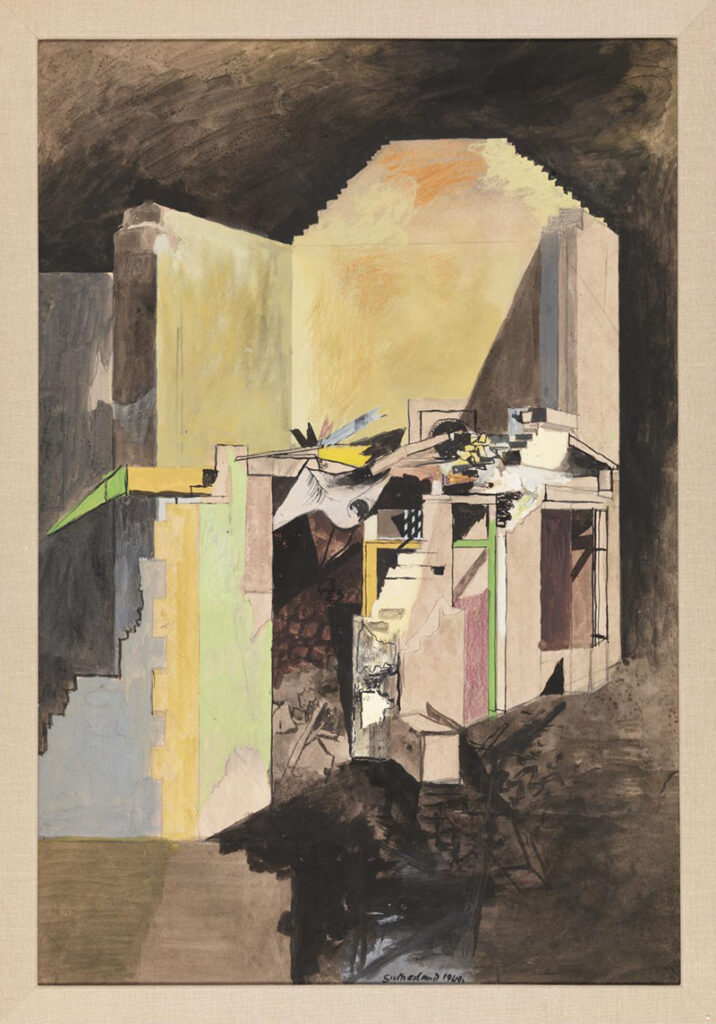
A cultural movement in Britain during the 1930s and ’40s which was influenced by eighteenth-century Romanticism and emphasised individualism and the depiction of intense emotions over social subjects. It developed in response to the impending threats of and the social conditions during World War II. Prominent artists associated with the movement include Graham Sutherland, John Minton and Paul Nash.
More Definitions
Tachisme
A French style of abstract painting, characterised by random splotches and dabs, it gained popularity in the 1940s and 1950s…
Tropical Modernism
Architectural style that adapts Modernist architectural principles and materials for thermal comfort in the hot and humid climate of the…
Academic Realism
A style of painting that was influenced by European academies of art from the sixteenth century onwards. It was characterised…
Futurism
An avant-garde artistic movement that emphasised speed, technology, violence and youth. It originated in Italy in the early twentieth century,…
Vesara Architecture
A term for an architectural style primarily associated with medieval-era temples in the Deccan region, especially north Karnataka. Derived from…
Critical Regionalism
Architectural philosophy emphasising site-specific design that draws on local topography and climate, social and cultural influences, and traditional building knowledge…
Chinoiserie
The European interpretation of Chinese and East Asian decorative arts, design, literature and culture, characterised by extreme decoration, stylised objects…
Formalism
An approach to art which emphasises aspects of form, such as line, shape and colour. Formalism engages with the visual…