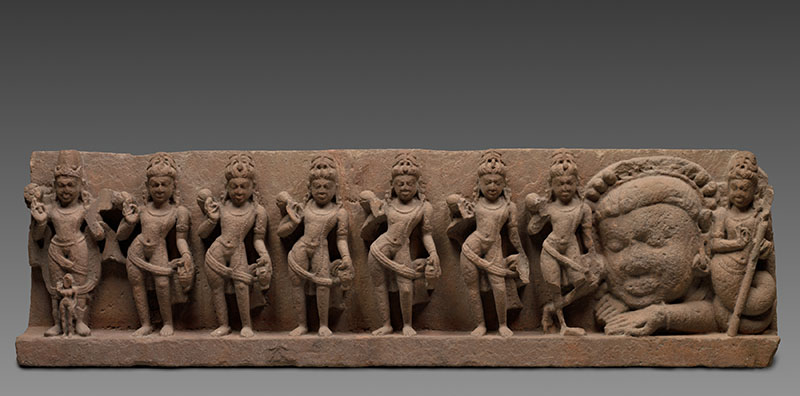
Meaning “nine planets” in Sanskrit, it is a grouping of astronomical bodies and their nine associated deities in Hinduism. These deities also find mention in Jaina texts, where they are included as Jyotiska Devas (“heavenly beings”). The nine deities are Ravi (Sun), Soma or Chandra (Moon), Mangala (Mars), Budha (Mercury), Brihaspati (Jupiter), Sukra (Venus), Sani (Saturn), Rahu (the ascending node of the Moon) and Ketu (the descending node of the Moon). They may be carved onto architectural elements, such as the doorways or niches of a temple, or may be worshipped in a separate shrine within the temple complex.
More Definitions
Vajrasattva
A bodhisattva in the Mahayana and Vajrayana traditions of Buddhism, he is primarily associated with the Akshobhya Buddha. Iconographically, he…
Kinnara
A celestial being in Buddhist and Hindu texts, legends and art, depicted with the head, torso and arms of a…
Bhagavad Gita
Section of the Sanskrit epic Mahabharata, composed as a dialogue between the Pandava prince Arjuna and his charioteer and companion…
Triratna
Also known as the Three Jewels of Buddhism, triratna comprises the Buddha, dharma (his teachings) and sangha (the community). In…
Shaivite Upanishads
A body of fourteen Upanishadic texts dedicated to Shaiva traditions and practice, which expound on the worship of the Hindu…
Kaitabha
A demon in Hindu mythology who emerged from Vishnu's earwax and was killed, along with Madhu, by Vishnu’s manifestation Hayagriva…
Anandatandava
Meaning “dance of bliss,” it is a cosmic dance performed by the Hindu deity, Shiva, in his Nataraja form.
Agni
The god of fire in the Vedic pantheon and one of the five elements of Indian cosmology. Agni is also…