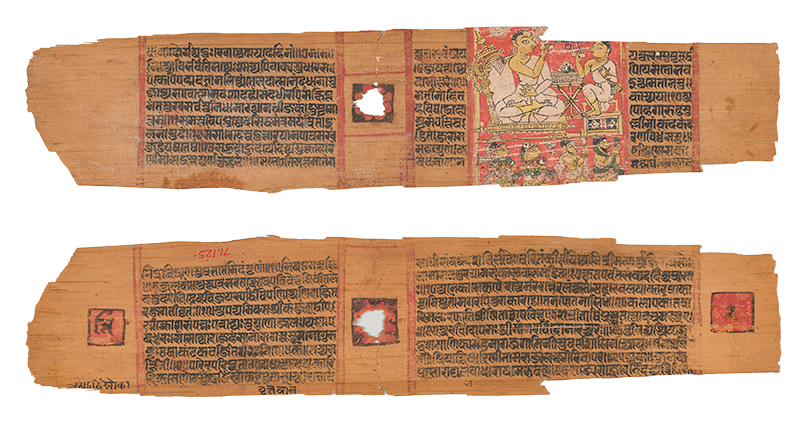
Old Indo-Aryan language, in which a substantial number of the Indian subcontinent’s premodern religious, philosophical, literary, and scholarly texts are composed. Its earliest form is the language of the Rigveda (c. 1500–1000 BCE). Its classical register, which is the language of the majority of Sanskrit texts, was codified later, around the fourth century BCE by the grammarian Panini. The name derives from the term samskrita, ‘well-made’ or ‘perfected’, defined in contrast with prakrita, ‘natural’, a term later applied to a range of vernacular Middle Indo-Aryan languages. The earliest inscriptions in Sanskrit date to the first century BCE and use the Brahmi script; they were found at Ayodhya and Hathibada, in the present-day Indian states of Uttar Pradesh and Rajasthan, respectively. From around the fourth century CE onwards, although not widely spoken, Sanskrit was a major language of literature, learning, and royal self-presentation in the subcontinent as well as culturally affiliated regions including Afghanistan and Java. Its literary and political use in the subcontinent declined from about the tenth century onwards as it was progressively displaced by the regional vernaculars, and later by Persian at the courts of the medieval Muslim rulers.
Sanskrit
Link copied!