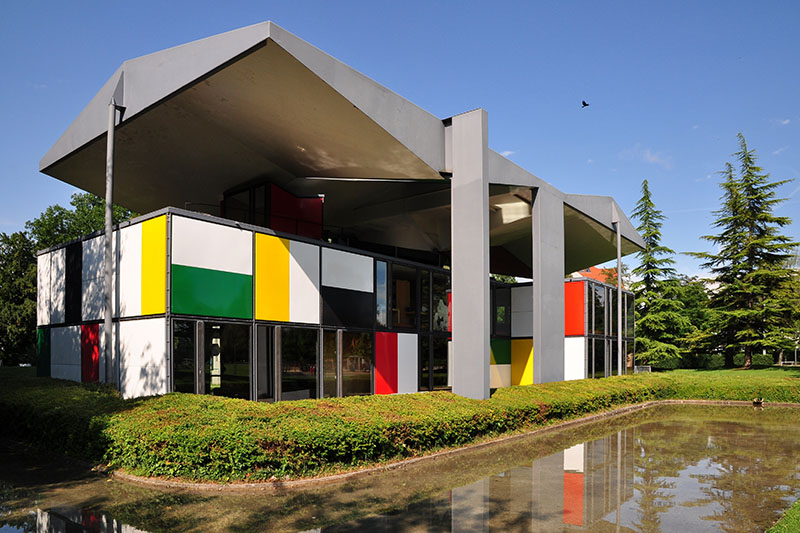
A cultural and philosophical movement that originated in western Europe and sought new paradigms in art and socio-cultural discourse to reflect the transformations brought on by industrialisation in the late nineteenth and early twentieth centuries. It was the dominating current of artistic practice until the 1970s and spread out globally, comprising a diverse set of stylistic movements such as Realism, Post-Impressionism, Cubism, Futurism, Surrealism and Dadaism, among others.
More Definitions
Neo-Romanticism
A cultural movement in Britain during the 1930s and '40s which was influenced by eighteenth-century Romanticism and emphasised individualism and…
Art Nouveau
A cultural movement in art, architecture and applied and decorative arts that sought to modernise design and free it from…
Neo-Impressionism
A late nineteenth-century movement in French painting that opposed the empirical realism of Impressionism. It used the scientific principles of…
Constructivism
An early twentieth century artistic and architectural movement that was started in Russia by painter and architect Vladimir Tatlin and…
Victorian Salon Painting
A number of painting styles that gained popularity in English salons during the reign of Queen Victoria (1837–1901), such as…
Naturalism
A painterly style where elements are depicted in their natural setting, without the use of ornamentation and idealised forms. Naturalist…
Tachisme
A French style of abstract painting, characterised by random splotches and dabs, it gained popularity in the 1940s and 1950s…
International Style
Style of architectural design characterised by lightweight, rectilinear structures using industrial materials such as steel, concrete and glass, often featuring…