Sacred Forms: The Many Lives of a Chola Bronze
An exploration of the ritual lives of Chola-era bronze idols — from their making and consecration to worship, procession, burial, and rediscovery.
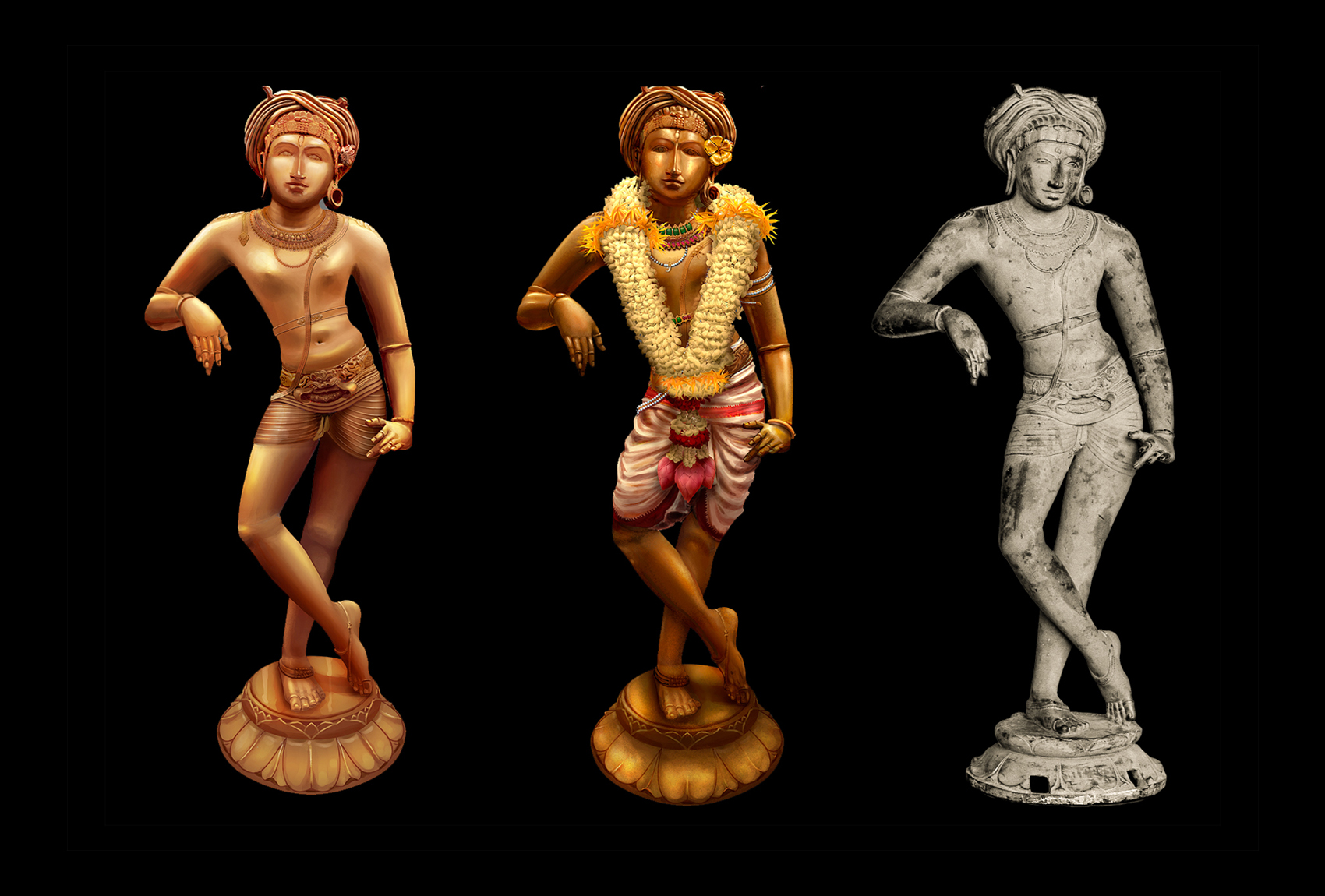
The many lives of a Vrishabavahana idol; Middle Cholanadu; Tiruvenkadu, Thanjavur, India; 1011 CE; Bronze; 106.7 cm. IIllustration: Anupam Arunachalam for Impart, Photograph: American Institute of Indian Studies
In 1951, a farmer ploughing a field beside the Swetharanyeshwarar Temple in Thiruvenkadu in Tamil Nadu made an accidental discovery of immense historical significance — a hoard of buried bronze sculptures. Scholars dated them to the time of the Chola dynasty — specifically, the eleventh century CE.
Three more such hoards of bronze sculptures were unearthed in Thiruvenkadu in 1925, 1960, and 1972.
Amongst other objects, the 1951 hoard contained an exquisite statue depicting a young man leaning gently to his right, as if resting on a missing object or figure.
He was identified as the Hindu god Shiva, and the missing figure as his vahana or mount, the sacred bull Nandi, also known as Rishabha. This uncommon iconographic form of Shiva is Vrishabhavahana — the one who rides rishabha (lit. bull). The same hoard also contained a statue of Shiva’s consort Uma.
This depiction of Shiva in his youth is one of very few instances, yet his identity is unmistakable. Distinct aspects of Shiva’s iconography are present: matted locks wrap around his head like a turban and fan out sensuously over his shoulders and down his back; a crescent moon, serpent, and flower are lodged in his hair.
Shiva’s third eye is etched onto his forehead and his lips are slightly upturned in a solemn smile.
He stands 108 centimetres tall in the classical tribhanga or triple-bent pose — one bend each at the neck, waist, and knee — on a lotus-shaped pedestal. His left hand rests on his hip, while his right arm leans on the now-missing Nandi.
The statue presents a marked departure from Shiva’s more common guise as an itinerant ascetic figure covered in ashes and wearing a leopard-skin waist cloth, that gained prominence in early modern North India.
In Tamil Nadu, from the time of the Pallava dynasty in the eighth century, Somaskanda icons — depicting Shiva with Uma and their son Skanda — were often simultaneously an idealised representation of Pallava kings, their wives, and crown princes, equating royalty with divinity.
During the reign of the Chola dynasty, Vrishabhavahana — another regal form of Shiva — gained popularity. This form was believed to confer victory on the king’s army and thus linked to royal success and prosperity.
Here, he is adorned like a royal of the time, wearing a profusion of jewellery: three elaborate necklaces, a patra-kundala or ear plug in his left ear, a waist belt, armlets, bracelets, rings, and anklets.
A yajnopavita — a three stranded, knotted sacred thread — rests languidly across his chest, a band encircles his midriff, and a girdle with an elaborate kirtimukha (lit. face of glory, a lion’s face motif associated with regal power) clasp holds his loincloth in place.
Who commissioned this statue? Who made it? And how did it end up buried in a field outside a little town?
The answer lies in a Chola-era structure: Swetharanyeshwarar Temple at Thiruvenkadu, near where the bronze was found. An inscription on the south wall of the central shrine, dated 1011 CE, suggests the Vrishabhavahana statue was originally commissioned by Kadamban Kolakkavan, a military chief in the court of Rajaraja Chola (r. 985–1014 CE), to be installed there.
Another inscription, dated 1012 CE, engraved along the north wall records that the following year, a companion image of Shiva’s consort Uma, unearthed alongside the Vrishabhavahana idol in 1951, and the image of the bull to accompany Shiva, had been donated by eleven members of a local elite military group.
A tradition of commissioning bronze idols existed in the northern Tamil country as early as the sixth–seventh centuries CE, under Pallava rule. However, those bronzes were much smaller — about twenty-five to thirty centimetres high.
From the ninth century onwards, under Chola rule, devotional bronzes began to be commissioned on a much larger scale in the Kaveri river delta region. Temples had grown to require ten to twelve bronzes for their annual ritual cycles, and in particular for ceremonial processions.
Such idols were commissioned and gifted to temples by individuals, as well as groups of people. They had evolved to be more than devotional offerings and acted as symbols of prestige, affiliation, and local standing within Chola society.
Portable processional images had existed in South India as early as the sixth and seventh centuries CE — but they had been made from wood, and eventually decayed. By the ninth century, however, there was a move towards more permanent materials. Rebuilt and newly commissioned temples were constructed in stone, and increasingly, sacred images began to be cast in metal.
Immovable stone icons were installed in the garbhagriha or sanctum of the temple, the innermost physical and spiritual core of the temple, as the principal object of worship.
Another type of idol, however, was portable and used in rituals and processions. Known as utsavamurti or festival idols, these icons move, to this day, within temples and through towns, making the divine publicly accessible. They receive devotion in the streets, and participate in the rhythms of community life, transforming the divine into a deity with a social role and a living presence.
Known in Tamil as seppu thirumeni (sacred copper bodies), bronze processional images were durable and polished to glow in lamplight, making them well-suited for ritual handling and public display. Most of these bronzes stand beneath an arch on lotus-pedestals with rings or holes at the base for securing them with ropes during processions. Many have a sira-chakra or projecting disc behind their head from which garlands could be hung
Inscriptions from the time of the Chola dynasty tell us that kings, queens, and other royals, military officers, merchants, priests, guilds, village assemblies, and local elites all participated in gifting bronze statues and endowing them with ritual services and finery. If the commissioning of temple buildings was one form of piety and prestige, the donation of statues was another.
Spurred by such prolific patronage, a large network of bronze sculpture workshops emerged. Sculptor lineages in the Kaveri basin began to develop their own distinctive styles.
Art historian Vidya Dehejia has classified two stylistic lineages from this time: the ‘Coastal’ and the ‘Capital’. The ‘Coastal’ style workshops, centred around Nagapattinam, produced slender, sinuous figures with oval faces and elongated torsos.
The ‘Capital’ style workshops, associated with Thanjavur — the Chola capital — and inland regions such as Tiruchirappalli, produced more compact bodies with broader shoulders and squarer heads.
Though the sculptors of many bronzes remain anonymous, art historians have identified distinctive styles like that of the so-called ‘Thiruvenkadu Master.’ Images attributed to him include Shiva as Ardhanarishvara (c. 1015–1020), Pichcha Devar (c. 11th century), Bhairava (c. 1010), and a four-piece Kalyanasundara (c. 1012), all originally installed at the temple at Thiruvenkadu.
The Thiruvenkadu Master’s work is often identified by carefully rendered rounded fingers and fingernails, an intimate understanding of anatomy and posture which translates into sinuous elegant forms, and a distinct looped knot on the loincloth.
The bronze sculpture of Vrishabhavahana, discovered by the Tamil farmer, is believed to have been made in the Thiruvenkadu Master’s workshop.
The life of this particular bronze, from inception to worship, burial and rediscovery, draws an arc that it shares with many other Chola-period bronzes. It would have begun in the master’s workshop.
Historically, these idols — of deities, and, increasingly in the 12th century, of saints canonised in texts like the Periya Puranam — were cast using the lost-wax method, in which a hand-modelled wax figure is encased in layers of clay, melted away with heat, and replaced with molten metal. Once cooled and refined by the sculptor, the result is a one-of-a-kind idol — the only replica of the hand-moulded wax sculpture transmuted into metal.
The making of bronze idols was enshrouded in ritual — technical treatises like the Manasara (1–500 CE) note that the sthapati or master sculptor observed ritual abstinence before beginning work and offered prayers to the deity whose image he was about to create.
After their completion, bronze idols were made fit for worship through prana pratishtha (lit. establishing life force, or consecration), a series of rites that infused them with divine presence, likened to a soul entering a body. The 5th-century Kamikagama — the first of the twenty-eight Shaiva Agama texts governing temple and personal worship of Shiva — describes twenty-two elaborate rituals through which an idol is consecrated.
The idol was then carried to its designated shrine inside the temple and dressed, adorned, and installed there. The priest would perform a first full worship of the idol, marking its completed transformation into divinity.
This very same process lives on to this day in temples across Southern India.
Once installed, the bronze — now recognised as a deity — enters an ongoing cycle of service. Each day begins with ceremony. The deity is approached, attended to, and ritually invoked for worship with sacred chants and music. The bronze is not just a stand-in for divinity, it is a deity that leads its own life according to a sacred schedule.
Adornment is a symbol of auspiciousness and acts as a protective talisman. Bronze deities were typically clothed, bedecked with jewels, and decorated with flowers, garlands, and perfumed pastes. The inscription that records the commission of Uma, the consort of Vrishabhavahana at the Swetharanyeshwarar Temple, also records the donation of jewelled ornaments to grace the idols.
Deities were presented with naivedyam or food offerings at least thrice a day. Chola temple inscriptions record what ingredients were needed, which villages supplied them, how often offerings were made, and how the food was then distributed as sacred prasadam, or blessed food, to devotees.
After the last rituals and ceremonies of the day, the deities — accompanied by a procession of attendants carrying lamps and incense — were taken to their bedchamber, where the divine figure was put to rest for the night.
Abhishekam, or ceremonial baths, were among the most intimate acts in the bronze’s ritual life. Historical accounts and temple records describe images being rubbed with ash, cowdung, a variety of fruits, honey, ghee, and other substances, washed with scented water, and polished until they gleam. This repeated care altered the surface of the metal over time.
That is why bronzes that remain in continuous worship look different from those unearthed from the ground or those that are housed in museums. Perpetually worshipped images tend to be worn smooth by centuries of handling and cleaning, while excavated bronzes preserve crisper details and mineral-encrusted surfaces with visible patina from their time spent in the earth. In pristine condition, they too, would have been golden and resplendent.
Perhaps the most dramatic moments of a bronze’s life occurred when it left the temple premises. Grand public displays of rituals that would have otherwise been conducted within the temple were an essential strategy for projecting cultural and religious unity across territories under the Chola
On special occasions throughout the year, the deity would be taken from their home within the temple, for ritual activities like ceremonial baths, sacred hunts, or to enact events from their hagiography. They would travel to gardens or groves where they received offerings, rested in mandapas or pavilions, and interacted with devotees.
In procession, the deity appeared almost like royalty. People from near and far thronged to temple towns, lining processional routes to partake of darshan, the sacred act of observing the deity and receiving blessing. Such processions were important in reinforcing the divinity that imbued the bronze, and were carefully planned civic events, intended to allow people to encounter the gods.
In some processions, the deities were installed in small pavilions that rested on wooden or bamboo poles, which allowed them to be hoisted and carried on the shoulders of devotees.
In other instances, deities were installed and secured to wooden vahanas, ritual vehicles or chariots that were pulled by the crowds.
The deity in its chariot, or borne on shoulders, would be accompanied by an entourage of lamp, flag, parasol and flywhisk bearers, musicians, hymn-singers, dancers, priests, attendants, and garland carriers. A diverse crowd of pilgrims and devotees would line the roads, looking on, joining and walking along, participating in a multisensory spectacle of sound, movement, fragrance, and devotion centered around the moving idol.
In the Chola period temple-donors and women from the upper rungs of society could gain privileged positions within the workings of a procession through patronage and donations to temples. These prestigious acts included waving flywhisks, singing, dancing, or riding in temple cars.
Over time, as temples and their compounds grew in size and came to include outer walls, gateways, multiple halls, and circumambulation paths, rituals and processions adapted accordingly and bronze idols began moving through the temple’s physical space in a prescribed manner.
In places like Chidambaram one procession occurred during the sea-bathing festivals in Masi, the eleventh month of the Tamil calendar, when Shiva and his consort were taken to the coast for a ceremonial bath in the sea.
Where the sea was too far, riverbanks or man-made tanks could serve as a substitute.
Records such as a c.1146 Thiruppanandal temple inscription of Rajaraja II and a c.1210 Tiruvaymur temple inscription of Kulottunga III inform us, that as temple processions grew in scale, they led to a remodeling and expansion of local infrastructure. Roads were cleared, tanks and bathing facilities constructed, shelters built, lamps installed, and freshwater sources prepared for devotees.
Behind the visible splendour of processions and rituals was an extensive administrative apparatus. Worship did not thrive on devotion alone — it required a great deal of organisation as well.
Chola inscriptions reveal, in extraordinary detail, villages assigned to provide ingredients for the deities’ food, committees formed to take care of jewellery, temple staff paid for festival duties, and endowments earmarked for lamps, garments, and other offerings. The bronze deity stood at the centre of a large network of labour, patronage, taxation, and redistribution.
The Vrishabhavahana bronze was commissioned in the eleventh century, entered the temple, and was established as a living deity. Its life would have been a rich and busy one, full of ritual, celebrations, and human interactions.
The idol was likely removed from its home in the temple, and buried for safekeeping during the thirteenth or fourteenth century, a period of instability marked by raids and the plunder of Chola territories by rival kingdoms.
After its re-discovery it was transferred to the Thanjavur Art Gallery.
To encounter a Chola bronze in the museum today is to glimpse only the last act of its life-story.
There, Chola bronzes are typically displayed unadorned, artificially lit, isolated, against neutral walls. They are appreciated for their execution, aesthetic features, and beauty and no longer treated as deities.
Visiting Vrishabhavahana in a temple, resplendent in all his glory, would have been an altogether different experience. He would have stood amidst the fragrance of lamp oil, incense, flowers, and other offerings. He would have glowed in the lamplight — just as he was made to. Though still one and the same bronze, the effect on the beholder would have differed immensely — depending on the stage of Vrishabhavahana’s life at which they stepped into his presence.
Archi Banerjee is a Research Specialist at Impart, where she works on research and production of image-forward writing on South Asian art history.
This Journey was developed in consultation with historian Anirudh Kanisetti, building on research supported by an Impart Research Grant awarded to him in 2024 for his book Lords of Earth and Sea: A History of the Chola Empire (Juggernaut, 2025). Kanisetti is also the author of Lords of the Deccan: Southern India from the Chalukyas to the Cholas (Juggernaut, 2022).
Branfoot, Crispin. “Approaching the Temple in Nayaka-Period Madurai: The Kutal Alakar Temple.” Artibus Asiae 60, no. 2 (2000): 197- 221. https://doi.org/10.2307/3249918.
Davis, Richard H. Lives of Indian Images. Princeton University Press, 1997.
Dehejia, Vidya. “A Passion for Inscriptions: ‘Reading’ Chola Temple Walls.” Accessed July 31, 2026. https://vidyadehejia.com/wp-content/uploads/2023/10/Singapore-conference-3.-WAI_3-Dec_Vidya-Dehejia.pdf.
Dehejia, Vidya. The Thief Who Stole My Heart: The Material Life of Sacred Bronzes from Chola India, 855–1280. Princeton University Press, 2021.
Impart. “Bronze & Stone Timeline.” Accessed March 31, 2026. https://imp-art.org/timeline/chola-temples/.
Impart. “Vrishabhavahana and Uma Chola Bronzes, Thanjavur Art Gallery.” Accessed March 31, 2026. https://imp-art.org/articles/vrishabhavahana-and-uma-chola-bronzes-thanjavur-art-gallery/.
Kolappan, B. “The Abode of the Tallest Nataraja Bronze Idol.” The Hindu, April 21, 2022. Accessed March 31, 2026. https://www.thehindu.com/news/national/tamil-nadu/the-abode-of-the-tallest-nataraja-bronze-idol/article65341384.ece.
Orr, Leslie C. “Processions in the Medieval South Indian Temple: Sociology, Sovereignty and Soteriology.” In South Indian Horizons: Felicitation Volume for François Gros, edited by Jean-Luc Chevillard and Eva Wilden, . École française d’Extrême-Orient, 2004.