-
ChicagoSunil, Nileena. "On Muses & Musings: Pushpamala N’s ‘Sculptor’s Notebook’." Impart Perspectives, September 4, 2026. https://imp-art.org/perspectives/dispatches/on-muses-musings-pushpamala-n-sculptors-notebook/
-
MLASunil, Nileena. "On Muses & Musings: Pushpamala N’s ‘Sculptor’s Notebook’." Impart Perspectives, Sep. 4, 2026, https://imp-art.org/perspectives/dispatches/on-muses-musings-pushpamala-n-sculptors-notebook/. Accessed 20 Oct 2026.
-
HarvardSunil, N. (2026) On Muses & Musings: Pushpamala N’s ‘Sculptor’s Notebook’, Impart Perspectives. Available at: https://imp-art.org/perspectives/dispatches/on-muses-musings-pushpamala-n-sculptors-notebook/ (Accessed: 20 October 2026).
On Muses & Musings: Pushpamala N’s ‘Sculptor’s Notebook’
Capturing the artist's formative influences and experiences, 'Sculptor’s Notebook' is at once a personal essay, a dissertation, and a stand-alone piece of art.
By Nileena Sunil
Link copied!
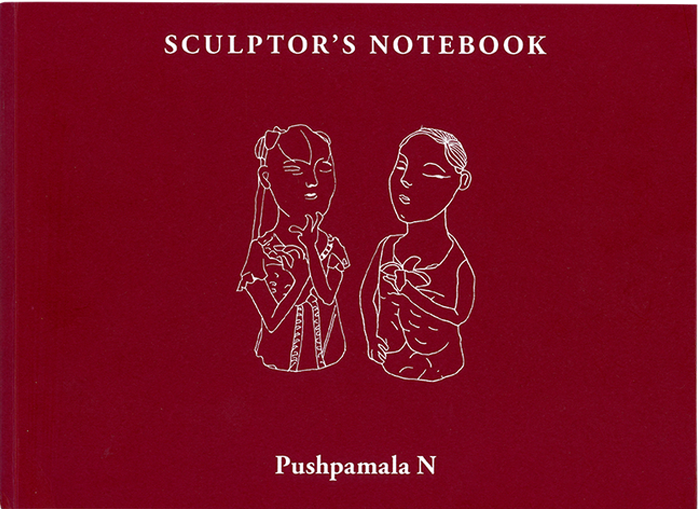
Cover of Sculptor’s Notebook; Author Pushpamala N; Publication Design by Nihaal Faizal; Published by Reliable Copy. Courtesy the artist
Sculptor’s Notebook by Pushpamala N is an interesting text for many reasons, not the least of which is its form. It is, according to the writer, a dissertation in the form of a personal essay. Since it is not a conventional thesis, it is not structured into different chapters, nor does it contain much academic language. Rather, it forms a continuous narrative, which goes back and forth in time, dictated by the flow of the writer’s thoughts and memories. The text discusses the artist’s inspirations, influences, and formative experiences that have since informed her oeuvre, ever since she graduated in 1985 with a Master of Arts in Sculpture from the Maharaja Sayajirao University (MSU), Baroda. Over 40 odd years, Pushpamala has worked across a variety of mediums and formats — sculpture, photography, video, performance art, woodcut prints, and writing, among others. While sculpture was her focus when she wrote her dissertation, she turned to mainly photo- and video-performance later on. Nevertheless, her works across mediums inform each other, as is evident in Sculptor’s Notebook.
The dissertation-slash-essay was published as part of Reliable Copy’s (Fine) Arts Dissertation series. Established in 2018 by the artists Nihaal Faizal and Sarasija Subramanian, the press defines itself as a publishing house and curatorial practice dedicated to works, projects, and writing by artists, and is known for republishing theses written by former fine arts students from MSU, Baroda. According to curator Pramodha Weerasekera, these republished dissertations can also be called reproductions because they painstakingly recreate “any stains, tear marks, blank pages, notations, and spelling errors that were visible in the originals.”
In Sculptor’s Notebook, which Reliable Copy co-published with the Sharjah Art Foundation, Pushpamala’s writing is interspersed with pictures of her artworks and punctuated by blank pages. The text patterns morph in step with her musings. In a few places, lines are arranged in what looks like verses from a poem. “An inner meditative look / in the gesturing hands; the / rhythm of music, dance / the hands are soft, vulnerable / the arms; thin, gawky, against the / solid sentimentality of thighs and torso”, Pushpamala writes in one such section. All this adds to how the writing resembles the free-flowing entries of a personal diary rather than an academic dissertation.
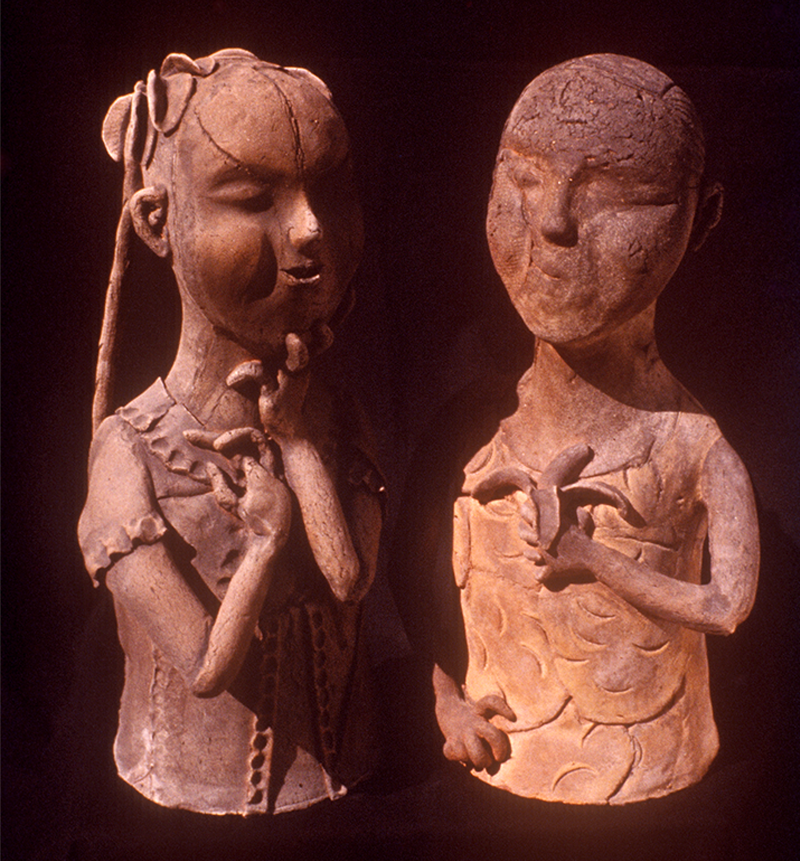
The book also includes a 2022 interview with the artist, providing additional insights, context, and her retrospective thoughts on her master’s thesis. In it, Pushpamala notes that she saw her dissertation as something not separate from her artwork and indeed, once you browse through its pages, you know Sculptor’s Notebook is a piece of art, even if it is in the form of a book. Going back and forth between descriptions of her works and life experiences, the text emphasises how the two correlate in Pushpamala’s graduate work. She describes her sculptures of women as “awkward, fleshy, and plump faced”, before adding that they are “voluptuous” and “coquettish”, comparing them with the real-life women she was inspired by. She also speaks of specific sculptures in terms of traits — how some have “an assertive personality” or “a mischievous independence”, while another has a “warm and maternal presence.”
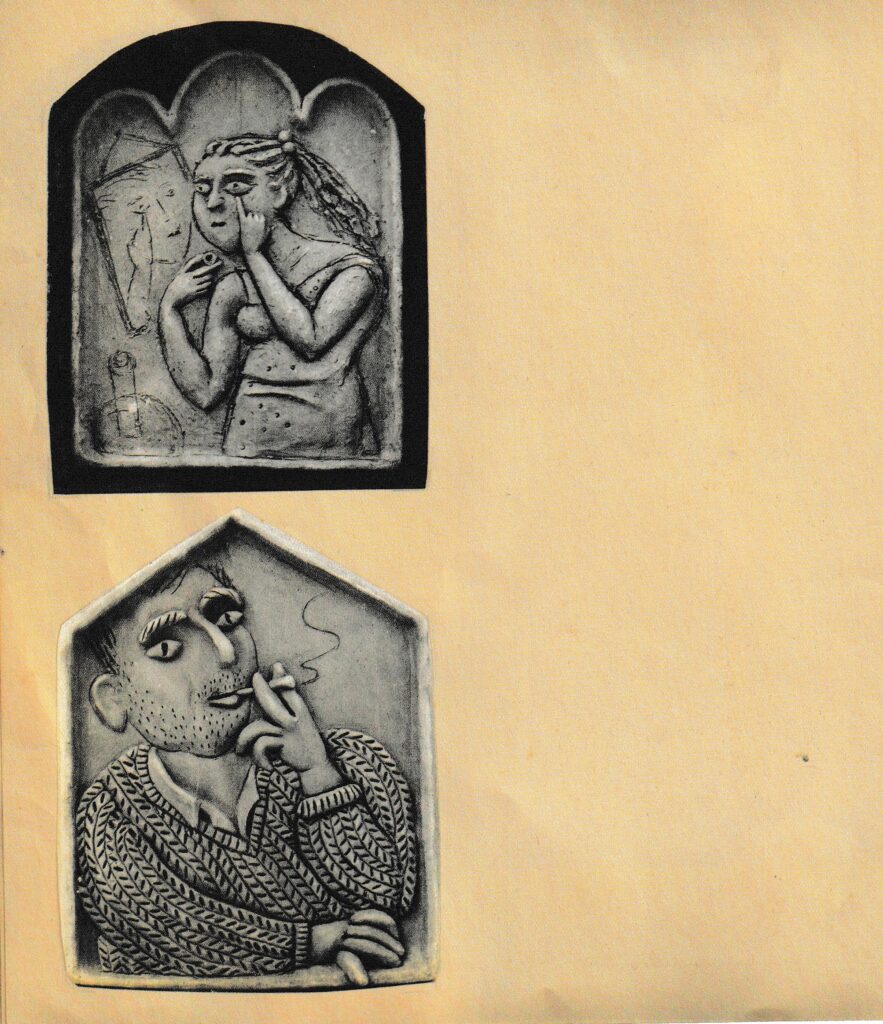
While most of the writing is observational, there are parts in which Pushpamala reflects on her practice. She writes, “When I do a sculpture of a girl eating a banana, a man smoking a beedi, or a dog scratching itself, I want to capture those transient, fleeting moments that are the fabric of memories, of happiness.” Her woodcut prints and terracotta plates featured in the book depict ordinary, light-hearted moments, with titles like Best Friends, Adolescence, Pani Puri, Dressing-Up, and A Beedi Smoker. These acts, according to her, may be “prosaic and transitory, but also eternal and universal.” She also reflects on the process of firing terracotta sculptures in a kiln, saying, “the modernity of the subject and the ancient process [of turning clay into ceramic] connects this moment [from my practice] with all time and history.”
Pushpamala mentions a variety of influences which shaped her art back then, which range from Indian and Western art, to popular and kitsch forms, as well as real life encounters. While talking about the aesthetic sense she favours, she writes that her subjective reaction to the human body is not in terms of “a Venus or a David”, but closer to “the Yakshas and Sundaris of Indian sculpture, or even the plump heroes and heroines of film posters.” This is not the only place where Pushpamala talks of such unusual juxtapositions that draw on modern popular culture as well as familiar historical art motifs. She mentions that her sculptures of women are “reminiscent of the bra ads that I saw in buses, the women of kitsch calendars, the heavy rounded limbs of yakshis.” Such disparate references surface in many of her works — not just her early sculptures but also later in her artistic career to critique or mock dominant narratives around gender, cultural stereotypes, and societal norms.
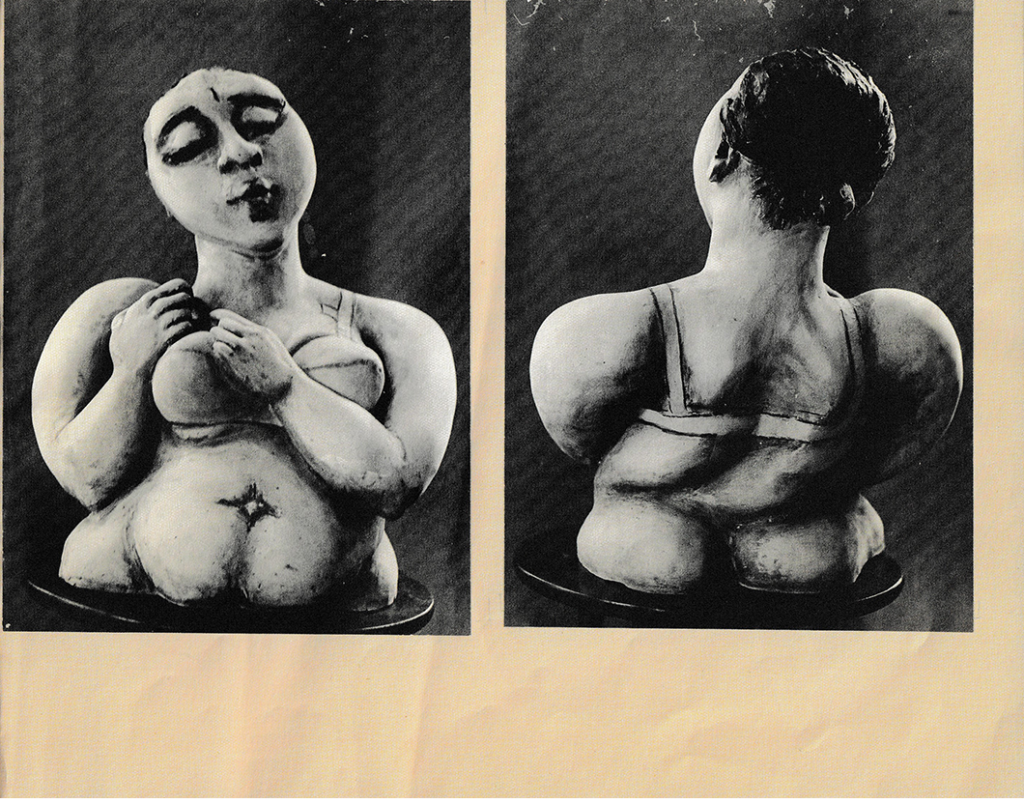
Most of Pushpamala’s sculptures from this period are of women, and she talks about the thought process and feminist sensibilities that shaped them. In the interview, she mentions being part of a very male dominated field, which pushed her to develop ways that were different from the usual portrayal of women in art, done mostly by men. She talks about creating figures of awkward and embarrassed women who are not meant to be graceful or attractive the way female figures are often expected to be. Her aim, at the time, was to create images of women, not as martyrs or victims, but as whole, strong human beings, “who looked straight at the world.” One artwork she repeatedly brings up in this context is her plaster sculpture Woman Adjusting Bra. She says that she drew inspiration for this from plaster busts used for bra displays in shop fronts, sundaris of Indian temple sculpture, and daily mental images of women dressing in the ladies’ hostel where she stayed. This sculpture captures a moment rarely seen as an ‘appropriate’ subject for art, emphasising the sculpted woman’s warm and very human presence. She is seen by Pushpamala as “funny, but not a figure of fun.”
Undergarments are a recurring motif in her work. Aside from Woman Adjusting Bra, it also occurs in Languid Woman, a woodcut figure showing a woman leaning against a cushion in a bra and printed petticoat. “In my work, the human body, particularly the woman’s body, is looked at with detachment, but also as something that is familiar, and so with fondness at its familiarity,” she says in reference to these two sculptures. Even though both works show women in their underwear, they don’t come across as sexual or even provocative. Instead, they embody a playfulness that characterises much of her work. Pushpamala also talks about her girlhood, her family, and her life as a student at a hostel, as experiences that informed her depictions of women. In the interview, she mentions her mentor Raghav Kaneria had suggested she sculpt something similar in tone to the humorous sketches in her sketchbook. This thrilled her since she always had the notion of sculpture as “something very sombre and serious.”
Her light-hearted approach influenced her sculptures of women, with exaggerated proportions and comic, almost caricatured expressions. These early nods to dramatic expressions and poses can be mapped to Pushpamala’s later turn to performance photography as her primary medium in the mid-nineties. Back in 1985, when Pushpamala penned Sculptor’s Notebook, she was working mostly in sculpture. Yet, it is impossible to miss the references to acting and photography that, in hindsight, seem all the more relevant to her artistic trajectory and the kind of work she has since produced.
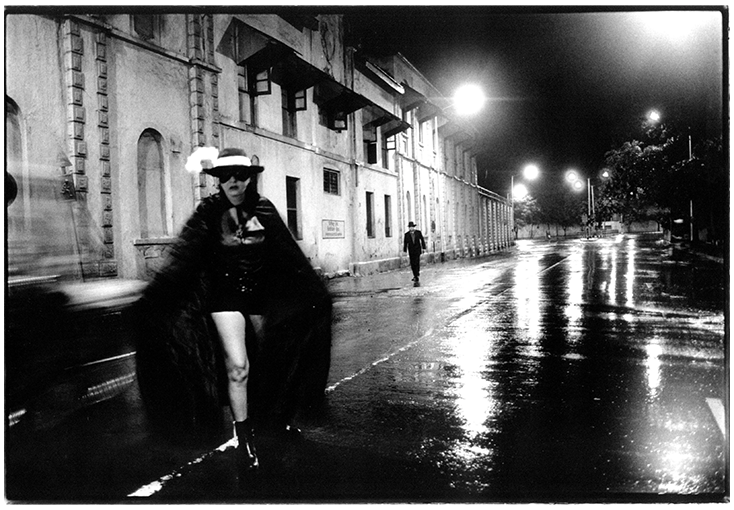
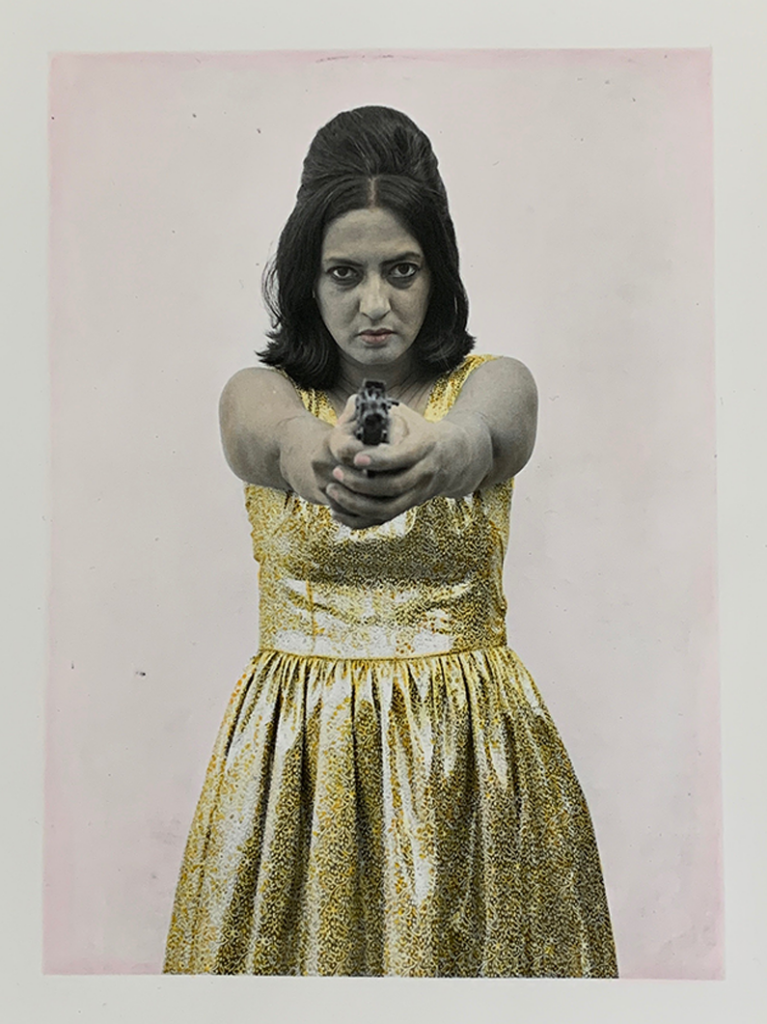
In the dissertation, she mentions family pictures and her mother acting in productions staged by the ladies’ club in their neighbourhood — something she credits for influencing her love for role-playing and exaggeration. Pushpamala’s performance photography work — referred to as ‘photo-romances’ — often involves herself modelling for the camera in disruptive and dramatic portrayals. For instance, her photo-romance Phantom Lady or Kismet (1996–98), in which she plays the role of a mysterious masked figure, embodies the same ‘theatricality’ and ‘playfulness’ she talks about in her dissertation in the context of her sculptural practice. In the interview portion, she mentions how Phantom Lady or Kismet also began as a “playful thing” for a show about cinema. Similarly, her other works, such as Sunhere Sapne (1998), which captures the fantasy of a middle-class housewife and her alter-ego, and Native Women of South India: Customs and Manners (2000–04), showcase her flair for theatricality and her fondness for subverting how women are typically viewed or were represented, much like her early sculptural work depicting women.
In the interview, the artist reveals that she titled her dissertation “Sculptor’s Notebook” after the Paul Klee Notebooks. Klee’s Notebooks contain extensive writing about colour theory and modern art; in contrast, Pushpamala’s “Notebook” does not contain strictly academic notes about sculptural theory, techniques, materials, proportions, and the like. Instead, the reader becomes privy to her intensely particular musings and observations about her artistic practice as a graduate student at the start of her career. As a narrative that often goes back and forth in time, it constantly experiments with the written form, referencing inspirations and real-life muses. Ultimately, what the Sculptor’s Notebook offers is a unique opportunity to peek at the formative ideas and out-of-the-box thinking that propelled the career of one of India’s most versatile artists.
First published: September 4, 2026