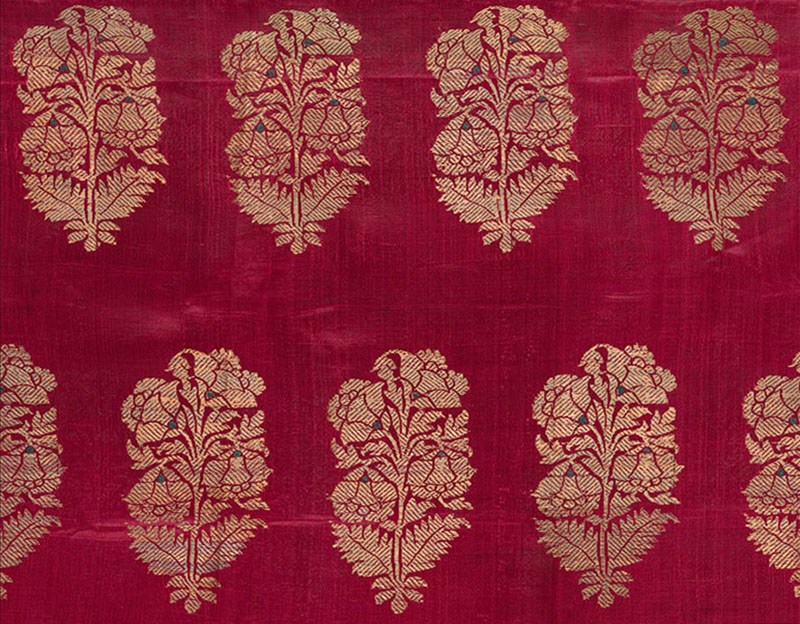
Meaning “little dream,” it is a woven brocade, characterised by a dense and rich zari work on the surface that renders the underlying silk fabric almost invisible. The complex weave was popular in the Mughal era, at which time production was centred in present-day Gujarat and the city of Benaras (Varanasi). Benaras remains an important centre of kinkhwab-weaving today.
More Definitions
Collagraph
A printmaking technique in which colour is applied to a printing surface covered with different materials and texture, then transferred…
Sapma and Thrima
Discontinuous patterning techniques in Bhutanese weaving, using supplementary weft to create single-faced motifs and patterns (invisible on the reverse of…
Selvedge
The edge of a fabric that does not require additional finishing work and prevents the textile from fraying and unravelling.…
Offset Oleography
A process of producing multicoloured prints using the offset technique. The inked image is printed on a rubber cylinder, then…
Khapa Sari
Also known as patiya sari, it is a tussar silk sari characterised by extra weft rib weaves in the pallu…
Kasavu
The gold zari used in the border of a traditional white Kerala textile, such as a sari or a mundu…
Herringbone Stitch
A needlework technique that uses stitches resembling bones extending from the spine of a herring fish. It is found in…
Counted-Thread Embroidery
A form of embroidery where the warp and weft are uniformly counted, resulting in a uniform, even pattern. It is…