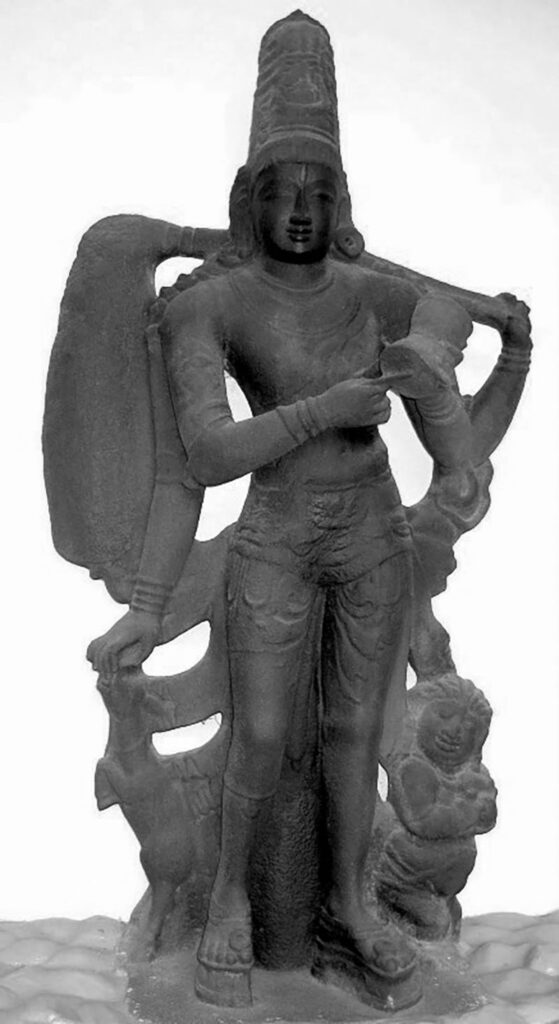
A form of the Hindu deity, Shiva, in which he is shown with a kankala-danda (a staff bearing the bones of a dead being). In iconographical representations, an ornamented Shiva is shown with his right leg bent, to suggest walking, and the kankala-danda held on his left shoulder. He is surrounded by women, bhutagana (his attendants), as well as sages, semi-divine beings and deities. This form is primarily found in southern India. A depiction of it can be found at the Gangaikondacolisvaram Temple in Tamil Nadu, India.
More Definitions
Navagraha
Meaning “nine planets” in Sanskrit, it is a grouping of astronomical bodies and their nine associated deities in Hinduism. These…
Vajrayogini
In Tantric Buddhism, she is a female form of the Buddha, which is associated with enlightenment and wisdom. Within iconographic…
Hinduism
Religious tradition originating in the Indian subcontinent, with wide internal variation and numerous sects; also known in scholarship as Brahmanism. The…
Virupaksha
A form of Shiva, he was the tutelary deity of the Vijayanagara empire (1336–1646 CE). Within Hindu mythology, he is…
Agamas
A collection of Hindu literary and scriptural texts that establishes systems of ritual and worship, among other things such as…
Devadushya
Meaning “divine cloth” in Sanskrit, it is an upper body garment. In Jainism, it is believed that the deity Indra…
Varuna
A Vedic deity associated with the moral values of rita (justice) and satya (truth), he also represents the natural elements…
Prajnaparamita
A central concept in Mahayana Buddhism that refers to the perfect way of seeing reality. It also refers to a…