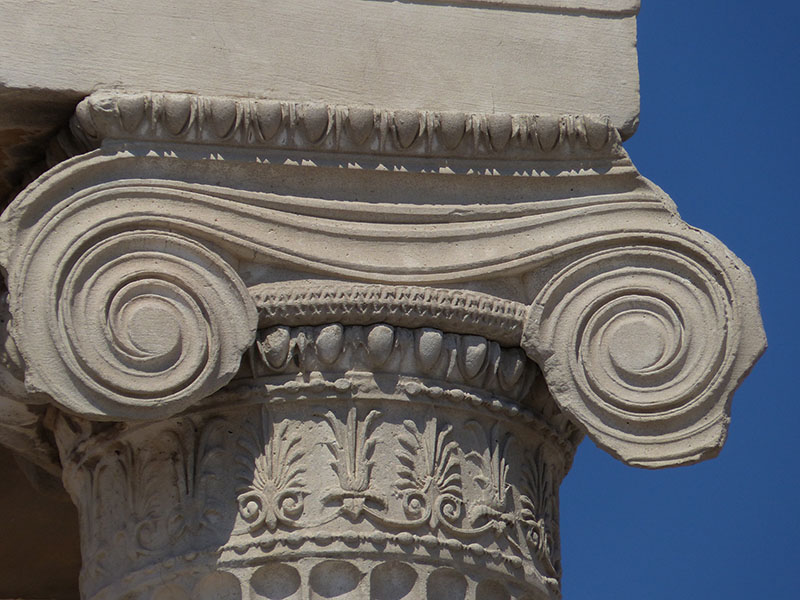
One of the three canonical orders of Western Classical architecture, it originated in the mid-sixth century in Ionia (present-day Turkey). It is characterised by the use of two symmetrical volutes on the pillar capital. Below the volutes, the column is typically designed with a wide collar or banding that separates the capital from the shaft of the pillar.
More Definitions
Futurism
An avant-garde artistic movement that emphasised speed, technology, violence and youth. It originated in Italy in the early twentieth century,…
Indian Modernist architecture
The adaptation of Western Modernist principles — functionalism, minimal ornamentation, and the use of industrial materials like reinforced concrete —…
Lyrical Abstraction
Romantic, expressive and abstract paintings made using loose and gestural brushstrokes. The style developed in France and the United States…
Action Painting
A style of abstraction where paintings are produced through vigorous and spontaneous application of paint over the canvas, in sweeping…
Cubism
A modern art movement developed in the twentieth century by artists such as Pablo Picasso and Georges Braque which rejected…
Neoclassicism
An eighteenth century cultural movement that drew inspiration from the arts and culture of classical antiquity. It embraced classical themes…
Nagara Style
A style of Hindu temple architecture commonly found in northern and central India and characterised by a curvilinear or rectilinear…
Narrative-Figurative Art
A tendency in early Modernist painting in India, marked by the presence of both narrative and figuration and deviating from…