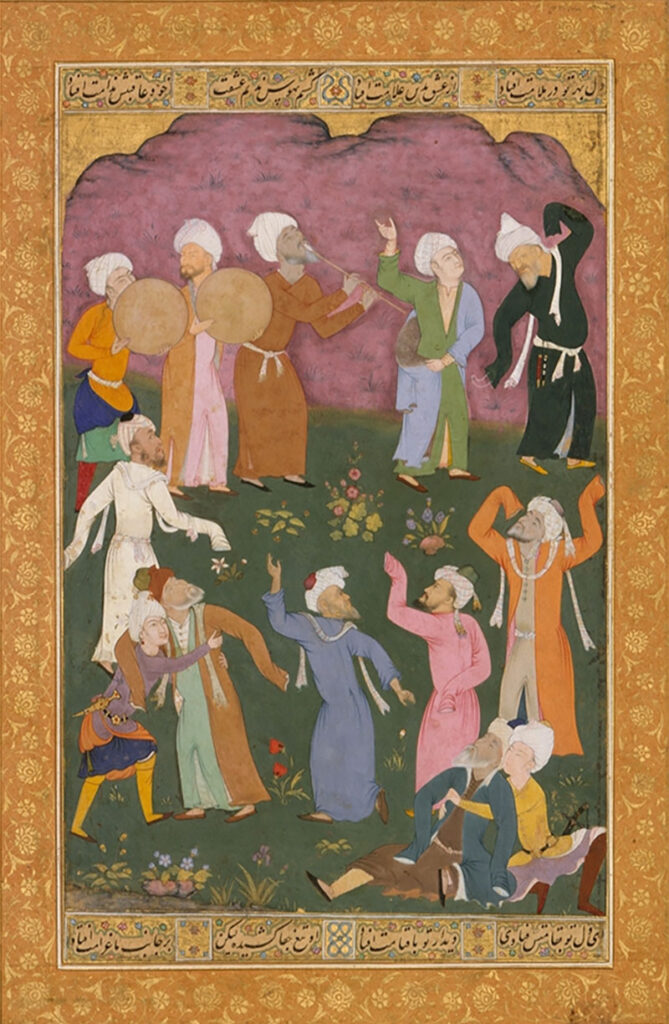
Islamic mystical tradition originating in the eighth and ninth centuries in West Asia as a fringe within orthodox Islam; known in Arabic as tassawuf (‘to dress in wool’). Since the nineteenth century, the English term ‘Sufism’ — drawing from the Arabic sufi, denoting an ascetic or renunciant — has been applied to a wide range of Islamic practices and cultural production. Sufism developed out of strains of Islamic asceticism from the time of Prophet Muhammad, which had adopted certain practices from Christian hermeticism and pre-Islamic Arab spirituality, including solitude, prayer and fasting. Partly in response to the material prosperity and perceived spiritual corruption under the Umayyad Caliphate (r. 661–750 CE) early Sufi practitioners sought to recover the simplicity and piety they believed the Prophet had practised. They diverged from other Islamic ascetics in their transgressive practices and beliefs, notably their valuation of inner knowledge (ma’rifa) over scriptural law (sha’ria), and their ecstatic communion with God through poetry and dance.
As it developed further into a coherent theology with various sects and persuasions, Sufism retained some core Islamic tenets but was distinguished by focus on the personal experience of surrender to God achieved by self-annihilation (fana), and often strenuous spiritual practice including material renunciation, meditation and repetitive prayers known as dhikr. The eighth-century saint Rabia is credited with developing the idea of selfless, unconditional love for God (ishq) that is often popularly associated with Sufism. Sufi fraternities, or tariqa, organised themselves around teachers, who were often thought to have miracle-working powers and worshipped as saints after their death. In the face of suspicion or persecution from orthodox authorities, Sufi practitioners worked to derive scriptural sanction from the Quran and the Sunna. In the tenth and eleventh centuries — amidst the wider medieval Islamic Golden Age — ‘classical’ Sufism developed, centred in Baghdad and parts of Iran and North Africa, as scholars built on various Sufi teachings and heterodox interpretations of Islamic scripture. This period saw the production of canonical Sufi philosophical texts, poetry in Arabic and Persian, and the formalisation of Sufi orders. Non-Islamic influences — including Neoplatonism, Iranian religions, and Gnosticism — were also assimilated into Sufi philosophy at this time. However, in subsequent centuries, the spread of Sufism to other regions and the success of Sufi missionaries can be attributed more to poetry than theology. As it spread to South Asia, East Asia and North Africa, it merged syncretically with local religions such as Hinduism, Taoism and Berber religions, respectively.