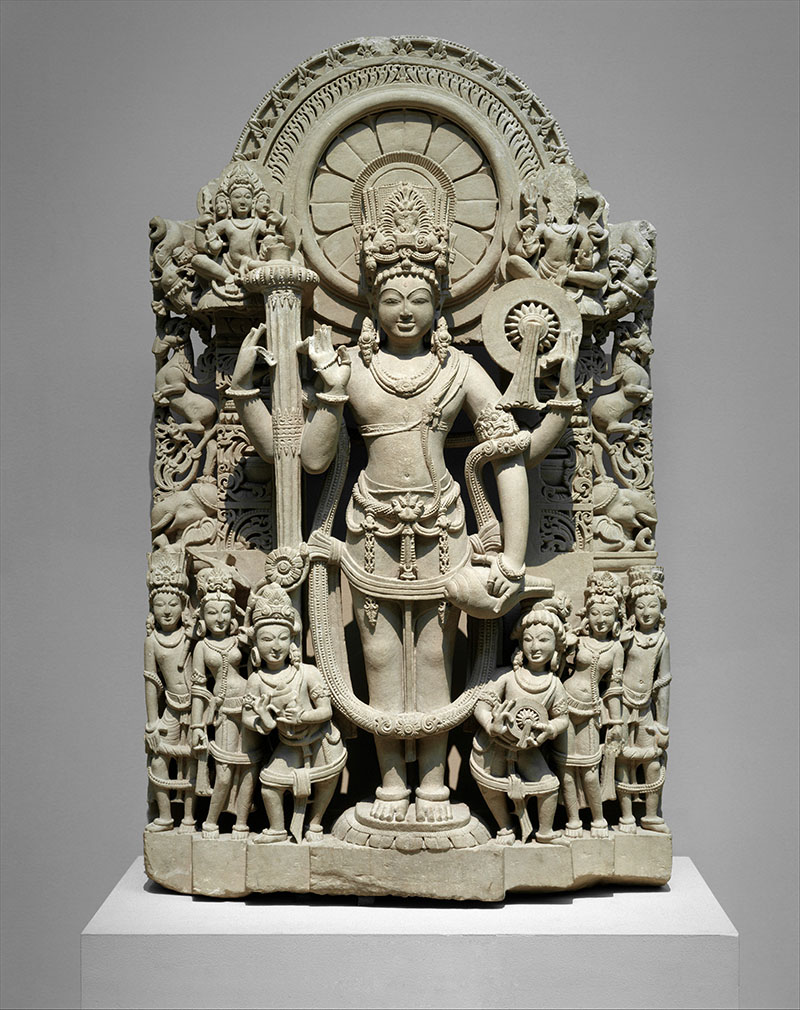
Major deity in Hinduism and principal god of its largest sect, Vaishnavism. The name derives from the Sanskrit root vish (‘to pervade’), reflecting Vishnu’s role as the all-pervasive sustainer of the cosmos. In the earliest Vedic texts, Vishnu appears as a minor solar deity. He rose to prominence in later Brahmanism through syncretisation with various non-Vedic cults of worship all centred around the region of Mathura and Delhi: primarily the cults of Vasudeva, a deified hero of the early historic Vrishni clan later synthesised as Vasudeva-Krishna; Narayana, a deity first described in the Brahmana texts as a primeval cosmic man or purusha; and the cowherd Krishna-Gopala, likely a pastoral deity of the herding Abhira people.
While its precise chronology is not known, the synthesis of Vasudeva, Narayana, and Krishna into Vishnu was well-established by the fourth to sixth centuries CE. The epic Mahabharata provides the earliest decisive references to Vishnu as a supreme being identical to Narayana and Vasudeva, and presents Krishna as one of his prominent avatars . The doctrine of avatara (‘descent-form’ or incarnation), fundamental to the syncretic cult of Vishnu, interprets him as a supreme godhead who manifests himself in times of moral darkness; these manifestations or avatars are in turn interpretations of regional, sectarian and tribal deities as aspects of Vishnu. By the eighth century CE, the Dashavatara, or ten incarnations, of Vishnu commonly listed Matsya (‘Fish’), Kurma (‘Tortoise’), Varaha (‘Boar’), Narasimha (‘Man-Lion’), Vamana (‘Dwarf’), Parashurama (‘Rama with the Axe’), Rama, Krishna, Buddha and Kalki (the avatar that is still to come), with significant variation across texts.
In later Puranic texts, Vishnu appears in the Trimurti — the triad of three major Brahmanical gods — in which he is attributed with preservative power alongside Brahma (creation) and Shiva (destruction). He is typically depicted as dark-complexioned, with four arms holding the shankha (conch), chakra (discus), gada (club), and padma (lotus), often reclining on the serpent Ananta or standing alongside his consort Lakshmi. His mount (vahana) is Garuda, an eagle-like mythological figure considered the king of birds.