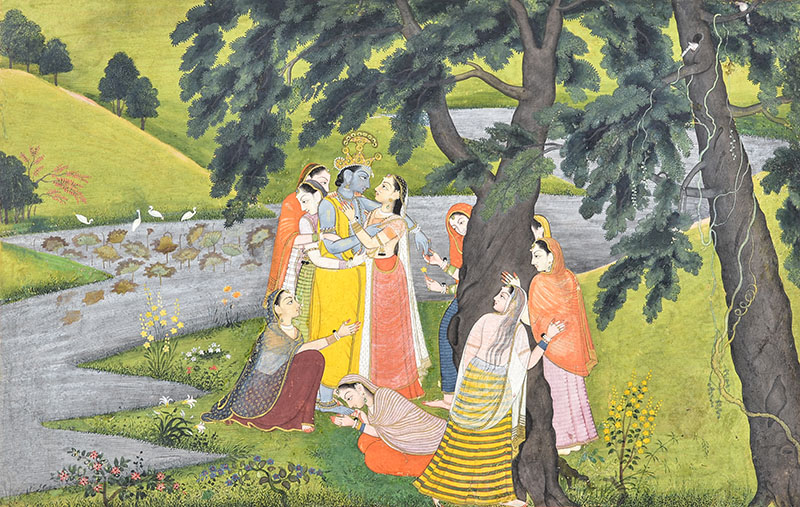
Major Vaishnava deity, whose cult developed with the Brahmanical assimilation of non-Vedic cults of and around Mathura in northern India by the third century CE, primarily those of the warrior deity Krishna (‘dark’ or ‘black’) of the Yadava clan, and the cowherd Krishna-Gopala (‘Krishna protector of cows’), likely a deity of the pastoral Abhira people. The latter tradition is the source of the widely depicted stories about Krishna as a child raised by the cowherds of Gokula, who engages in playful flirtations with the gopis (female cowherds) of the Vrindavana forest. Some scholars see the Krishna-Gopala cult as having originated independently and merged later into Vaishnavism through the early historic Vrishni cult of Vasudeva; others see it as an early extension of the same complex, known as the Bhagavata tradition. In texts such as the Harivamsha and the Vishnu Purana, the cowherd Krishna is firmly identified with Vasudeva-Krishna and absorbed into the Brahmanical figure of Vishnu. As an avatar of Vishnu — typically the eighth among ten Dashavatara — Krishna is given special importance in the Mahabharata, notably in the Bhagavad Gita.
In iconography, Krishna appears in several forms, including Bala Krishna (the divine child) and Gopala (the flute-playing cowherd), often accompanied by his consort Radha; he is known by various regional names, including Govinda, Jagannatha and Vithoba. From roughly the tenth century CE onwards, Krishna became a popular figure in Bhakti devotionalism, which emphasised a personal relationship between devotee and deity; Krishna-bhakti (‘devotion to Krishna’) has become widespread in many parts of South Asia, and has been a popular subject in visual and performing arts.