-
ChicagoMayavat, Dhara. "The Sacred Blues of the Indigo Temple." Impart Perspectives, June 26, 2026. https://imp-art.org/perspectives/dispatches/the-sacred-blues-of-the-indigo-temple/
-
MLAMayavat, Dhara. "The Sacred Blues of the Indigo Temple." Impart Perspectives, Jun. 26, 2026, https://imp-art.org/perspectives/dispatches/the-sacred-blues-of-the-indigo-temple/. Accessed 15 Oct 2026.
-
HarvardMayavat, D. (2026) The Sacred Blues of the Indigo Temple, Impart Perspectives. Available at: https://imp-art.org/perspectives/dispatches/the-sacred-blues-of-the-indigo-temple/ (Accessed: 15 October 2026).
The Sacred Blues of the Indigo Temple
Indigo dye practitioner Ashok Siju's studio is both a site of cultural production and transmission, where indigo expresses the living craft traditions of Kutch.
By Dhara Mayavat
Link copied!

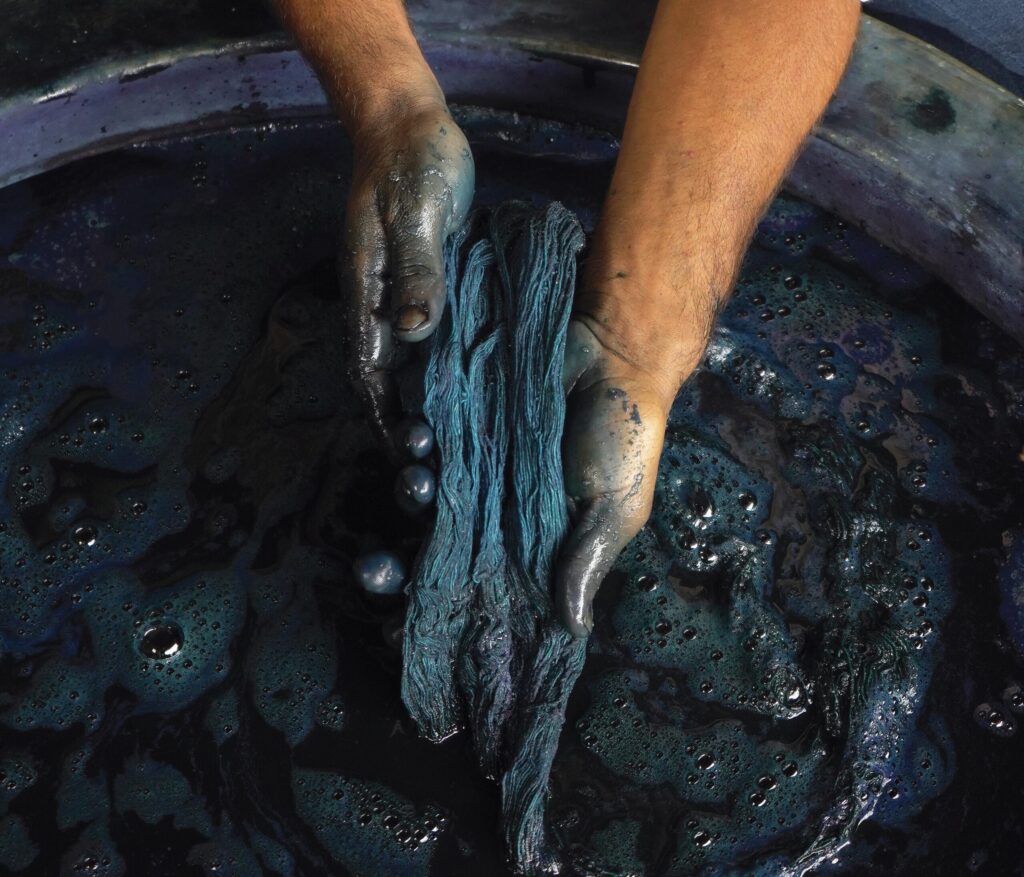
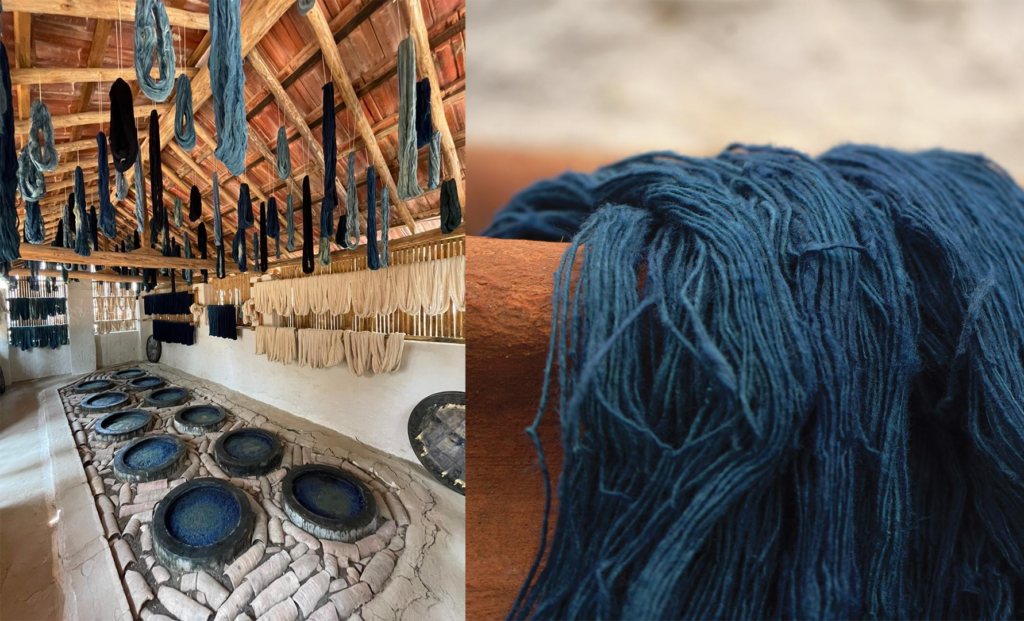
Kala cotton yarn being dyed at the Indigo Temple. Courtesy Ashok Siju
In the scorching heat of May, as cracks deepen across the white desert of Kutch, it is dyeing season at the Indigo Temple in Bhujodi village. The arid heat of the Rann, suited to natural microbial fermentation, activates its indigo vats. The process feels like mystical alchemy — the slow emergence of blue from green. Significantly, the name ‘Indigo Temple’ also emerged organically; visitors began calling it so, responding to the rare atmosphere of purity and meditative stillness of the studio space created by indigo dyeing practitioner Ashok Siju.
He and other dye practitioners from his family tend to each of the 12 dye vats in the space as living habitats; to be fed, rested, and carefully attended to. The process requires patience, attentiveness, and an acceptance of time as an active element in dye creation. In the summer months, when temperatures hover between 35-40°C, the teeming microbial life in the vats “breathes” the dye into existence. During the monsoon and winter months, the vats are allowed to rest, honouring seasonal rhythms. Deeply rooted in the region’s textile crafts, the studio is housed within a nearly two-hundred-year-old ancestral home.
Ashok calls his vats “mysterious and complex,” saying that the dyeing process is so much more than just using math or scientific knowledge to create the right conditions. To him, indigo dyeing is more of an art form, where there is no right or wrong. “The more you work with indigo, the more you learn how to work with it. You have to learn every single thing about it,” he explains.
Bhujodi village, where Ashok’s studio is located and where several artisan families reside, is one of the major textile and craft hubs of the region. Over the years, the studio has become a space of learning and exchange. Students, designers, and artists visit to observe and participate, often through workshops led by Ashok. The knowledge of dyeing that is shared is rooted in traditional techniques. In this sense, the Indigo Temple is both a site of cultural production and transmission, where indigo gains visibility, not as a commodity, but as an expression of the living craft traditions of Kutch.
The Barter Economy Legacy
Before “indigo” became the dominant term, majorly through colonial and trade vocabularies, it was most commonly referred to as “neel” (blue), a word used with variations across India. In the Kutchi language, it is also referred to as neelam (blue saphire), denoting its worth among Kutch artisans.
In the past, weaving and indigo dyeing were done by distinct communities of the Kutch region. Ashok belongs to the Vankar (weaver) community of Bhujodi village. The community traditionally procured hand-spun Kala cotton yarn from farming communities, such as the Ahir, and wool from the nomadic Rabari community of sheep and goat herders. They would barter woven cloth in exchange for the raw material for their looms, and other essentials, such as milk and grains. Women from the Rabari, Ahir, and Vankar communities also added value to woven textiles with their embroidery work.
In addition to community-specific embroidery to decorate plain textiles, locals also tapped the expertise of Khatri dyers associated with printing crafts, such as tie-and-dye practices of bandhani and resist-dyeing practices of ajrakh. They used natural dyes using organic ingredients, such as madder root and pomegranate, and of course neel from the wild indigo plant that grew in Kutch during the rainy season.
The barter system guaranteed that materials, skills, and livelihoods were collectively sustained. Within this structure, knowledge remained specialised and community-bound, with dyeing, weaving, embroidery, and pastoral labour practiced as distinct yet interlinked roles shaped by inherited legacies, orally passed through generations.
Since textile crafts in Kutch were part of a socio-economic web that sustained interdependent livelihoods, neel was not just a word but a lived experience. Cloths dyed blue protected shepherds and farmers in soaring temperatures. It was associated with the cool depths of fleeting rivers where newly-dyed textiles were rinsed. It evoked the quiet vastness of the inky blue sky of the desert after dusk, when sun-dried fabrics with hardened mud-paste patterns were collected.
Crafting a Future
With the rise of monetisation and market-driven production under colonial rule, these interdependencies between communities began to fray. The Partition event dealt the next blow. The heterogeneous Khatri community, with both Muslims and Hindus, saw many families migrate to Pakistan. The shared craft ecosystem, which had survived for so long, was gradually reorganised to allow for more individualised, market-driven practices. Ashok’s own grandfather, for instance, was keen to incorporate natural dyeing techniques into the weaving process. He set up the first indigo vats for the family business in 1990.
It is within such local experiments to streamline weaving and dyeing processes that indigo, once embedded within the barter economy of the Kutch region, began its movement beyond it. From the late 20th century onward, and especially after the 2001 Bhuj earthquake, craft-based organisations and NGOs also began to play an active role in reshaping indigo dyeing practices. They worked to connect artisans to new markets, encouraged experimentation, reintroduced natural materials and processes, and discouraged the use of synthetic dyes.
In doing so, they also enabled the movement of knowledge across previously distinct practices, often bringing dyeing directly into weaving contexts. Weavers, who had once been entirely reliant on Khatri dyers for coloured yarns and dyed fabrics, began to internalise processes that allowed for greater autonomy over their practice. This was not only an economic shift, but a change in how knowledge, labour, and authorship were organised. Therefore, the intervention of craft NGOs cannot be regarded as simply a ‘revival’ of indigo textiles in Kutch, but a reworking of practices in response to changing conditions of the craft.
A ‘Sacred’ Practice
Ashok’s practice is also about incorporating the region’s indigo dyeing traditions into his work. ‘Finished’ products are made entirely in-house, from dyeing the yarn with indigo, which is now sourced from southern India, to weaving on handlooms and pit looms, and finishing through hand stitching. The Indigo Temple brings multiple stages of dyed textile production under one roof, integrating them into a single, continuous process.
He often conducts unconventional experiments — for instance, playing music around the vats. “Vats become so still and calm when you play sad music… but it still gives these beautiful shades. Indigo vats change with music… your behaviour can change them. Vats feel the energy around them,” he says, admitting that even he was surprised with the results of his musical interventions in the dyeing process. Ashok also recommends cultivating a sensory relationship with the process of dye creation — by tasting or smelling the fermented liquid in vats. According to him, this is the best way to check the bacterial health and pH levels. Observing the colour and appearance of the “indigo flower”— a cluster of dark-blue, foamy bubbles that forms on top when the liquid is stirred — is another way to instantly gauge if a vat is ‘alive’ or ‘dead’. He believes that “true” practitioners stay open to the paths indigo opens up. “You don’t understand that thing [indigo] but that thing is trying to understand you through your way of seeing and working with it,” he says.
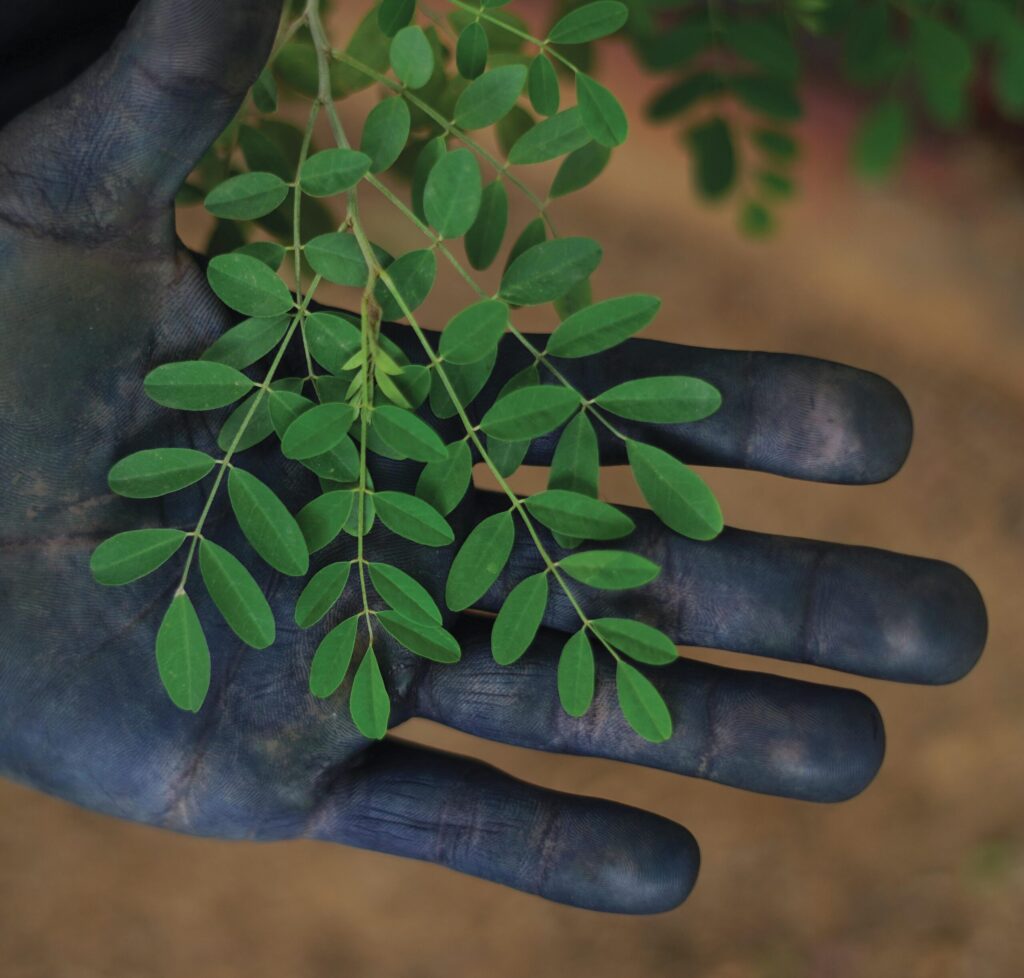
Indigo, across the subcontinent, has moved through many lives — plant, pigment, commodity, and symbol. Its meanings have been shaped as much by ecology as by systems of trade and power. Since the British Raj, indigo has been vulnerable to systems of extraction and valuation beyond the control of the communities that produce it. While this history remains critical, it also tethers indigo to a singular narrative of oppression and exploitation. This is where Ashok’s Indigo Temple makes a difference. It reframes indigo through material processes that are shaped by care, ecology, and ‘slow’ craft practices. It speaks to the value created outside commodity value chains of global trade while existing within modern design, craft, and tourist networks. Today, as conversations around sustainability and ‘conscious living’ gain urgency, spaces such as Indigo Temple invite a renewed attention to process, material, and time.
By integrating interdependent craft processes into a self-contained, contemporary artistic practice, the Indigo Temple seeks to resolve the tension between the market, which consistently devalues traditional crafts, and the centuries-old, community-based knowledge preserved by Kutch artisans. It seeks to show that the indigo dyeing and weaving practices of the region are not fixed traditions but dynamic ones that continue to evolve.
First published: June 26, 2026