-
ChicagoImpart Encyclopedia of Art. "Tarkashi." June 19, 2026. https://imp-art.org/articles/tarkashi/.
-
MLA"Tarkashi." Impart Encyclopedia of Art, Jun. 19, 2026, https://imp-art.org/articles/tarkashi/.
-
HarvardImpart Encyclopedia of Art (2026) Tarkashi. Available at: https://imp-art.org/articles/tarkashi/ (Accessed: 16 October 2026).
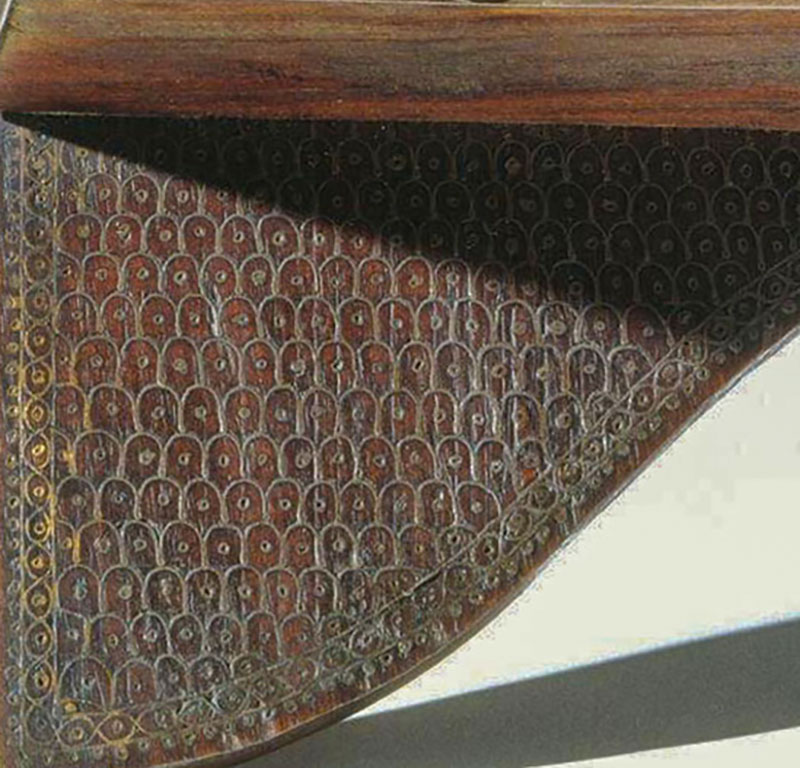
A decorative craft in which thin metal wire is inlaid on shisham and other hardwood, tarkashi (Urdu and Persian: taar, ‘wire’; kashi, ‘drawing’) is practised primarily in Uttar Pradesh, and more recently Rajasthan, in northern India.
Historical development
The term ‘tarkashi’ — also used for a type of needlework done in Pakistan and northwestern India — may broadly describe a range of wire inlay techniques on metal used in the Indian subcontinent since at least the seventeenth century, such as koftgari or others used in the production of Bidriware. However, the specific craft of inlaying metal wire on hardwood is said to have originated in Mainpuri, Uttar Pradesh, where it likely benefited from elite patronage in the late medieval and colonial periods.
Documentation predating the nineteenth century is scarce, and the exact origins of the craft are unclear, though comparable metal inlay crafts such as koftgari are likely of Persianate origin. FS Growse, a colonial administrator stationed in Mainpuri in the 1860s, records an oral narrative in which a thirteenth-century chieftain from Rajputana (present-day Rajasthan) is said to have migrated to present-day Uttar Pradesh, bringing with him a group of decorative artisans — likely wood and metalworkers — of the Ojha caste. A conflict between the chief and the artisans led to their expulsion from royal office, following which they settled near Mainpuri, where they remain today. A group of them is also reported to have subsequently returned to Rajasthan and settled in Jaipur, establishing it as a production centre of tarkashi products.
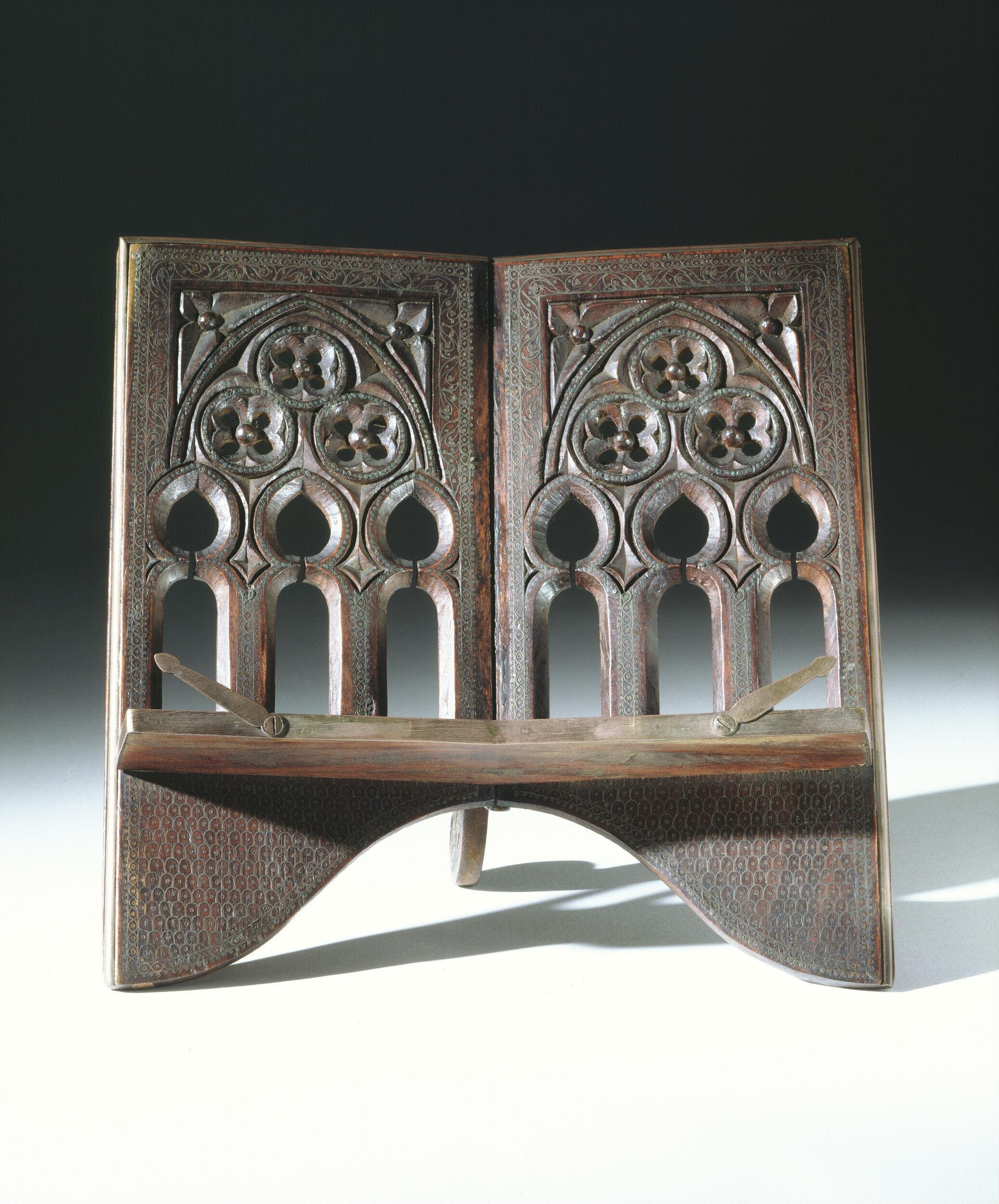
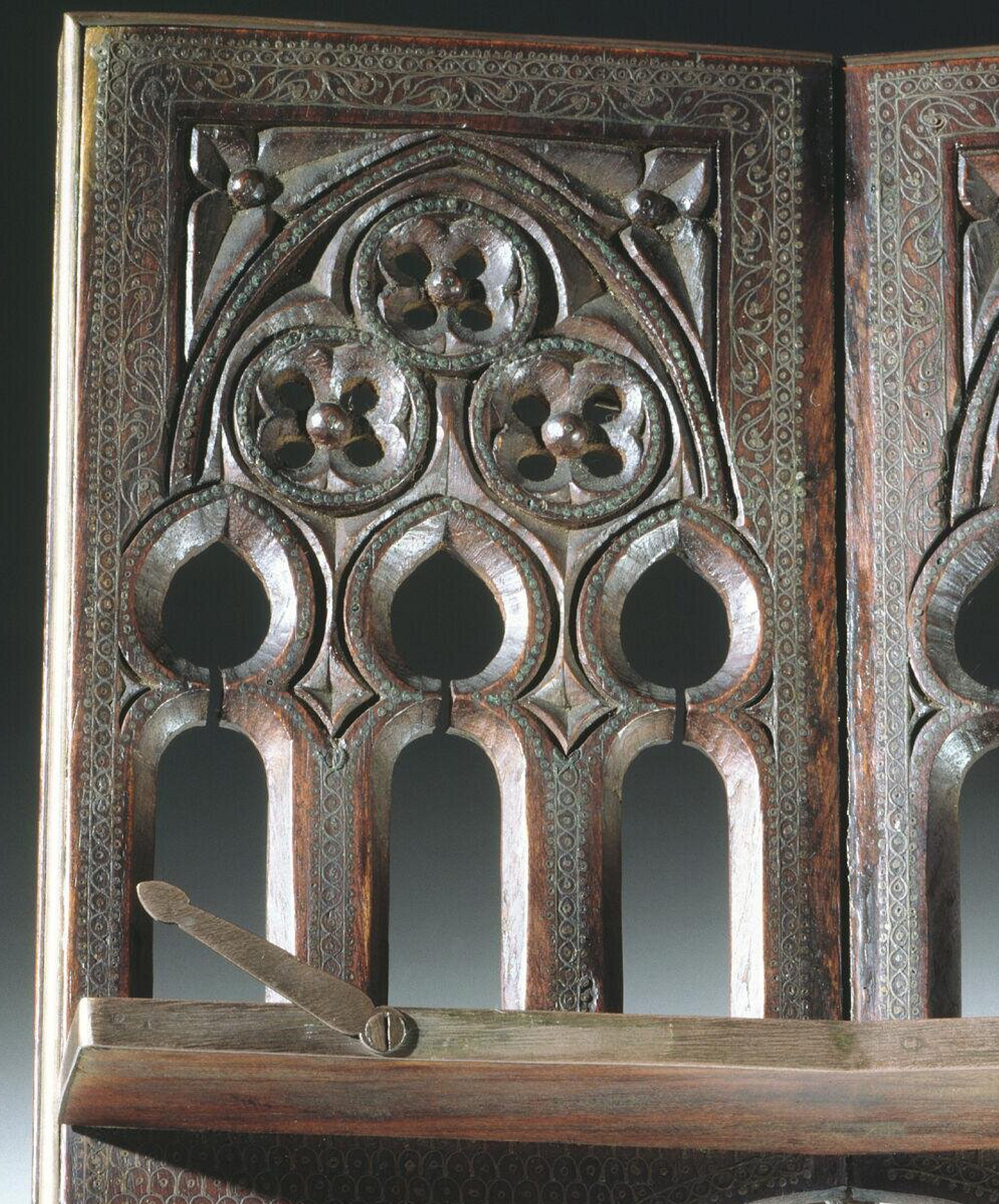
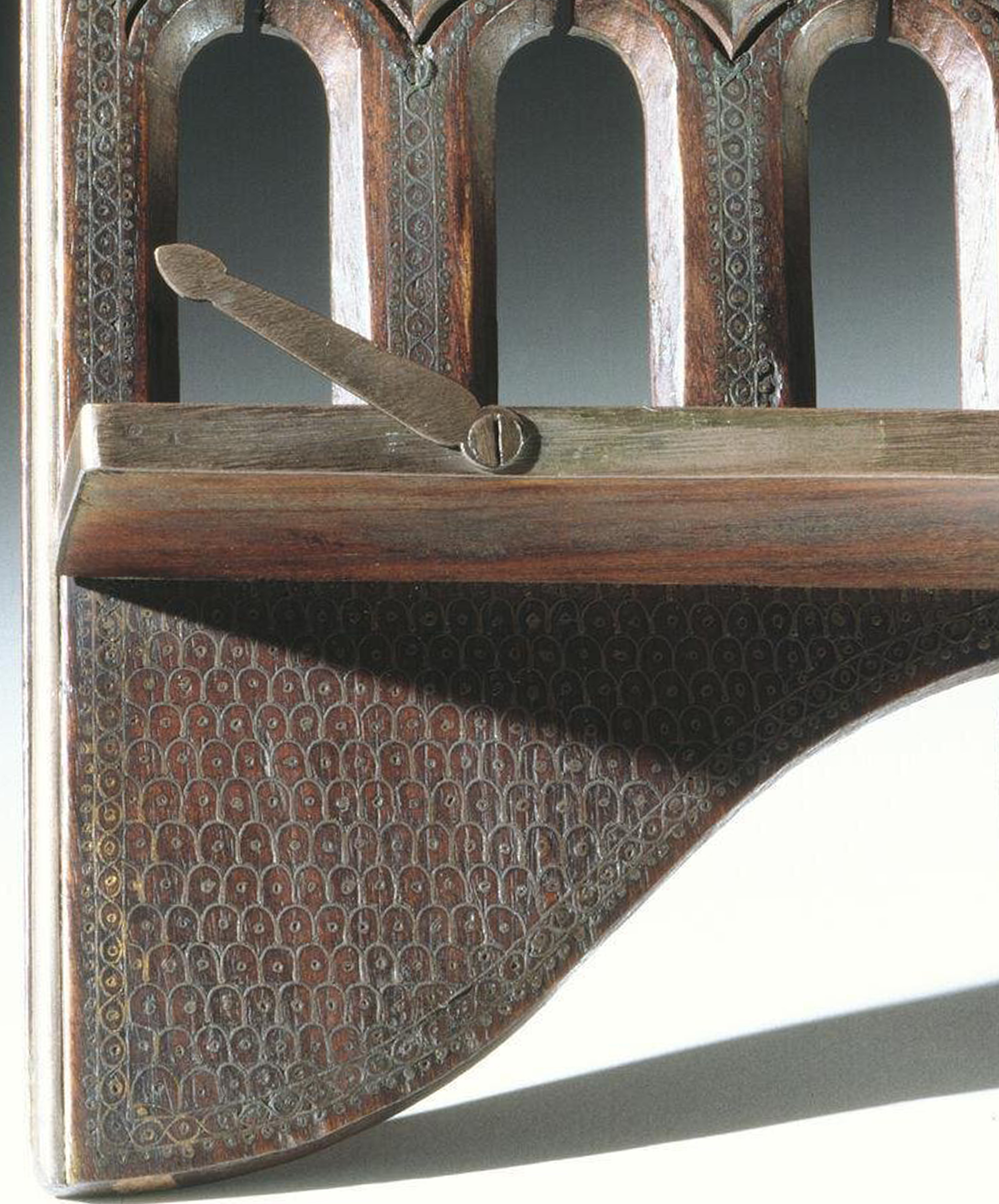
The craft of tarkashi in Mainpuri received significant impetus in the nineteenth century. Growse’s documentation notes that the work was traditionally applied to paduka (wooden footwear typically used by Hindus, also known in Hindi as khadaun), book holders, and jaali screens. Taking inspiration from other colonial efforts to monetise and develop indigenous crafts, contemporaneous with the British Arts and Crafts Movement, Growse employed a few tarkashi artisans and attempted some experiments including applying the technique to doors, Christian altars and other objects, and incorporating European Gothic patterns in the inlay. One book rest commissioned by Growse, carved and inlaid in the Gothic style, is now housed in the Victoria and Albert collection in London. His experiments generally contributed little to the future development of the form, but a pair of inlaid wooden doors he commissioned were used in the Bulandshahr Town Hall, built under his supervision and still extant today. Charles Horne, the judge of Mainpuri at the time, also developed some patterns for tarkashi artisans that were more successful; according to Growse, one geometric pattern developed from the carvings at Sanchi continued to be replicated. In general, this period saw the application of tarkashi to an expanded range of products, largely domestic items suited for European use and taste, some of which were displayed at the Delhi Durbar in 1903 and other colonial exhibitions — especially popular were display plaques. Colonial documentation notes that tarkashi products were also widely available at village fairs and markets.
Artisans and production centres
Colonial documents record the artisan community as Barhai (woodworker) or Lohar (metalsmith), noting that the two terms are used interchangeably in the Mainpuri district. More recent anthropological surveys mention Ojha and Jangid Brahman among a host of caste names that can refer to the Barhai in Uttar Pradesh. The Barhai are one among a multitude of artisan castes that belong to the Vishwakarma community, a fluid designation that encompasses castes of widely varying status and political power.
Mainpuri remains a major production centre and the work produced there is considered the finest; others in the state include Nagina in Bijnor district, Pilakhuwa in Ghaziabad district, and Saharanpur district, which is known for its woodwork. Jaipur in Rajasthan is also a major centre of production. Colonial sources also mention tarkashi specimens from Multan in Punjab, Pakistan, different in style from those produced in Uttar Pradesh.
Design and materials
Tarkashi is done preferably on locally sourced shisham (North Indian rosewood, Dalbergia sissoo), whose dense grain and coarseness help hold the inlay in place; its dark colour, due to its high oil content, also brings out the metal inlay by contrast. However, mango, teak and walnut wood are also used. The inlay is generally done in brass, though copper or silver may be used instead. Typical tarkashi designs feature geometric or floral patterns, usually with an emphasis on flowing, curved lines. A distinguishing characteristic of the craft is the profusion of small dots (bhiriyan) that fill the empty spaces; there can be as many as several hundred such dots in a few square centimetres of intricate tarkashi work.
Process
The considerable durability of the inlay in a well-made tarkashi product has been noted. The wood is first seasoned — the planks are stacked and exposed to air, protected from sunlight and rain, for six to seven months. It is then cut and shaped as per the design requirements. In some cases the inlay is done on parts that are later assembled by carpenters (tarkhan); in others, the product is built first and then inlaid. The wire is made by cutting thin metal sheets into strips roughly 2.5 centimetres wide, which are then hammered down to 2 millimetres with a sharp edge. These lengths are then marked, cut out and further straightened with forceps (chimti) for use.
The pattern is pencilled onto the wood with the help of a stencil and grid, and sometimes a compass (prakaar). It is then engraved using a chisel and hammer typically to a depth of 1 millimetre. The artisan then lays the wire down on its sharp edge over the groove with one hand, and taps it into place with a hammer held in the other. For the decorative dots, thin wire is coiled around the tip of a needle and often beaten directly into the surface. An intricate design often takes several days if not weeks. The engraving, inlaying and final assembly of parts may have once been done by one artisan, but today these have become specialised skills.
To finish the product, the wood is rubbed with a sanding stone (silli) and any cracks or grooves filled in with a mixture of shisham sawdust, glue and water (burada). After drying, the excess mixture is scraped off and the surface is polished again using sandpaper. More recently, artisans have begun incorporating bone powder, camel bone, marble dust and silver in the inlay work.
Contemporary status
In addition to its traditional applications, tarkashi is used on various domestic objects such as doorframes, cabinets and chests, mirror-frames, plates, and religious plaques and icons. The technique is listed in the Uttar Pradesh state government’s One District One Product scheme, which seeks to promote the state’s handicrafts and provide loans to artisans.
First published: 19 June 2026
Image Gallery
Bibliography
ANI. “Mainpuri’s Tarkashi Art Empowering Women by Providing Employment, Artists Seek Govt Support in Boosting Sales.” The Print, February 16, 2022. Accessed December 26, 2022. https://theprint.in/india/mainpuris-tarkashi-art-empowering-women-by-providing-employment-artists-seek-govt-support-in-boosting-sales/834353/.
“Application Details (Mainpuri Tarkashi).” Geographical Indications. October 24, 2019. Accessed December 26, 2022. https://search.ipindia.gov.in/GIRPublicSearch/Application/Details/673.
Chattopadhyay, Kamaladevi. India’s Craft Tradition. New Delhi: Ministry of Information and Broadcasting, Government of India, 1980.
Crooke, William. The Tribes And Castes Of the North-Western Provinces And Oudh, vol. 1. Calcutta: Government Press, 1896. Accessed June 10, 2026. https://archive.org/details/dli.pahar.1415/page/192/mode/2up?q=artisan.
Growse, F. S. “The Art of Tar-Kashi or Wire Inlay.” The Journal of Indian Art and Industries 2, nos. 17–24 (October 1888). London: W. Griggs.
https://archive.org/details/sim_journal-of-indian-art-and-industries_1888-10_2_17-24/page/n193/mode/2up?q=growse.
Neave, E. R., ed. Mainpur: A Gazetteer. District Gazetteers of the United Provinces of Agra and Oudh 10 (1910). Allahabad: Government Press. https://archive.org/details/in.ernet.dli.2015.48097/page/n3/mode/1up?q=tarkashi.
Ranjan, Aditi, and M. P. Ranjan. Handmade in India: Crafts of India. New Delhi: Mapin Publishing, 2007.
Singh, K. S., ed. People of India: Uttar Pradesh, vol. 42. New Delhi: Anthropological Survey of India and Manohar Publishers, 2005.
Victoria and Albert Museum. “Book Rest.” V&A Collections. Accessed June 10, 2026. https://collections.vam.ac.uk/item/O76397/book-rest-unknown/.
Watt, George. Indian Art at Delhi 1903: Being the Official Catalogue of the Delhi Exhibition, 1902–1903. Calcutta: Superintendent of Government Printing in India, 1903. https://archive.org/details/in.ernet.dli.2015.510219/page/n253/mode/2up?q=tarkashi.
Feedback