-
ChicagoImpart Encyclopedia of Art. "Sharada Peeth." June 8, 2026. https://imp-art.org/articles/sharada-peeth/.
-
MLA"Sharada Peeth." Impart Encyclopedia of Art, Jun. 8, 2026, https://imp-art.org/articles/sharada-peeth/.
-
HarvardImpart Encyclopedia of Art (2026) Sharada Peeth. Available at: https://imp-art.org/articles/sharada-peeth/ (Accessed: 16 October 2026).
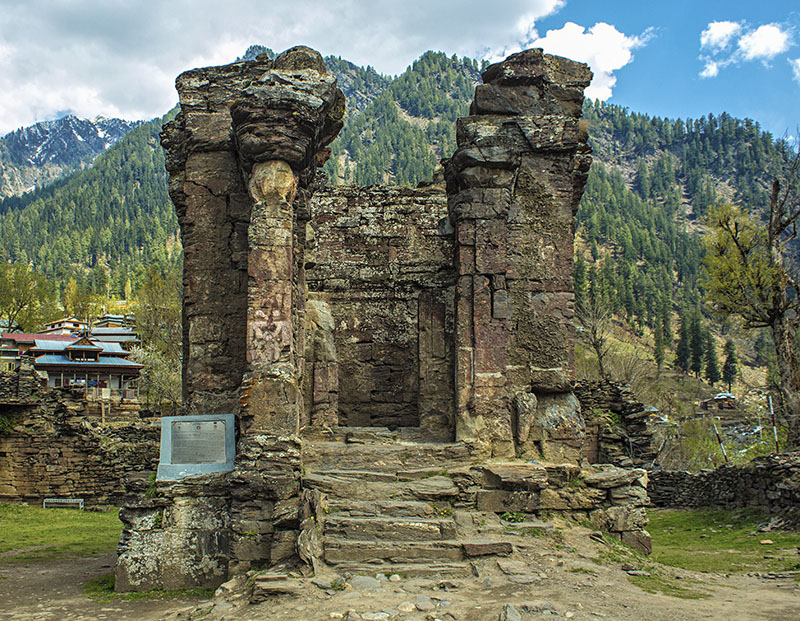
A ruined stone temple in the Neelum Valley of Azad Kashmir, Pakistan, dating perhaps between the eighth and eleventh centuries CE, Sharada Peeth (from pitha, Sanskrit, ‘seat’) is dedicated to the Hindu goddess Sharada, a form of Saraswati. Associated with the Shakta tradition and long regarded as one of the Shakti Pithas, the site has been a prominent place of worship and pilgrimage, particularly for Kashmiri Pandits, a Brahmin community of the Kashmir region.
Historical background
The Neelum Valley formed part of the wider historical Kashmir polity and, from the early medieval period onward, came under the rule of successive dynasties, including the Karkota (seventh–ninth centuries), Utpala (ninth–tenth centuries) and Lohara (eleventh–fourteenth centuries). In the fourteenth century the region passed into the control of the Shah Mir dynasty, and was subsequently incorporated into the Mughal empire. The exact construction and consecration dates of Sharada Peeth remain unknown, in the absence of any surviving inscriptions associated with the temple. The structure has been tentatively dated to between the eighth and eleventh centuries on the basis of architectural comparisons with other early medieval temples in Kashmir. Some scholars have suggested that the temple may have been commissioned by Karkota monarch Lalitaditya Muktapida (r. 724–760 CE) who is also credited with the construction of the stylistically comparable, though larger, Martand Sun Temple near Anantnag in Kashmir, India.
Textual references
The name ‘Sharada Peeth’ for the temple is relatively modern, and historical sources refer to it simply as Sharada. The fourteenth-century Madhaviya Shankaravijaya — the oldest and best-known hagiography of the eighth century philosopher Shankara — describes Sharada as Sarvagya-pitha (‘seat of omniscience’); it is where Shankara is believed to have embraced Shaktism and achieved enlightenment. According to later tradition, he opened the temple’s southern entrance as part of a test set by the goddess Sharada, who then closed it behind him as he ascended to heaven. Early documentation of the site comes from references to the Neelum Valley in the Sanskrit Nilamata Purana, generally dated to between the sixth and eighth centuries. The text combines mythological and folkloric material about the sacred geography, rituals and social traditions of the Kashmir region, and describes the Neelum Valley as the site where the goddess Sati’s right hand is believed to have fallen after Vishnu divided her body into fifty-one parts. The temple at the site is accordingly considered one of the Shakti Pithas — sacred sites where each of these parts are said to have fallen.
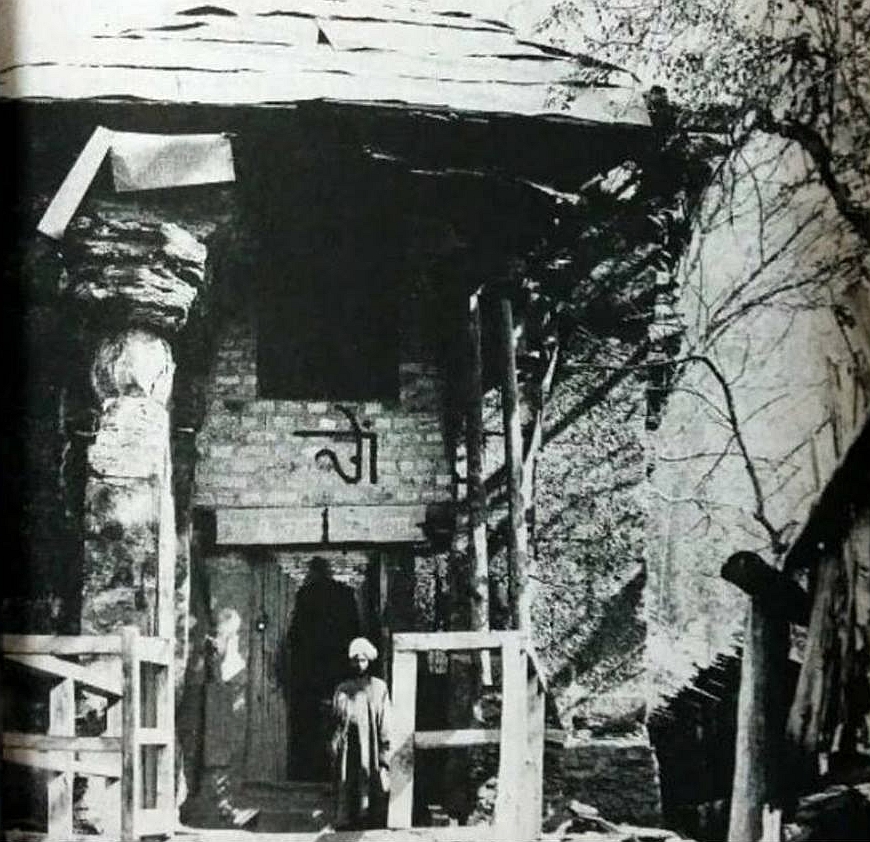
The earliest definitive reference to the temple itself is in Al-Biruni’s eleventh-century Kitab al-Hind, in which it is said to contain a wooden idol and be much revered and visited by pilgrims. The temple is mentioned again, though only in passing, in the twelfth-century Sanskrit historical chronicle Rajatarangini by the Kashmiri historian Kalhana. The Kashmiri poet Jonaraja’s 1422 addendum to Kalhana’s text — the Dvitiya-Rajatariningi — also refers to it, recounting a story in which a ruler of the Kashmir Sultanate sleeps on the floor of the temple and meets the goddess Sharada in a dream. The religious significance of the site and its continued use are further confirmed by a brief account in the late-sixteenth-century Ain-i-Akbari by the Mughal court historian Abul Fazl, who describes Sharada as a riverside temple dedicated to the goddess Durga, and relates a story that the temple vibrates or shakes on the eighth day of every lunar fortnight, producing a remarkable visual effect.
Design and construction
Sharada Peeth belongs to the tradition of Kashmiri stone temple architecture, a regional style characterised by a square central sanctuary set within a walled quadrangle; recessed niches composed of trefoil arches within high-pitched pediments; fluted pillars with capitals in a loosely Doric style, and a pyramidal superstructure (shikhara). The closest surviving comparable structures are the Martand Sun Temple and the Kashmiri-style stone temples of the Salt Range in Punjab, Pakistan.
The temple courtyard is laid out on a raised platform aligned east to west, built to level the uneven terrain. It is accessed from the western side via a long staircase and a gateway of the characteristic Kashmiri double-porch type with trefoil arches; of the supporting columns only those on the northern side survive. The rectangular courtyard is bounded by thick stone walls around 3 metres high; the northern perimeter wall, the most intact, extends some 43 metres in length. The inner face of each wall features a deep niche in the standard trefoil-pediment style. The niche in the northern wall, directly facing the sanctuary, is reported by one historical source to have once housed two small lingams; a similar small niche is situated in the eastern wall. The southern wall has largely been lost to erosion from the adjacent Neelum River.
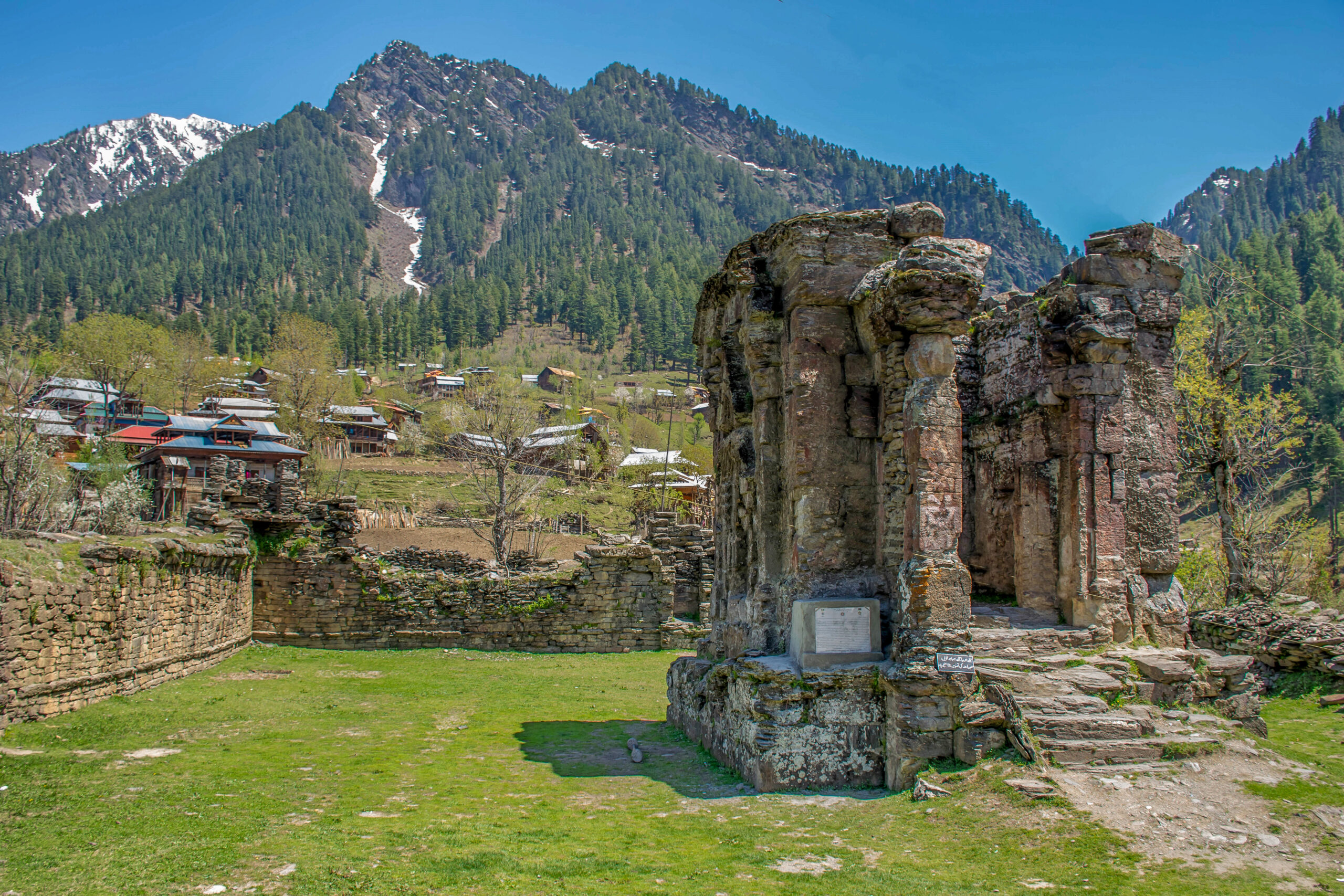
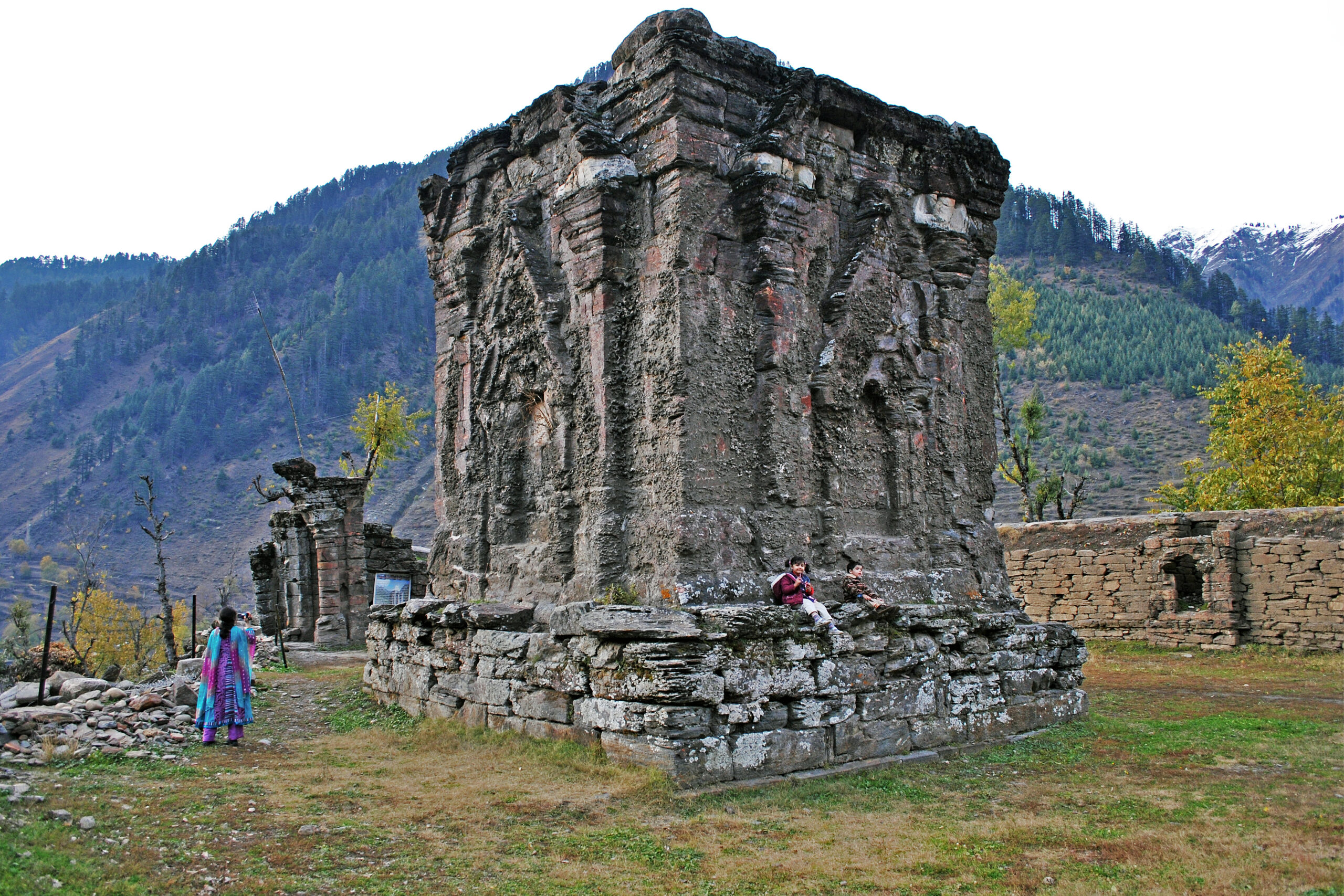
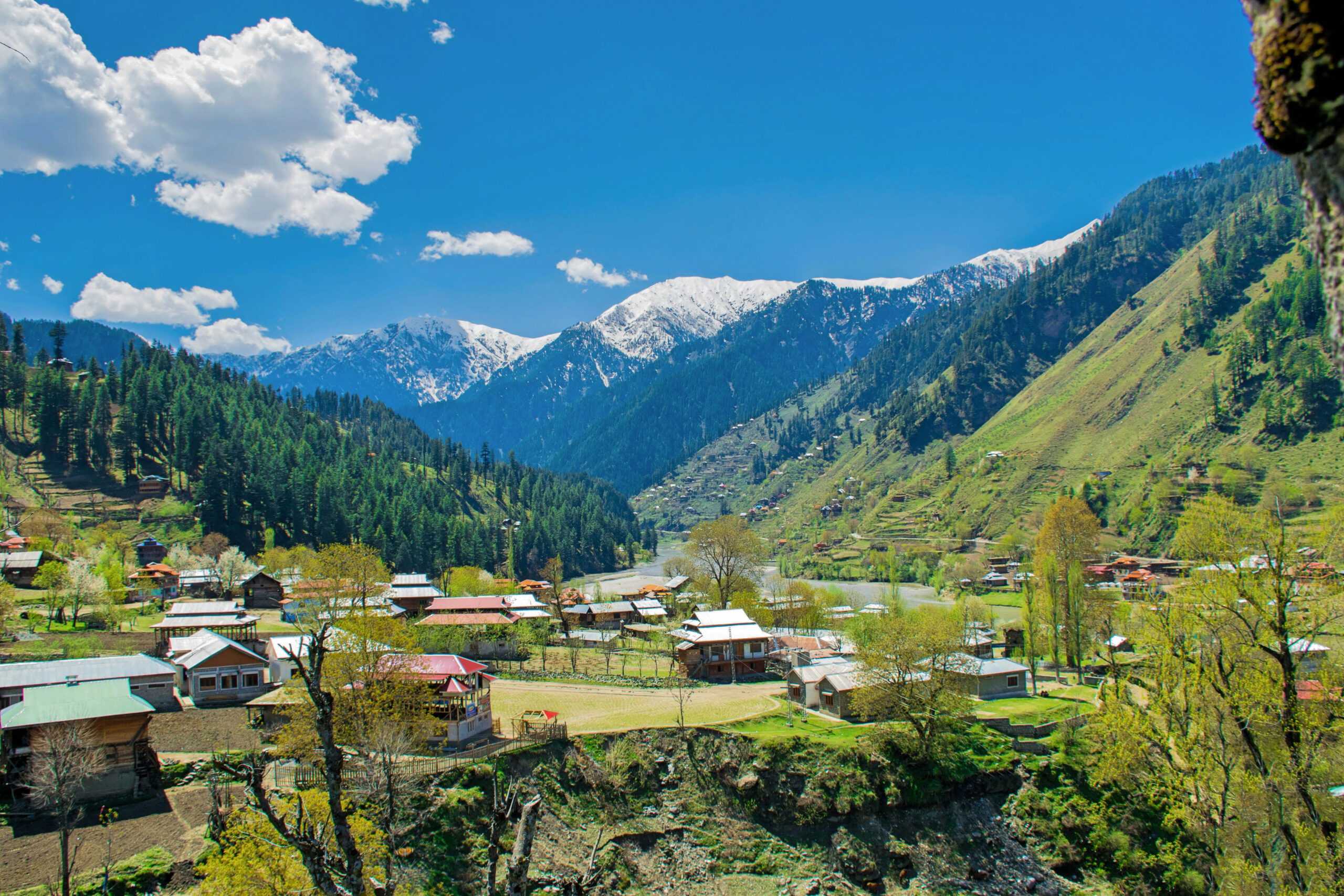
The structure housing the cella — the main chamber or sanctum where the deity would have been housed — stands at the centre of the quadrangle, raised on a square plinth around 1.5 metres high. It comprises three thick walls of locally quarried red sandstone and rubble rising to a height of around 6 metres, and forming a square some 3.8 metres on each side. It is entered from the west through an open portico once supported by two stone pillars. The three exterior faces bear reliefs of the characteristic Kashmiri scheme of blind trefoil arches with smaller trefoil-headed niches set beneath each arch under double pediments. Traces of stucco in sheltered recesses suggest that the chamber was originally finished in lime plaster. The interior is plain; its only conspicuous feature is a large rough sandstone slab on the floor, traditionally believed to cover the spring-cavity in which the goddess Sharada is said to have appeared to the mythic Vedic sage Shandilya, making it a space of particular significance. Colonial accounts record red cloth draped on this slab, along with tinsel, bells and conches, indicating active veneration.
Whether the structure was ever crowned by a shikhara is debated: stylistic similarities with other Kashmiri stone temples and the elevation repeated in relief on its three faces suggest a conical superstructure, and most modern accounts consider that it did exist before collapsing or being destroyed. However, as there is no substantial stone debris around the chamber, some accounts consider the shikhara — or any kind of roof — to have never existed.
Decline
The deterioration of Sharada Peeth has commonly been attributed to periods of religious iconoclasm, specifically during the reign of Sikandar Shah Miri (r. 1389–1413) and subsequent seventeenth-century raids by the Bomba clan. However, contemporary historiography and architectural analysis have challenged this narrative. The pattern of damage — with the purported loss of the roof while the walls of the cella remain largely intact — is inconsistent with manual demolition by medieval forces, who likely lacked the means to systematically dismantle heavy stone roofing without compromising the supporting masonry.
Photographic records from the last two centuries reveal a progressive shift in the alignment of the stone blocks, suggesting the possibility of ongoing environmental or seismic stress. This, combined with the temple’s proximity to the Neelum River and the absence of any literary or historical account of vandalism, has led scholars to propose that natural forces, such as seismic activity or recurrent flooding, may have been the primary causes of the structure’s ruin.
By the time British archaeologists encountered the site in the nineteenth century, the site was largely abandoned; Alexander Cunningham, in 1848, was among the first to document it. In the 1880s, the structure was briefly repurposed as a military outpost, during which a temporary pitched roof was installed over the cella. It is not known when the temple was last formally attached to a lineage of temple priests, but its continued use by devotees at least until the early twentieth century is evident from colonial accounts of offerings found at the site.
Religious significance
Although little is historically established about Sharada Peeth and the extant structure is relatively bare, the site has accrued considerable religious significance over time, as seen both in the earliest textual references to it and its place in popular lore. In light of the flourishing Sanskrit intellectual culture in Kashmir at the turn of the first millennium, which is well-documented, Sharada Peeth acquired the status of a full-fledged centre of learning — with monastic quarters and a library, often likened to Nalanda and Takshila — in premodern texts as well as in the modern popular imagination. There is however no significant archaeological evidence to support the claim. The goddess Sharada is associated with learning and wisdom; she lends her name to the Sharada script, a Brahmic script in which Kashmiri religious literature was traditionally composed, historically the domain of Kashmiri Pandit scholars. For the Kashmiri Pandit community, Sharada Peeth remains a long-enduring symbol of cultural and religious identity.
Various stories in local folklore offer to explain the temple’s ruined condition. One attributes it to a curse laid by the Pandavas, the protagonists of the epic Mahabharata, after they were denied entry by the temple’s priests, while another holds that Sharada herself cursed the site when the mythological Vaishnava king Prahlada failed to pay her due reverence. Sharada Peeth also holds religious significance for Hindu communities outside Kashmir. The nineteenth-century Carnatic musician Muthuswami Dikshitar described Sharada Peeth as the home of Saraswati in his composition Kalavathi Kamalasana Yuvathi (‘Deity of Arts, Wife of Lotus-Seated Brahma’). Certain South Indian Brahmin communities are said to perform ceremonial prostrations toward Sharada Peeth at the start of formal schooling.
Politics
Following the Indo-Pakistan War of 1947–48, the princely state of Jammu and Kashmir was partitioned along a military border, leaving Sharada Peeth ten kilometres on the Pakistan-administered side while the Kashmiri Pandits remained in India. In 1989–90, sectarian violence and unrest led to a mass migration of the Pandits out of the Kashmir Valley, where they were a religious minority, contributing further to the community’s sense of alienation from their ancestral home. Against this backdrop, Sharada Peeth has in recent years become a point of contention for Kashmiri Pandit organisations and Hindu nationalist groups in India, for whom its state of ruin represents the decline of Hindu power and influence in the region. Kashmiri Pandits including organisations such as the Save Sharda Committee have campaigned for the conservation of the temple and for access to the site, in the vein of the Kartarpur Corridor, which allows Indian Sikh pilgrims to visit Gurdwara Darbar Sahib Kartarpur in Pakistan, and similar provisions allowing Pakistani Kashmiri Muslims to visit sites of worship in India. However, the Pakistani government has delayed such plans, citing security concerns.
First published: 8 June 2026
Image Gallery
Bibliography
Ahmad, Junaid, Abdul Samad, and Anas Mahmud Arif. “Deterioration of Śarda Temple, Neelum Valley, Pakistan: General Perceptions vs New Findings.” Pakistan Heritage 9 (2017): 53–70. https://www.academia.edu/97579337/Deterioration_of_%C5%9Aarda_Temple_Neelum_Valley_Pakistan_General_Perceptions_vs_New_Findings.
Ahmad, Junaid, and Abdul Samad. “Śarda Temple and the Stone Temples of Kashmir in Perspective: A Review Note.” Pakistan Heritage 7 (2015): 111–22. https://www.scribd.com/document/408142338/07-ShardaTempleandtheStoneTemplesofKashmirinPerspectiveAReviewNote.
Bates, C. E. A Gazetteer of Kashmir and the Adjacent Districts of Kishtwar, Badrawar, Jammu, Naoshera, Punch and the Valley of the Kishan Ganga. Calcutta: Office of the Superintendent of Government Printing (1873). https://archive.org/details/in.ernet.dli.2015.49416.
Hashmi, Anees Ur Rashid, Sumaira Shafique, and Shabnum Gull. “Sharda: The Glory of the Past and the Preservation of Ancient Site in Azad Kashmir.” Pakistan Research Journal of Social Sciences 3, no. 1 (2024). https://prjss.com/index.php/prjss/article/view/220/243.
Mādhava-Vidyāraṇya. Sankara-Dig-Vijaya: The Traditional Life of Sri Sankaracharya. Translated by Swami Tapasyananda. Chennai: Sri Ramakrishna Math, 2008.
Mahaldar, Satish. “Sharada Peeth: A Spiritual Journey through Time.” Kashmir Scan, March 3, 2023. Accessed February 25, 2025. https://kashmirscanmagazine.com/2023/03/sharada-peeth-spiritual-journey/.
Naqvi, Mubashar. “Heritage: Opening the Gates to Sharda Peeth.” Dawn, May 7, 2023. Accessed February 25, 2025. https://www.dawn.com/news/1751139/heritage-opening-the-gates-to-sharda-peeth.
Prabhakar Deshpande, Prashant. “Significance of Sharda Peeth in Reconciliation between Hindus and Muslims.” Times of India, March 26, 2023. Accessed February 25, 2025. https://timesofindia.indiatimes.com/blogs/truth-lies-and-politics/significance-of-sharda-peeth-in-reconciliation-between-hindus-muslims//.
Rashid, Salman. “Heritage: Goddess of the Mountains.” Dawn, April 1, 2018. Accessed February 25, 2025. https://www.dawn.com/news/1398483/heritage-goddess-of-the-mountains.
Stein, Marc Aurel. “Kalhaṇa’s Rājataraṅgiṇī: A Chronicle of the Kings of Kaśmir.” (Translator’s notes). Westminster: Archibald Constable and Company, Ltd., 1900, 282–284. https://archive.org/details/dli.pahar.1527.
Feedback