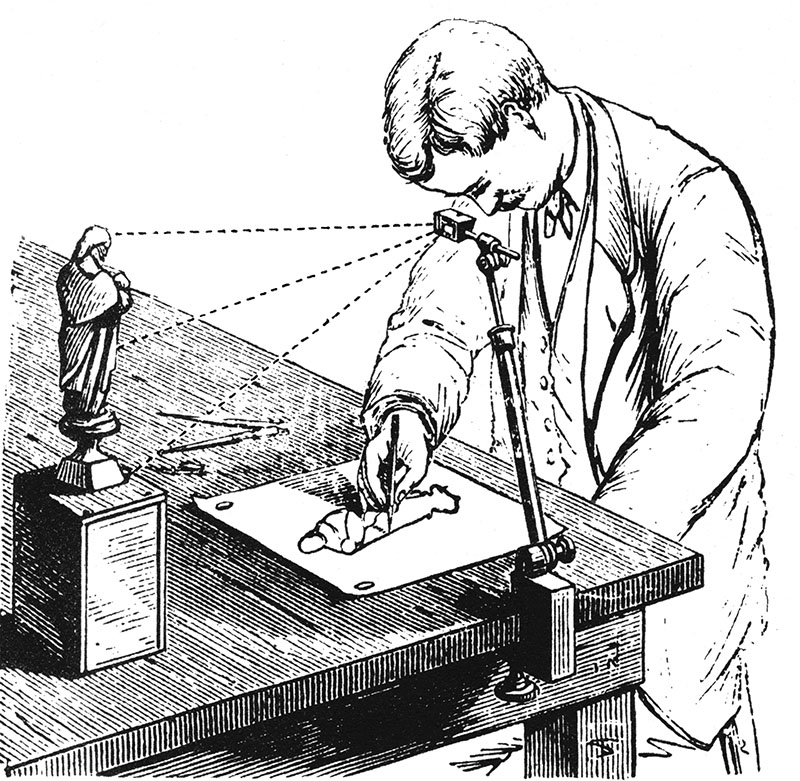
An optical device and precedent to the camera, which was used as an aid for drawing and sketching. Developed in 1806 by William Hyde Wollaston, it featured a prism with four faces set on a stand above a sheet of paper, which superimposed the reflection of the subject in front of the artist onto the drawing surface. From the Latin, meaning “light chamber.”
More Definitions
Low-Warp Loom
Handloom commonly used for traditional tapestry and carpet weaving, in which the warp threads are stretched parallel or nearly parallel…
Lease Rod
A tool used to separate warp yarn threads and keep them in their place in a hand loom. It is…
Ambar Charkha
A version of the traditional charkha which uses multiple spindles as opposed to a single spindle and is intended for…
Enlarger
A transparency projector used to produce photographic prints from negatives and transparencies. Enlarging became popular in the mid to late…
Collodion Wet Plate
A nineteenth-century method of producing photographic negatives using a glass plate coated with a silver emulsion. While relatively inexpensive and…
Hollowed Bone
A tool made from shaping human or animal bone and used by prehistoric people as tools as well as to…
viewfinder
The eyepiece on a camera that allows the photographer to compose and determine the focus of the image received through…
Naksha
Also known as a jala, it is an arrangement of threads that maps the desired design and is attached to…