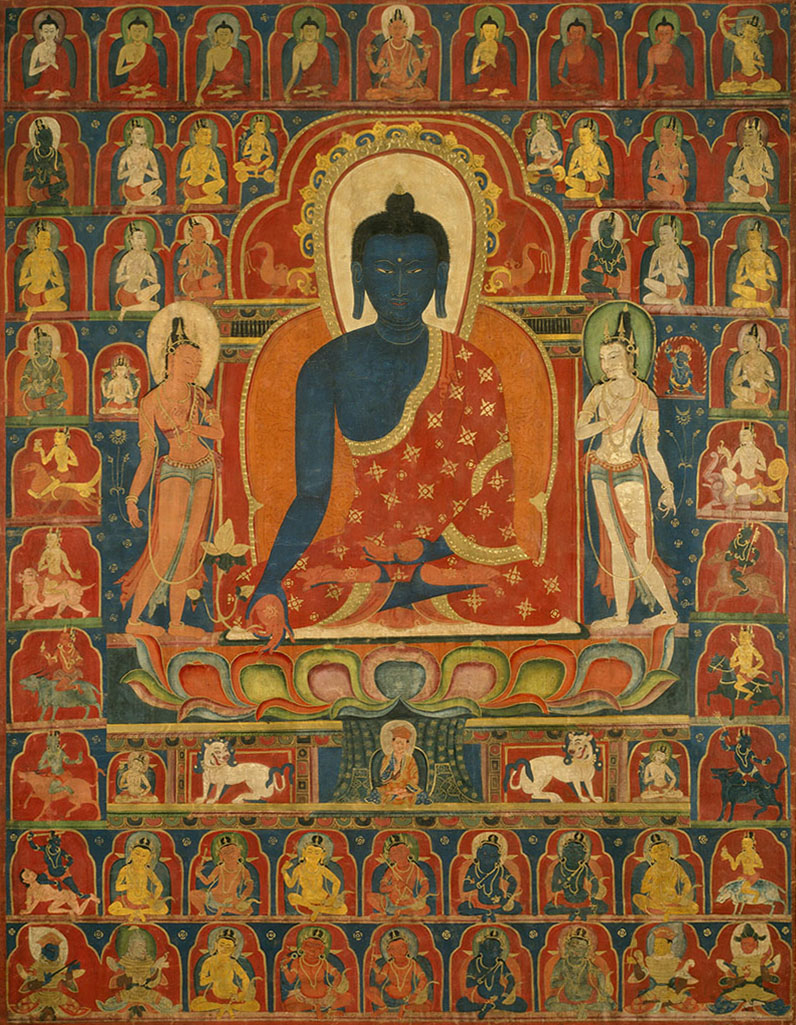
Also known as the Medicine Buddha, he is the Buddha of healing and medicine in Mahayana Buddhism and is believed to cure suffering through his teachings. He is considered a bodhisattva who took twelve significant vows upon attaining enlightenment. He is also an important deity in Chinese Buddhism, along with Amitabha and Shakyamuni. The deity is typically depicted seated, holding a lapis or blue jar of medicine in his left hand and the stem of the aruna fruit (myrobalan or Terminalia chebula) in his right hand. He is also depicted with a blue halo. From the Sanskrit bhaisajyaguru, meaning “medicine master.”
More Definitions
Siddhayika
In Jaina religious art, a yakshi (nature spirit) who is an attendant of Mahavira, the twenty-fourth Tirthankara. Her iconographical attributes…
Purusha
The conception of man according to Hindu philosophy as established in the Vedas and the Upanishads. The purusha is a…
Devi Upanishad
A minor Upanishad often classified as one of the eight Shakta Upanishads, it is one of the nineteen late-Vedic texts…
Triratna
Also known as the Three Jewels of Buddhism, triratna comprises the Buddha, dharma (his teachings) and sangha (the community). In…
Dalai Lama
The name Dalai Lama is a combination of the Mongolic dalai, meaning "ocean" or "big," and the Tibetan bla-ma, meaning…
Andhaka
A malevolent asura king from the Hindu pantheon who fought a war with Shiva and other devas after being granted…
Pashupati
An epithet originally used for the Vedic deity Rudra and now denoting one of the incarnations of the Hindu deity…
Kevala
A concept in Jainism that pertains to omniscience or the attainment of supreme wisdom. It is the last in the…