-
ChicagoPathak, Davangi. "Aesthetics of Resilience: An Interview with Artist Arpana Caur." Impart Perspectives, April 14, 2026. https://imp-art.org/perspectives/interviews/aesthetics-of-resilience-an-interview-with-artist-arpana-caur/
-
MLAPathak, Davangi. "Aesthetics of Resilience: An Interview with Artist Arpana Caur." Impart Perspectives, Apr. 14, 2026, https://imp-art.org/perspectives/interviews/aesthetics-of-resilience-an-interview-with-artist-arpana-caur/. Accessed 16 Oct 2026.
-
HarvardPathak, D. (2026) Aesthetics of Resilience: An Interview with Artist Arpana Caur, Impart Perspectives. Available at: https://imp-art.org/perspectives/interviews/aesthetics-of-resilience-an-interview-with-artist-arpana-caur/ (Accessed: 16 October 2026).
Aesthetics of Resilience: An Interview with Artist Arpana Caur
Caur explains how she uses recurring visual motifs and layered symbolism in her art to confront dark and violent realities of the present and past.
By Davangi Pathak
Link copied!
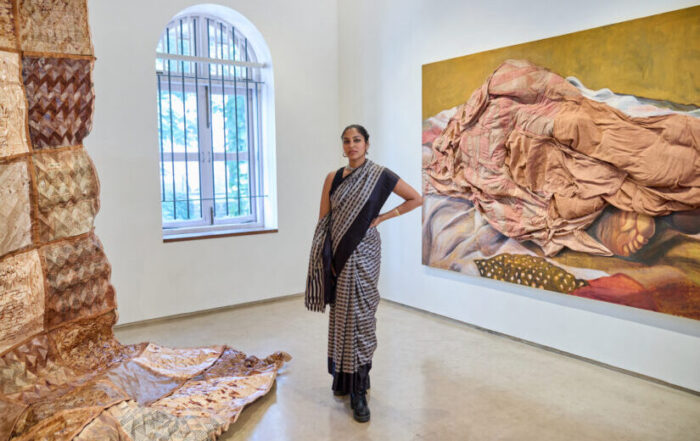
Arpana Caur with one of her works. Courtesy the artist
Arpana Caur’s childhood coincided with the formative years of the nation — a time when its citizens negotiated identity, memory, and rupture after the 1947 Partition event. She subsequently shaped her artistic practice to address dark and often violent realities of the past and present. Family and community trauma repeatedly creeps into her work in visual metaphors of death and loss. The 1984 anti-Sikh riots, in particular, marked a pivotal moment in her life as her grief spilt onto canvas. Caur has also never shied away from confronting ‘unpleasant’ societal truths, from the plight of widows in Vrindavan to environmental degradation and the detrimental effects of urbanisation.
Her mother, ‘Padma Shri’ Ajeet Cour, who brought her up as a single parent, has been a key influence. Caur refers to her as “dynamite,” the word encapsulating her admiration for the strong, liberal-minded, and at times radical woman, who encouraged her to pursue painting. A product of their combined labours is the Academy of Fine Arts and Literature, founded in 1975. The institution houses seven museum-galleries, a stitching and sewing centre focused on women’s skill development, a contemporary art gallery, and a full-fledged Sculpture Department. Dedicated to nurturing young and emerging talent, the Academy has played a noteworthy role in shaping education and community engagement around contemporary art and literature.
Caur has also articulated a distinct representation of the feminine in her work — gentle but with the capacity to confront violence, social oppression, displacement, and historical trauma embedded in the day-to-day. Every so often, she takes refuge in philosophical themes and spiritual symbolism, her perspectives influenced by her Sikh heritage, Punjabi literature, and devotional poetry. As a self-taught artist, Caur uses vibrant colours, simple figuration, and spatial arrangements that stylistically draw on Pahari miniatures and the Punjab and Sikh Schools of miniature painting, in addition to folk and tribal visual languages, such as Madhubani, Warli, and Gond art. In a wide-ranging conversation, Caur delves into the inner workings of her practice, one that has stretched across five decades of creativity.
Davangi Pathak: One prominent theme in your body of work is the lives of women depicted through everyday actions like weaving and sewing — calm and soft, yet not weak. What draws you to such portrayals?
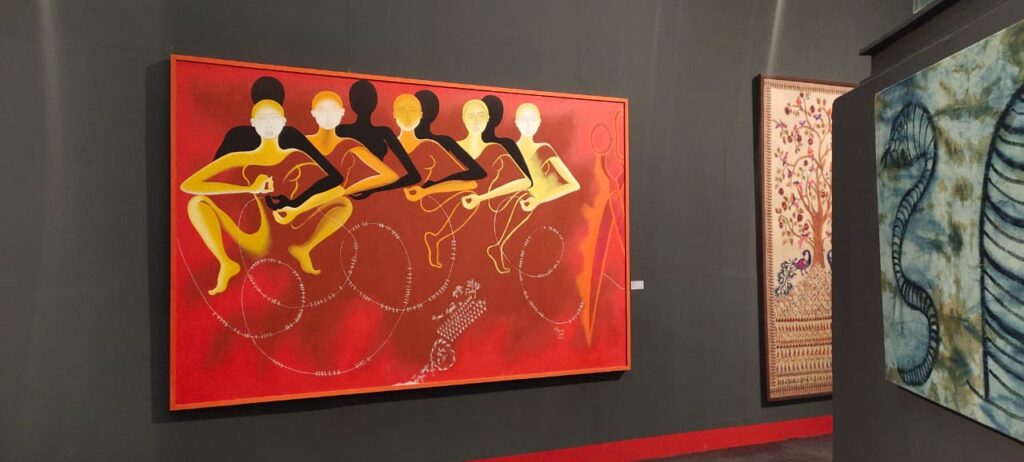
Arpana Caur: Both for my first solo show in 1975, 51 years ago, and my first group show in 1974, the subject of my paintings were mostly ‘women in interiors’. In those days, a majority of Indian women were homebound. I was the child of a single mother. I had no brother, so we were a family of three and a household of only women. It was a very difficult life, financially as well as socially — especially for my mother as a single parent raising two girls. So women naturally became my subjects when I began my painting career. My mother was very scared and protective of both of us, although she’s a bold woman. But in those days, society was largely conservative. My mother would often feel like we were battling the world without a male figure by our side. My paintings were influenced by this — they are symptomatic of how I grew up, that time period. The depiction of women stitching and sewing also recurs in my work, as a way to symbolise [the passage of] time. Even so, I will say that only a small part of my work over the years can be described as being centred around women.
Pathak: Is there a particular theme that you keep returning to even now?
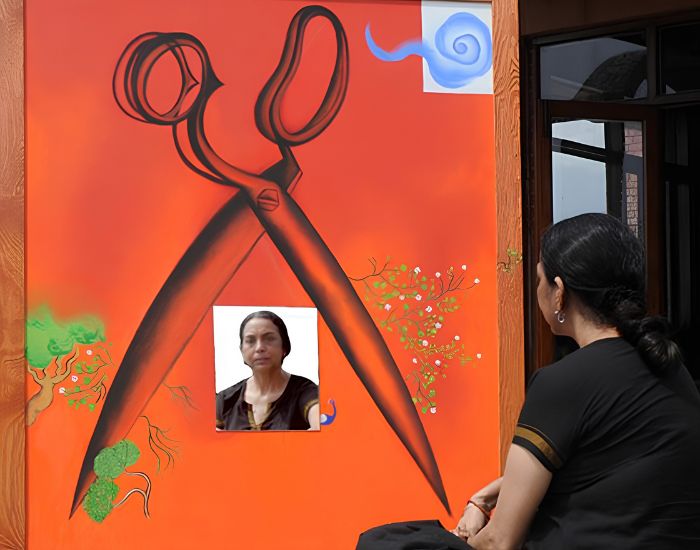
Caur: Twenty-five years ago, I started this series, and I’m still continuing to add to it because it’s never ending — Day and Night. When I started, I personally had never seen any painting depicting this natural transition that happens every day. Not in Western art, or Indian art. To depict an image to paint, I thought of having a Yellow Woman embroidering the thread of life and a Black Woman as a shadow, cutting the same thread. I wanted to depict duality; these paintings show that when Death approaches, Kaal (Time) comes and cuts the thread. Like how the Greeks say that the Fates spin, measure and cut the thread of life.
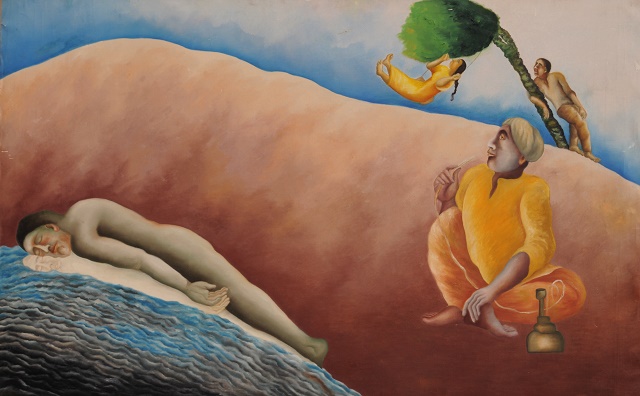
Pathak: Previously, you have spoken about how the 1984 Sikh massacre led you to create the World Goes On series that won the gold medal at the VIth International Triennale (1986). Can you share some of your memories from that time?
Caur: When the massacre happened, people were dragging Sikh families out of their homes onto the streets to kill them… women were raped. Being Sikh and foremost a human, this was both devastating and terrifying. My own mamaji (maternal uncle) was dragged out of a bus in Simla. We lost family friends in the riots. Houses were destroyed… they were deliberately set on fire and burned down. Thousands of people had to take shelter in relief camps. My mother said it best: “1984 was like an echo of 1947.”
At the time, both she and I worked at the relief camps in Delhi from morning till night. I still remember, it was wintertime. Many at the camps had no woollen garments, they had no medicines, no food. So, we would take whatever we could buy. Every day, a langar would be organised and we would take provisions for it. For six months, we worked in the relief camps. I was deeply affected by it all. I started painting and what emerged was the series World Goes On. Ebrahim Alkazi had the courage to exhibit those paintings at the Art Heritage Gallery in 1985. Then, the series went to Bombay [now Mumbai], then Calcutta [now Kolkata]… it was exhibited at the Triennale in 1986. I was shocked when one of the paintings won the gold medal there. That was a big turning point.
Pathak: Your visit to Vrindavan in 1987 also had a significant impact on your life soon after. How did this trip influence your work?
Caur: Memories of the massacre were still fresh. In 1987, we went to Vrindavan to see the temples, to see some art. However, fate had some other plans. When we got off our vehicle, we saw thousands of abandoned, starving widows with shaven heads. It was such a shocking sight! There were four Bhajan ashrams, in which they were chanting eight hours a day for eight ānnas (50 paise) and one little bowl of rice. So much poverty! Their families had discarded them. For them, a widow was just an extra mouth to feed. People also believed it was a bad omen to keep a widow in the house. Shaken by the atrocities, I did a series called Widows of Vrindavan and that was exhibited again by The Art Heritage in 1988. Seeing so much pain affected me. I started painting death and started using water as a motif for it. Water has not left me since then. I continue to paint water in different contexts because I needed to paint death… and I use thread and scissors as a symbol for time and violence.
Pathak: What role has traditional and folk art played in your practice?
Caur: I draw my style from miniatures, where one little painting holds multiple scenes and the fourth wall gets removed. You can see inside and outside at the same time, like in Basohli miniatures. My work has been deeply influenced by the figuration style — the simplification of how figures are drawn in such artwork. I’ve used elements of architecture, nature and landscapes from traditional miniature paintings. In some of my paintings, I deliberately choose a dark background, which creates this impression of a dark space. Then, I use colour palettes that look like light falling on a body or object, forming contours. Secondly, I’ve often used folk art elements deliberately to pay respect to these living traditions of art-making. That’s why my mother and I started collecting folk art 40 years back and set up the museum to showcase these traditions. Now, of course, folk art is recognised and valued. This shift happened within the last 10-12 years, especially for Gond and Warli art. But, forty years back, it was a bad situation.
I found myself incorporating their motifs in my work as a homage. I started giving scholarships to folk artists like Suresh Dhurvey, a Gond artist. In 1993, I collaborated with a Godana tattoo artist from Madhubani named Satnarayan Pandey. We worked on a paperworks series named Between Dualities that showcased both rural and urban worlds. To attain the skin colour-type texture of paper, Pandeyji applied a coat of cow dung and water mixed together. In a painting from that series, I painted a vertical column of cars of pink, yellow, blue and green titled So Many Horsepower, comparing traditional horses and modern cars. He would often paint trees to depict the rural. I contrasted this with a row of chairs in different colours, tumbling and called it Kissa Kursi Ka, referencing Delhi’s corridors of power and political games by leaders. Then, in one of his tree paintings, I added a gun leaning on it and called it The Same Wood because from that same innocent tree comes the wood which makes a gun.
Pathak: I understand that your family experienced displacement during the Partition, when your grandparents moved to Delhi. How did such ruptures shape your early life, your artistic practice?
Caur: Our culture [in India and Pakistan] is the same, but we are always at loggerheads. I always knew our culture is the same because my mother, as a writer, would invite Pakistani writers for conferences. Now, they’re not coming because of political reasons. Politically, it’s always a clash.
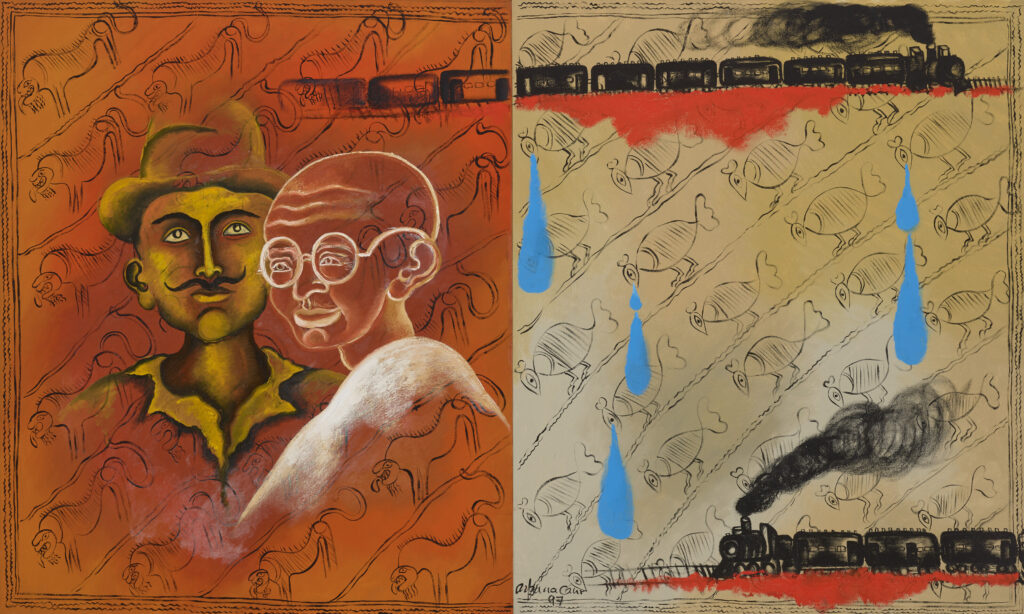
My nana (maternal grandfather) and my mother would often recall Lahore as the ‘Paris of the East,’ but then they would talk about the trauma of seeing the blood-soaked trains — I would sometimes have nightmares as a child about the trains from their stories. I didn’t experience it directly, but my mother talked about it a lot. Her interviews are constantly shown at the Partition Museum in Amritsar. I did paintings about these blood-soaked trains, crisscrossing the border, called The Great Divide. I made it when India turned 50 years old. I painted Bhagat Singh and the Basanti Chola against a background of Madhubani lands, criss-crossing trains full of blood, lions, and weeping birds. I showcased how Bhagat Singh and Gandhi had opposite methods, but the same vision. It’s an eight-feet long diptych, now in a museum in Chicago.
Pathak: Are there any family objects from the time of Partition or post-Partition life that have stayed with you and influenced how you think about history, belonging, and identity?
Caur: My grandfather only brought one Granth Sahib on his head during Partition. Till date, we pray in front of it. I did a painting based on this titled 1947. I painted Madhubani lions in the background. Along with the Granth Sahib, the man in the painting carries a bundle of memories on his back, in the form of a cloud.
Pathak: You are also known to have a deep interest in literature. Is there a particular literary work that has significantly influenced your work?
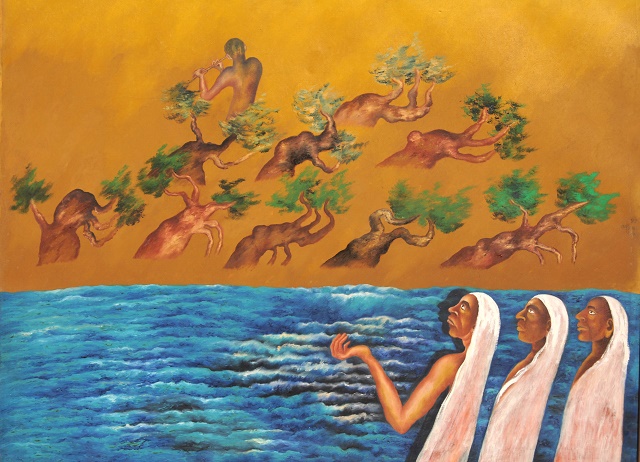
Caur: My mother won a ‘Padma Shri’ as an Indian writer. She has written about 30 books in Punjabi so my inclination towards literature comes very naturally. One of my favourite books is written by my mother — Uss Paar — which means “that side.” She describes Lahore, her childhood, her being born there… then the events of the 1947 Partition and her efforts to build bridges, post-independence, with writers to foster a cultural dialogue. One of our museums at the Academy is dedicated to this theme of cross-border cultural exchanges. She has written The Blue Potter, a book with seventeen sketches of her contemporaries, such as Kushwant Singh, Krishna Sobti, and Amrita Pritam. Another story that I became deeply fascinated by is that of Sohni and Mahiwal — how much they longed to be with each other. In one of my paintings, I showcased how devoted Sohni was about meeting Mahiwal. Just to have a glimpse of him, she was ready to drown amidst the high tides of Chenab.
Pathak: Would you like to share anything about your current or upcoming projects? Are you exploring any new themes, materials or mediums at present?
Caur: Right now I am still working on a few series and retouching some old paintings that are getting restored. I spend most of my time managing the museum and my life. My mother is 91 years old, I am 71. I have a lot to take care of. (She chuckles.) From April 2026 onwards, we are planning to do some programming in collaboration with some organisations and foundations to keep the museum and space active.
First published: April 14, 2026