-
ChicagoUpadhyay, Shweta. "Painting Urdu: How Language Becomes Art." Impart Perspectives, April 10, 2026. https://imp-art.org/perspectives/features/painting-urdu-how-language-becomes-art/
-
MLAUpadhyay, Shweta. "Painting Urdu: How Language Becomes Art." Impart Perspectives, Apr. 10, 2026, https://imp-art.org/perspectives/features/painting-urdu-how-language-becomes-art/. Accessed 16 Oct 2026.
-
HarvardUpadhyay, S. (2026) Painting Urdu: How Language Becomes Art, Impart Perspectives. Available at: https://imp-art.org/perspectives/features/painting-urdu-how-language-becomes-art/ (Accessed: 16 October 2026).
Painting Urdu: How Language Becomes Art
Through annotations, painting, and photography, several contemporary artists have repurposed the Urdu script to explore narratives of loss and estrangement.
By Shweta Upadhyay
Link copied!
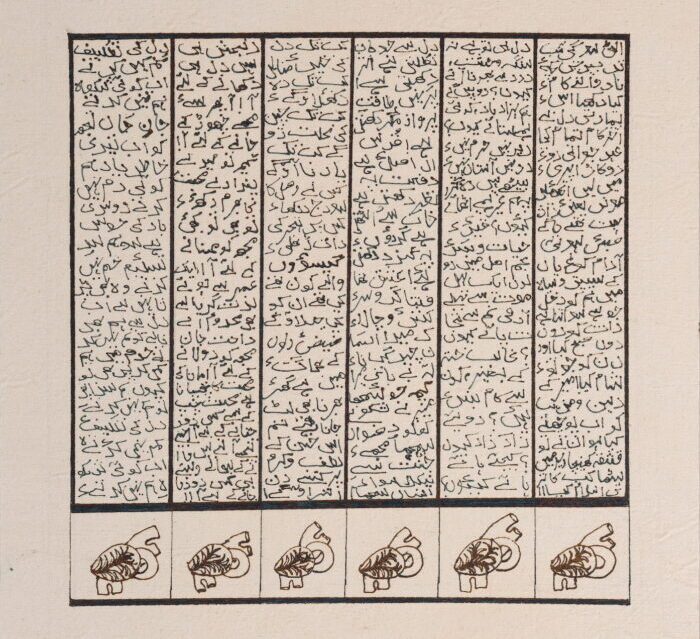
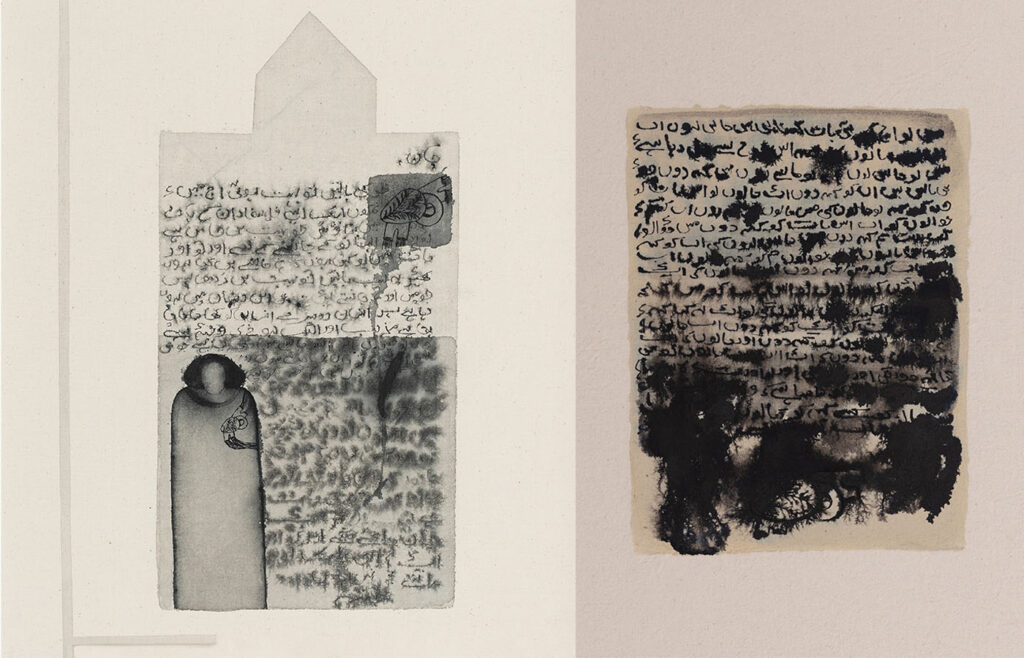
29th August, Dil..Meer, Ghalib, Iqbal, Faiz, Faraz-o Jaun ki Zubani, from Nafas series; Arshi Irshad Ahmadzai; 2020; Ink on Manjarpat fabric. Courtesy the artist
Six ghazals by six poets about the hankering heart. Urdu couplets with ‘dil’ as their thematic lynchpin tightly fitted in vertical columns drawn on a page. The calligraphic text stacked in silos look like shards shaped like crescent moons, or mourning bodies. The rendered ghazals include “kab tak dil ki khair manae” by Faiz and “ranjish hi sahi, dil dukhane ke liye aa” by Faraz. At the base of each ghazal-filled column is a drawing of a disembodied, perambulatory heart. This work, titled Dil… Meer, Ghalib, Iqbal, Faiz, Faraz-o-Jaun ki Zubani (2020) by Arshi Irshad Ahmadzai is part of her series Nafas or Isolation Diaries. The artworks emerged from the letters she wrote to her absent husband, while in confinement during the pandemic at her parents’ house in Najibabad, Uttar Pradesh. It was the first time Ahmadzai used copious Urdu text in her artistic practice.
Tapping into the expressive potential of the language, Nafas gives shape to the fictions of Ahmadzai’s private loneliness, and the pleasure and displeasure of waiting, through references to Urdu poets, fables and events. This lends a literary framework to the artist’s interior world by placing it within a constellation of poetic allusions. The letters are also filled with painted figures and leitmotifs of Ahmadzai’s visual repertoire, including female figures with featureless faces and pieces of furniture, but it is the Urdu language that is foregrounded to assert the self and the clamour within. “These meaningless poems and stories without head or tail are all mine, and at times referencing someone or the other,” says Ahmadzai about the series. “The Urdu language is an undercurrent of my bloodstream, like quiet streaks. It discreetly made its way into my work, and if I complain, it laughs a silent, solemn laugh.” *
The Perso-Arabic script and Urdu has been part of works by several contemporary artists, such as Baaraan Ijlal, Faiza Hasan, Saba Hasan, and Saubiya Chasmawala. Deployed through various visual techniques, Urdu texts are repurposed in their attempts to explore identity and highlight the historical erasure of the language. Sometimes the script is used only for its materiality and visuality, with the words themselves functioning like empty kernels devoid of implicit meaning in absence of the artistic context (seed).
While most of the letters in Ahmadzai’s Nafas are accessible to readers of Urdu, in her other works, the text leaks, appearing as blotches, as if blurred by tear drops. The connecting tissues of sentences are disrupted; pages are blackened and made wet as meaning gets shrouded by grief. In series like Bagh-e-Babur (2023), Qissa-e-Qabul (2022) and Bagh-e-Zenana (2024), the Urdu words are unreadable. “I often rob the words of their identity,” says Ahmadzai. “It is a grave crime to rob anyone, let alone words, of their identity. Is it fair then, to let words fend for themselves for all eternity? But in contrast, the titles of my works are very narrative, and end up revealing the secrets of words to some extent.”* In some of her works in the Nafas series, the arrangement of Urdu text invoked architectural features like shutters and partitions, but in her latest show Azal se Abad Tak: A Journey between Two Eternities (2026) at Chatterjee & Lal, Mumbai, the letters coalesce to suggest sky, clouds, fields, sea. Ahmadzai has eliminated the dots (or nuqta), making the text illegible. “It’s like putting out their eyes,” writes poet Sampurna Chattarji in the exhibition’s wall text.
Sometimes when words are not understood, they can still be used for incantations. Chasmawala grew up reciting Quranic verses without understanding them. Through her practice, she addresses this chink between form and meaning. Her graphic patterns made of Arabic letters are visual chants, a culmination of a series of performative gestures; she uses the calligraphic tool and makes a mark on paper with ink and then walks over the page, sits on it, and enacts a series of actions like spilling ink and layering the page. “Writing in Arabic, especially in calligraphic gestures or repetition, can feel ritualistic, almost prayer-like,” says Chasmawala. “There is a grid inherent to the script which makes it easier to move around the surface. Here the mark-making is cathartic… a way to purge emotions.”
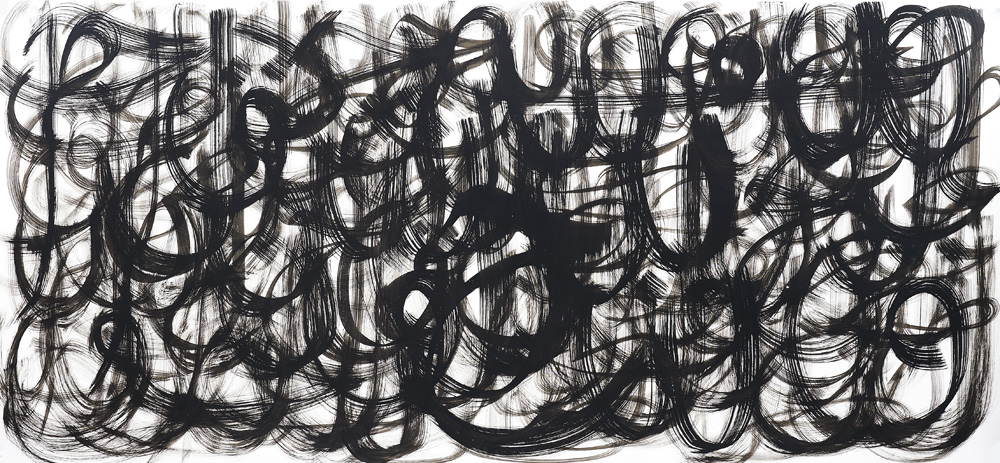
The Arabic alphabets are evacuated of their meaning to become a secret language of glyphs. Chasmawala strings together sentences of random words, unmoored from the need to make sense. Like Ahmadzai’s works, here also there is leakage of feelings, an affective spillage on the page. “Perso-Arabic script is a big part of my identity… the script and letters symbolise something sacred to me,” she says. “For instance, the letter ‘meem’ feels like a body in the act of submission.” Chasmawala has also started using meaningless Arabic script on old photographs in her recent works.
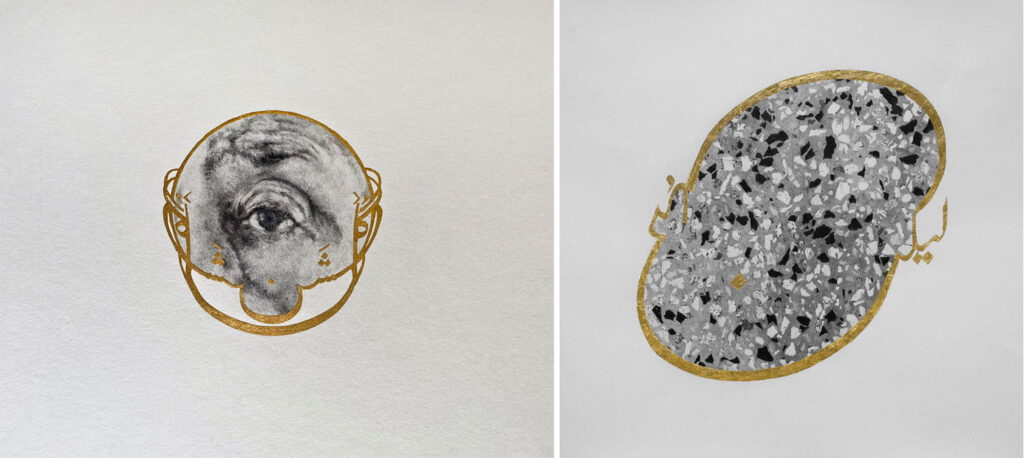
In Hyderabad-based artist Faiza Hasan’s work, Urdu is used both as annotations in her figurative drawings, and also as what she claims is the “lover’s eye.” Drawing from a form of jewelry used to contain images of a lover or loved ones, Faiza employs the outline of an Urdu word as a container to contour images. For example, in one work, the word ‘gulshan’ frames the eye of her maternal grandmother, while ‘lekin kahan’ outlines the image of the terrazzo floor of her grandmother’s house. This usage of her mother tongue Dakhni is enmeshed in the archival register of her artistic practice that involves mining family albums and re-drawing scenes, objects, and figures of personal history to create a catalogue of absences.
These works make a larger point of the erosion of Urdu language in India because of neglect and linguistic politics. Though most of these artists use Urdu words and the Perso-Arabic script as an affirmation of their identity, their works cannot be detached from the politics of marginalisation of the Urdu language after the 1947 Partition event. Urdu, a hybrid language born out of the intermingling of the Hindavi language with Turkish and Persian influences, and once a symbol of pluralism, started to be perceived as a language used only by Muslims in the subcontinent because of its script. Over time, Urdu literacy has fallen, aided by policies of overt erasure. Ahmadzai says that she does not want her works to be entangled in politics but it can’t be avoided. “These amorphous words are like daggers that tease the stark, controlled politics of today,” she says. “They claim their place on this soil. Today, Urdu carries the burden of its imposed ‘purity,’ and its stigma as the language of second-class citizens on its fragile shoulders, like a strong and silent river.”
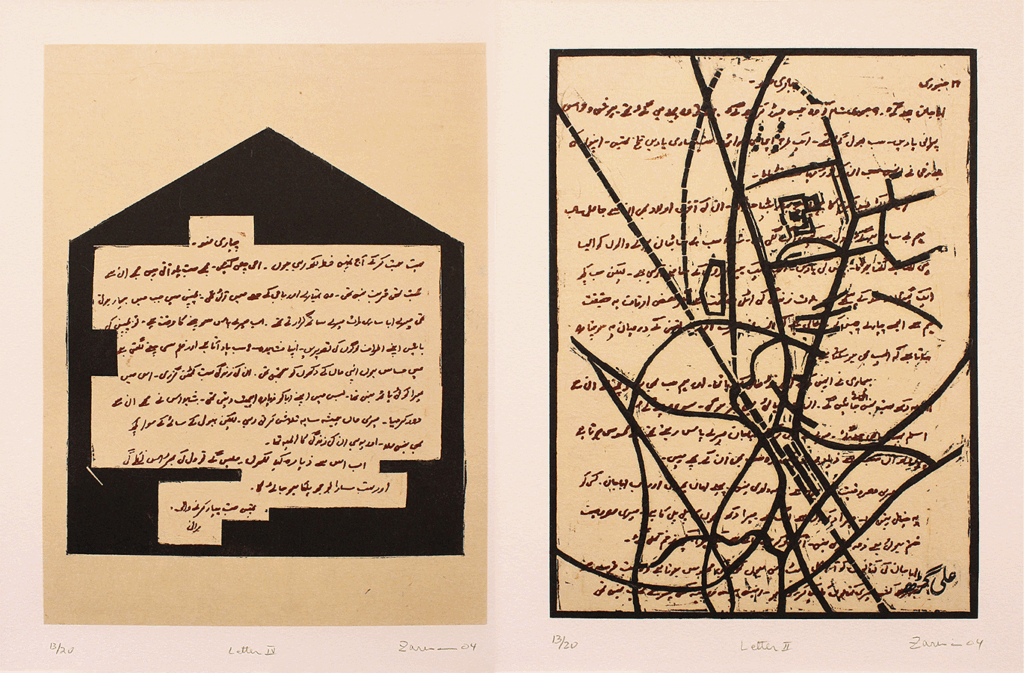
It was Zarina Hashmi (1937-2020), known professionally as Zarina, who first used Urdu text prolifically in her works. Ahmadzai acknowledges Zarina’s influence on Nafas; in fact, one of the letters in the series is titled Zarina ke Naam, in which she pays homage to the artist. The wounds of Partition had left a profound, pit-deep sense of homelessness in Zarina. Her works are replete with whimsical borders, skeletal houses, pitch-black margins that drag you in their vortex of darkness. They refer to the deracination wrought by Partition that separated her from her parents and siblings who moved to Pakistan. In an interview, Zarina had noted that words preceded images in her practice.
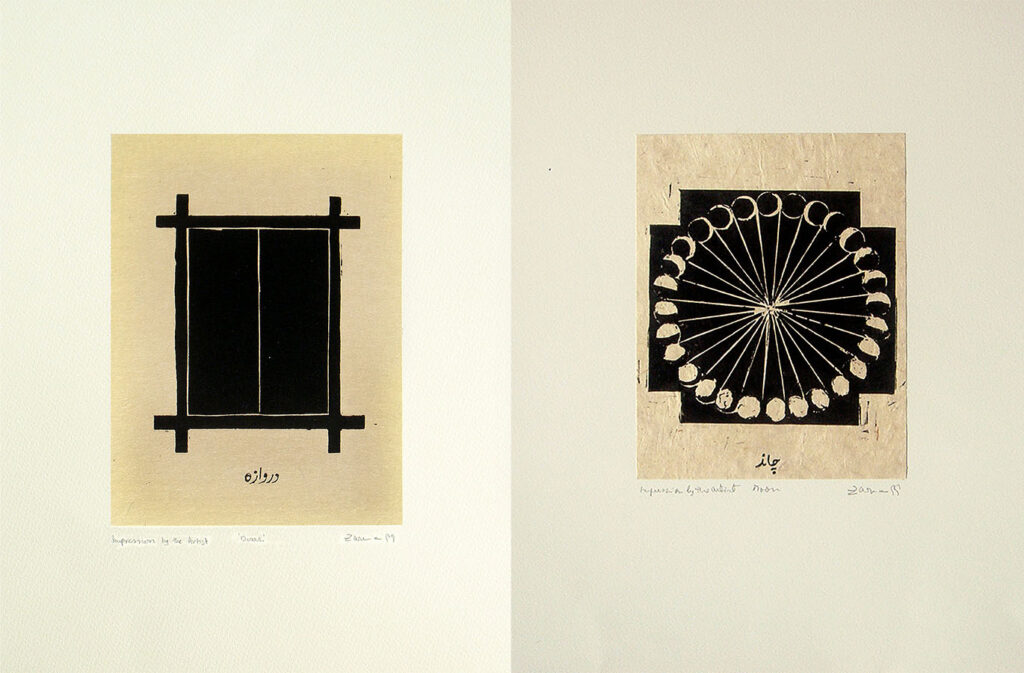
Some of Zarina’s works that foreground Urdu language are part of the show Urdu Worlds (2026) at the Ishara Art Foundation in UAE. Curator Hammad Nasar writes in the curatorial note that Zarina thought she was “too Muslim for the US and India, and too Indian for Pakistan.” Instead, she considered herself an “Urdu artist.” In her series Home is a Foreign Place, she pairs idea-images with certain Urdu words, such as ghar (home), sarhad (border), deewar (wall), aasman (sky), baarish (rain), chaukhat (threshold), khamoshi (silence), to define and craft a personal lexicon of loss, of being robbed of a place to belong to even as her art practice led her to find home in Urdu.
The language straddles multiple realms and registers in her work — from the architectural to the psychological, atmospherical to the celestial and political. In Letters From Home, consisting of eight monochromatic woodblock and metalcut prints, Zarina overlays lines from original letters written in Urdu by her sister Rani with maps and blueprints of old homes. Some texts are crossed out and smudged to signify that what they mean is irrelevant compared to how they occupy and anchor space in her works. They seem to convey that only abstruseness makes sense in the face of impossible loss, much like the garbled words in Saadat Hasan Manto’s short story Toba Tek Singh.
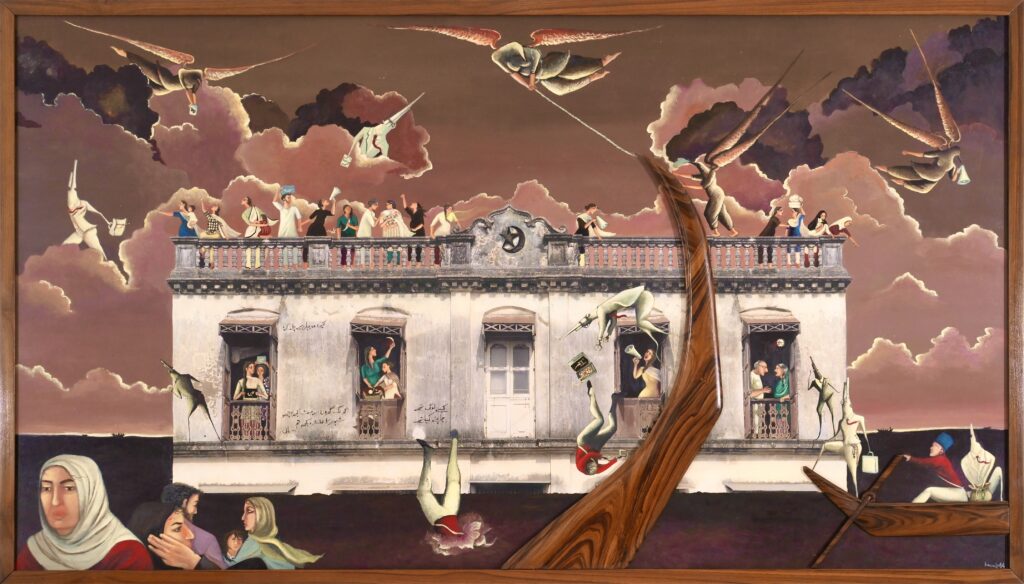
Baaraan Ijlal’s application of Urdu is an insistence against historical amnesia towards such narratives of loss. “I am not interested in turning Urdu into a decorative motif; it stands as a metaphor for its own existence,” says Ijlal. “After Partition, the entire linguistic and literary worlds were split. To use Urdu today is also to acknowledge that rupture, and to insist on continuity.” Ijlal’s use of Urdu couplets is most effective in her paintings from Hostile Witness (2014-ongoing). The research-based series has her partnering with her brother Moonis, who creates the frames for her paintings. The works record traces of violence, displacement and marginalisation left on historical sites and architectural spaces that are treated as sentient beings capable of recollection and reflection.
Swarming with a slew of characters and packed with dense activity — featuring both real and fantastical characters (like the crow woman Zaagh O Zaman and the tyrant Jabril with pistol heads, dressed in corporate suits) — the Pre-Partition style ancestral houses are reminders of what was lost in the historical, ecological, and moral battles fought over borders, nationhood, and belonging. Wispy Urdu verses by literary figures like Manto and Rajinder Manchanda Bedi are imprinted on fraying walls like testimonies. The series was inspired by these verses by Ijlal Majeed (Baaraan Ijlal’s father), “Achanak khulega kisi aik din / Wahan kya hua tha kisi aik din / Wahi phir se hoga kisi aik din / Kabhi jo hua tha kisi aik din” (Suddenly it will be revealed one day / What had happened there one day / It will happen again one day / What had already happened one day). According to Ijlal, these words are “like an excavation, and also a warning that history will repeat itself.”
While these artists use Urdu for a variety of purposes, from asserting plural identities to invoking Urdu’s rich legacy and issues of historical marginalisation, such works can appear incomprehensible to those who are not familiar with the language. But as Ahmadzai puts it, the viewers have a certain responsibility toward such artworks. According to her, language is alive, has breath (nafas) once expressed or written, whether with or without meaning. For Ijlal, the contact between the language and the viewer is sufficient in itself because it may trigger a memory or reaction, and with it, an acknowledgement of the language’s legacy. “Even when the words are unread, they still hold their gravity. Their very presence becomes a way of remembering,” says Ijlal. “Even if it is not comprehended by someone, it can be encountered.”
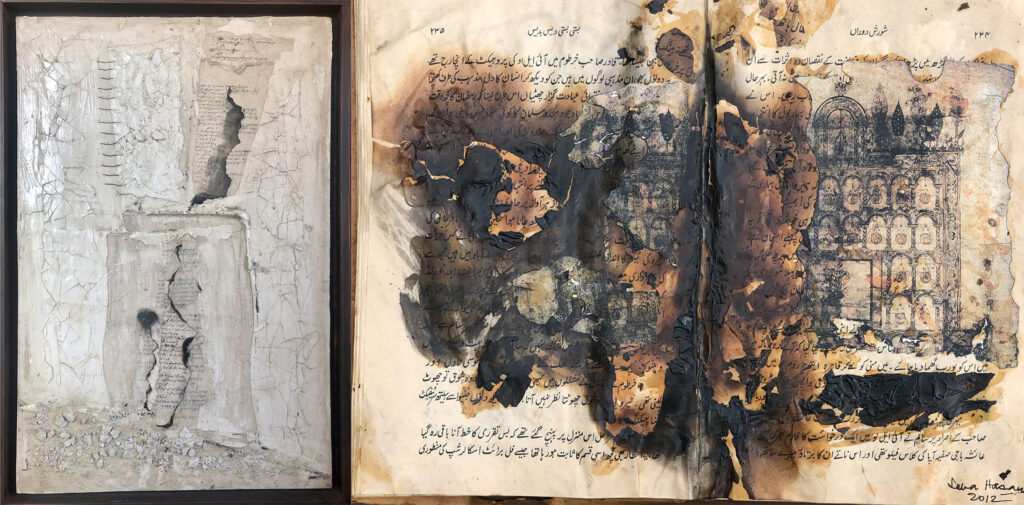
In artist Saba Hasan’s abstract works, the Urdu text is harnessed both for its calligraphic element, as a cultural signifier to address the politics of belonging, and as a moment of interiority and pause. Hasan integrates Urdu translations of feminist authors, such as Ismat Chugtai and Rashin Jahan, in her book sculptures, and often employs techniques to obscure these texts, such as burning and tearing. She does not think it is necessary for people to understand or read the words. “Sometimes you have to reduce the noise to get to the depth of feeling, to provide a moment of repose, silence and introspection. The use of Urdu provides that moment of stillness in my works,” says Hasan, who recently had a show of her book sculptures titled jo gayab hai, aur hazir bhi at KNMA, New Delhi. “In my art, though language is present, the words are abstract, and sometimes, not even clear. They are like a sign and a material along with other materials I use, like wire, silk, nails and leaves.”
For Faiza, the problem of comprehension is solved by using Urdu letters to insert “gaps” in her works. An insufficient archive and unreliable memory can often lead to an incomplete picture, and Faiza adeptly puts to paper this idea of what has been lost over time in her imagery. “A lot of gaps existed in the torn and faded old photographs that I was trying to restore,” says Faiza. “But, gradually, these gaps became a part of my process and a conceptual tool.” The idea of the gap, of narrative nonlinearity, is reiterated in her use of the Perso-Arabic script. “Urdu literacy has diminished, yet the letters are recognisable in their form,” says Faiza. “I suppose the Urdu words in my works are like visual gaps for the viewers,” she adds, remarking that that onlookers “fill” these gaps by ascribing imagined meanings to the shapes of the letters.
In her work and of others, we repeatedly encounter the Urdu script as a familiar presence but obscured, like a friend or lover distanced by time and forgetfulness. But still beloved.
*Translation of Arshi Irshad Ahmadzai’s Urdu quotes by Kadamboor Neeraj.
First published: April 10, 2026