-
ChicagoImpart Encyclopedia of Art. "Pinjrakari." March 9, 2026. https://imp-art.org/articles/pinjrakari/.
-
MLA"Pinjrakari." Impart Encyclopedia of Art, Mar. 9, 2026, https://imp-art.org/articles/pinjrakari/.
-
HarvardImpart Encyclopedia of Art (2026) Pinjrakari. Available at: https://imp-art.org/articles/pinjrakari/ (Accessed: 16 October 2026).
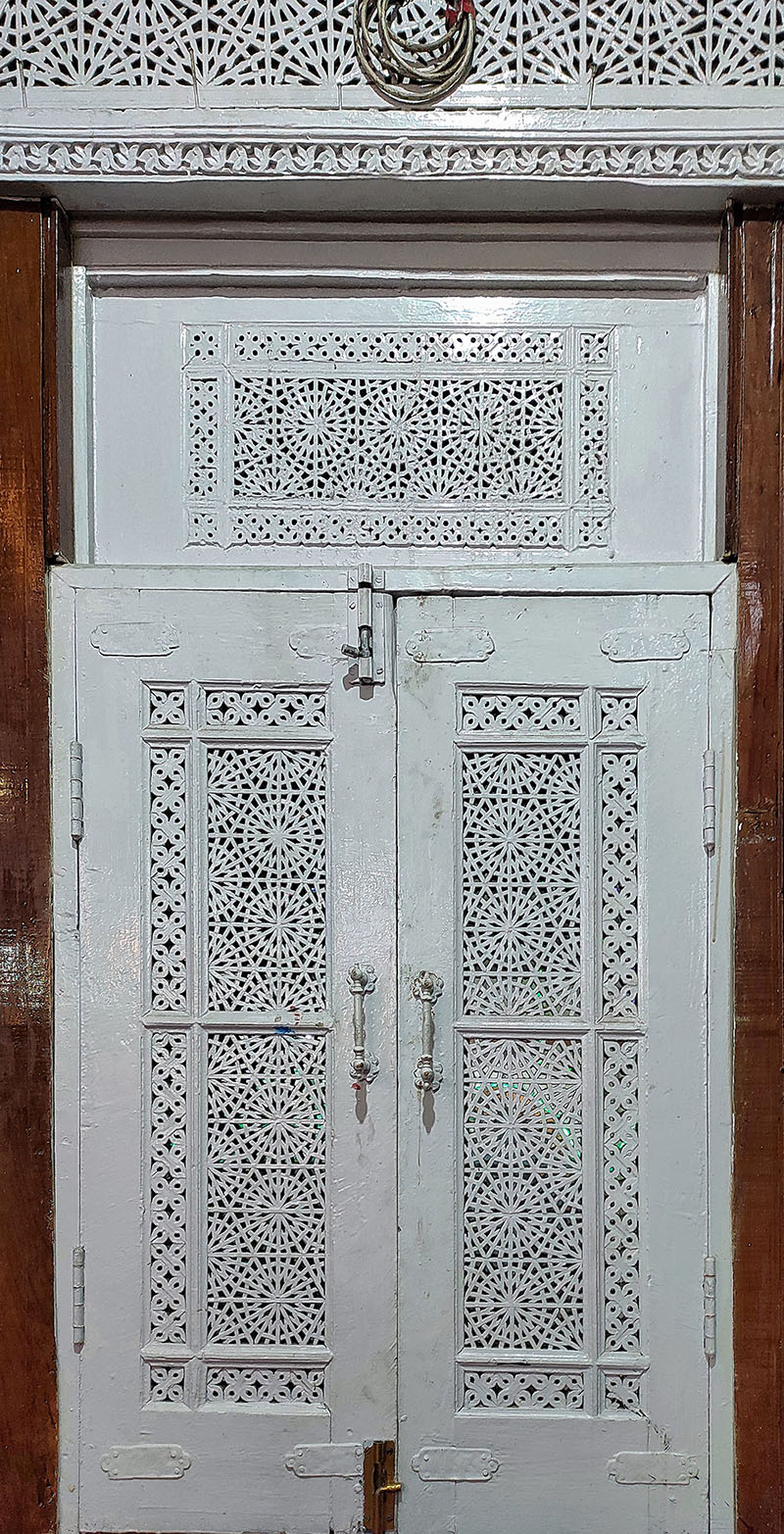
Framed wooden latticework from the Punjab and Kashmir regions spanning both modern Pakistan and India, pinjrakari (Urdu, pinjra: ‘cage’, kari: ‘craft’) is found in abundance in Islamic, Sikh, and to a lesser extent Hindu architecture. The craft is also used to decorate furniture or objects. Pinjra work is also referred to as mauj (Urdu: ‘wave’, connoting undulation or corrugation; also ‘delight’).
Historical background
Pinjra work’s reticular, symmetrical designs and repertoire of motifs are largely drawn from an Islamic aesthetic sensibility. From at least the thirteenth century on, with the spread of Islam in the Punjab through the works of Sufi saints, and the rule of the Shah Mir dynasty in Kashmir, the craft of pinjra developed in at least these two regions. The craft also likely received additional impetus from the political establishment of the Delhi Sultanate.
Pinjra work appears in historical documents during the reign of the Mughal emperor Akbar (r. 1556–1605); the Ain-i-Akbari, written by his grand vizier Abul Fazl, suggests that the craft had become highly developed and valued by this time. Later accounts of pinjra work are largely to be found in colonial documentation and exhibition catalogues, which mention several important centres of wood carving across the Punjab, including Amritsar, Lahore, Peshawar, and Ludhiana; these sources also associate the creation of the Sikh style of pinjra carving with Gurdaspur and Amritsar districts. Peshawar and Chiniot, both in present-day Pakistan, were distinguished for their intricate and sophisticated workmanship. At least one colonial source mentions the substantial export of pinjra work from Peshawar to Kabul. Examples of pinjra work were displayed at the Delhi Darbar in 1903.
The tradition of pinjra work has disappeared in most of its historical centres. In Kashmir, it is still practiced in Anantnag, Badgam, Baramula, Srinagar, Kupwara and Rajouri. In Punjab, only Amritsar is still an important centre.
Early examples and influences
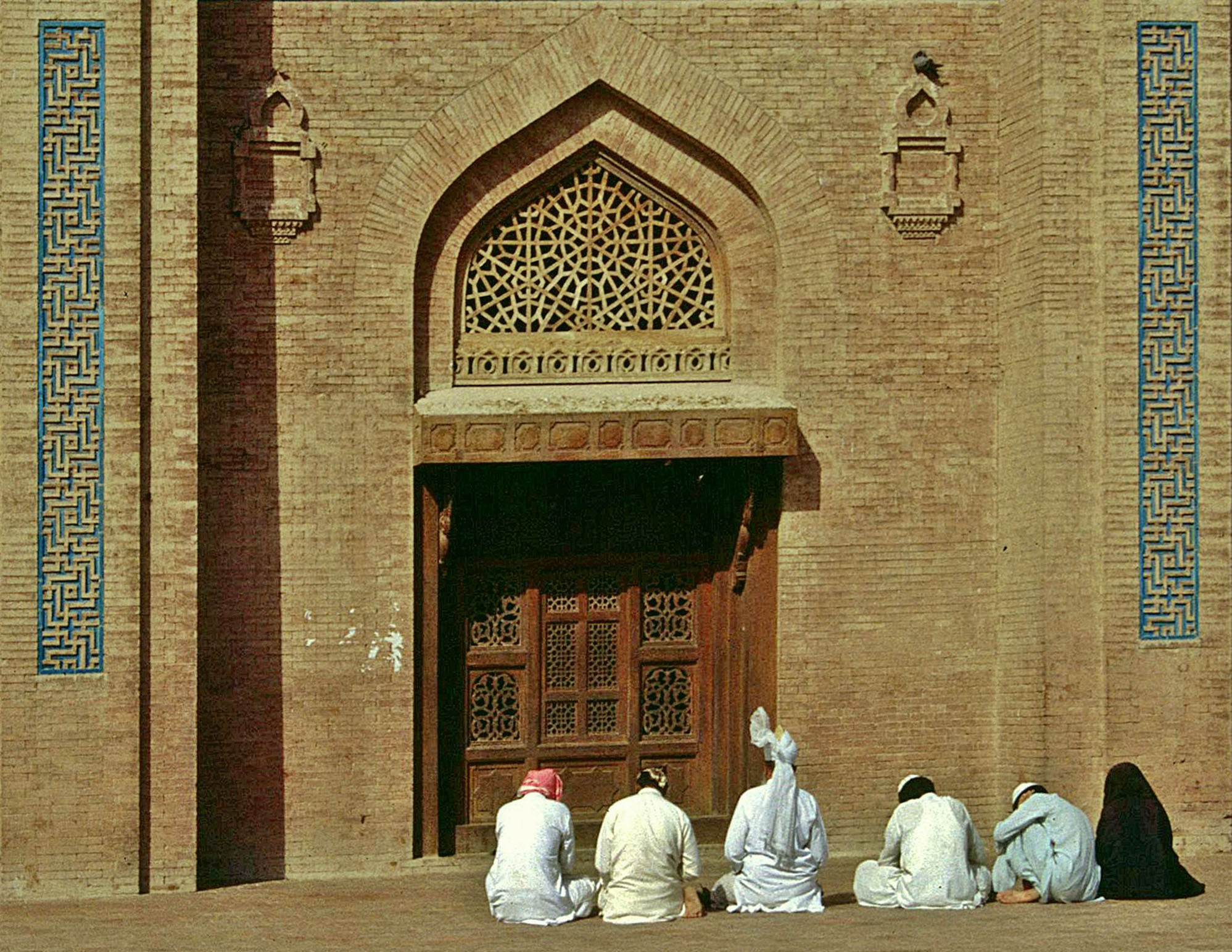
Muslim funerary architecture in the Punjab provides likely the earliest examples of wooden pinjra panels from the subcontinent; aspects of their design resemble the stone latticework or jaali of the early architecture of the Delhi Sultanate, suggesting a movement of styles and motifs from Central to South Asia. The thirteenth-century tomb of the Sufi saint Sheikh Bahauddin Zakariya and the fourteenth-century tomb of the saint Shah Rukn-e-Alam, both in Multan, Punjab (present-day Pakistan) feature pinjra panels in parts of the facade and other architectural components. Notably, some of these panels feature the six-pointed star, an important symbol from the Persian Islamicate repertoire that also appears in earlier or contemporaneous Central Asian and North African Islamic architecture. The eight- and twelve-pointed star are also Central Asian motifs seen in South Asian pinjra work, though the six-pointed star appears to have been favoured.
Construction and design
The wood employed in pinjra work varies by region. Sheesham (Dalbergia sissoo or North Indian rosewood) and deodar (Cedrus deodara) are commonly used; sources suggest that historically walnut wood was preferred in Peshawar and in Kashmir. Colonial collectors also commissioned pieces in olive wood. The catalogue of the 1903 Delhi Exhibition mentions pinjra panels inlaid with brass, though this appears to be a rare practice and is likely limited to a few objects in private collections or residences.
A typical pinjra panel or screen consists of many small, flat carved wooden parts which are joined together, rather than being carved from a single block of wood as would often be the case in a jaali. Pinjra panels used in residential buildings can be quite small, measuring between 900 and 2000 square centimetres, with several panels often joined to cover more area. Historical funerary or monumental architecture sometimes features larger panels — the tomb of Syed Jalaluddin Posh in Ucch, Pakistan has a panel measuring 180 by 120 centimetres (21,600 sq cm). Depending on the pattern, a single panel can have as many as two thousand parts.
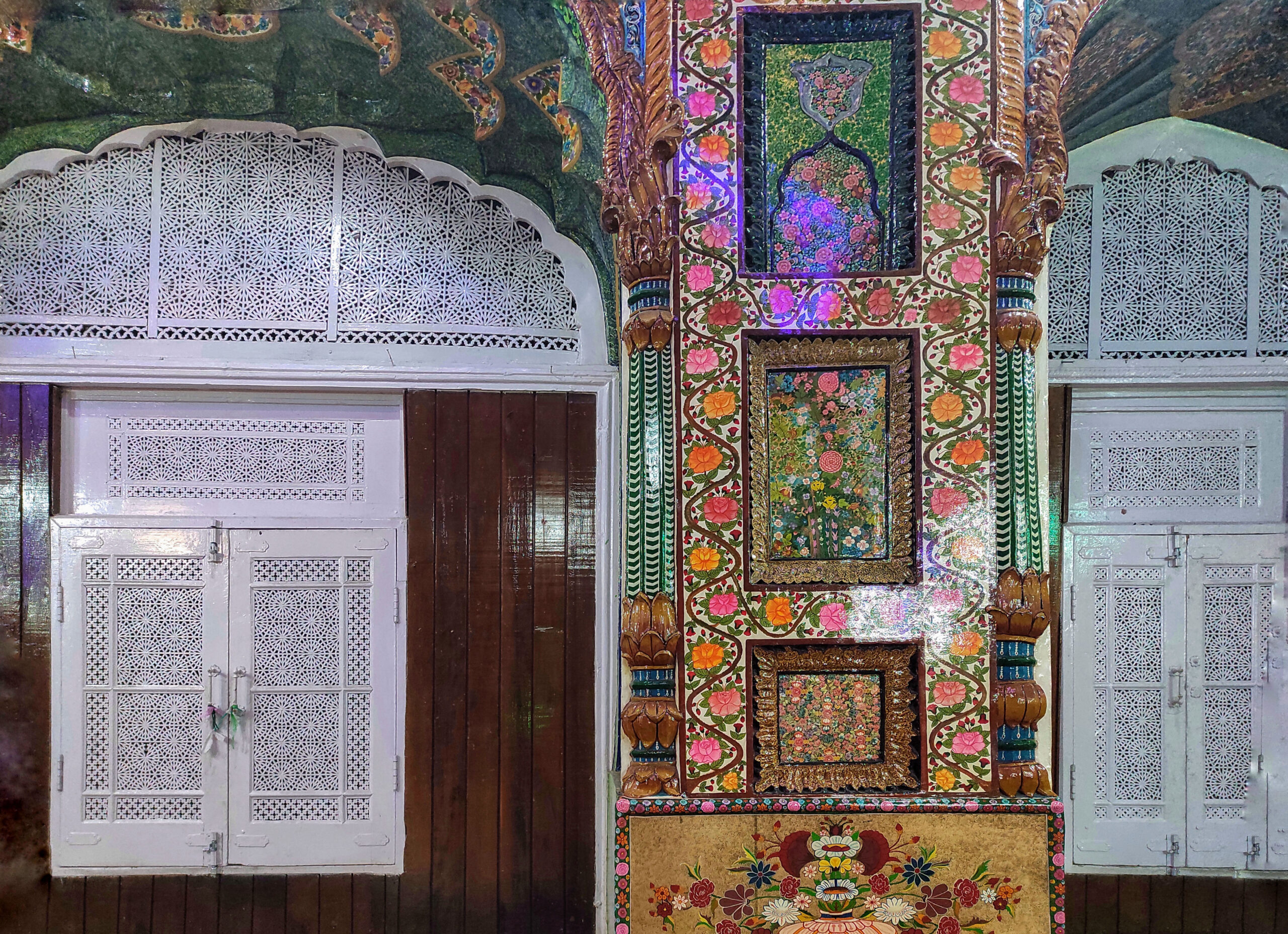
These parts are joined together without any adhesive; instead, the ends of abutting pieces are finely shaped to fit into each other using bridle joints or other variations of the mortise and tenon joint, depending on the region. The pieces are held together by the resultant tension within the frame, and the joints are usually not visible to the naked eye. The hardness of sheesham helps the wood hold tension better, making it particularly suited to this craft. A well-made pinjra panel can remain stable even when the frame is damaged. The Ain-i-Akbari describes two method of pinjra-making in use at the time — one that used only these types of non-adhesive joinery, and one in which additional cords were used to strengthen the panel; it suggests that the former was more valued. Today, artisans also use nails and glue.
References to specific designs are mostly found in colonial accounts. There are a multitude of names designating pinjra patterns, either on the basis of specific motifs, geometrical compositions, or the directionality of the symmetrical pattern. For example, the aath baarah (‘eight twelve’) is a design comprised of eight and twelve pieces of two elements respectively; the katar-i-dar (‘dagger of fear’), is a design shaped like a dagger; the girih sarr refers to a design that radiates from a central star; girih jharna refers to a flowing design (jharna, ‘stream’ or ‘waterfall’).
Use in architecture
As an architectural element, a pinjra panel may be variously used on facades, doors, partitions, or walls, where it serves to disperse light, create privacy, or ventilate a space. Sometimes the panel may be covered with translucent handmade paper to block cold air while still allowing light to pass through.
Residences in Punjab commonly utilise pinjra panels on doors or projecting balconies with bay windows (bokharcha), the latter possibly descended from the latticework moucharaby of North Africa and West Asia. As per colonial accounts, the design of the pinjra-carved door in Punjab varied; in the Islamic style, the door, the lintel surmounting it, and the jambs on either side all comprised elaborately carved panels. In the Sikh and Hindu styles, the pinjra panels were limited to the overdoor, with the door below it smaller. The bokharcha featured pinjra panels at the base of its bay windows. In interior design and furniture, pinjra work is often incorporated into the design of the takhtposh (bench), bedsteads, partition screens, or the chaunki (low wooden stool).
First published: 9 March 2026
Image Gallery
Bibliography
Aamir, Naela. “Pinjra Work in the Architecture of Punjab: A Historical Overview of the Material Evidence.” (2017). https://www.researchgate.net/publication/364722000_Pinjra_Work_in_the_Architecture_of_Punjab_A_Historical_Overview_of_the_Literary_and_Material_Evidence.
Kipling, J. L. “Punjab Wood Carving.” The Journal of Indian Art 1, no. 4 (1886).
“Moucharaby.” Encyclopedia Britannica. Accessed December 7, 2022. https://www.britannica.com/technology/moucharaby.
O’Dwyer, M. F. Monograph on Wood Manufactures in the Punjab. Lahore: Civil and Military Gazette Press, 1889.
Ranjan, Aditi, and M. P. Ranjan. Handmade in India: Crafts of India. New Delhi: Mapin Publishing, 2007.
Watt, George. Indian Art at Delhi 1903: Being the Official Catalogue of the Delhi Exhibition, 1902–1903. Calcutta: Superintendent of Government Printing in India, 1903.
Feedback