-
ChicagoImpart Encyclopedia of Art. "Kolhapuri Chappal." March 9, 2026. https://imp-art.org/articles/kolhapuri-chappal/.
-
MLA"Kolhapuri Chappal." Impart Encyclopedia of Art, Mar. 9, 2026, https://imp-art.org/articles/kolhapuri-chappal/.
-
HarvardImpart Encyclopedia of Art (2026) Kolhapuri Chappal. Available at: https://imp-art.org/articles/kolhapuri-chappal/ (Accessed: 16 October 2026).
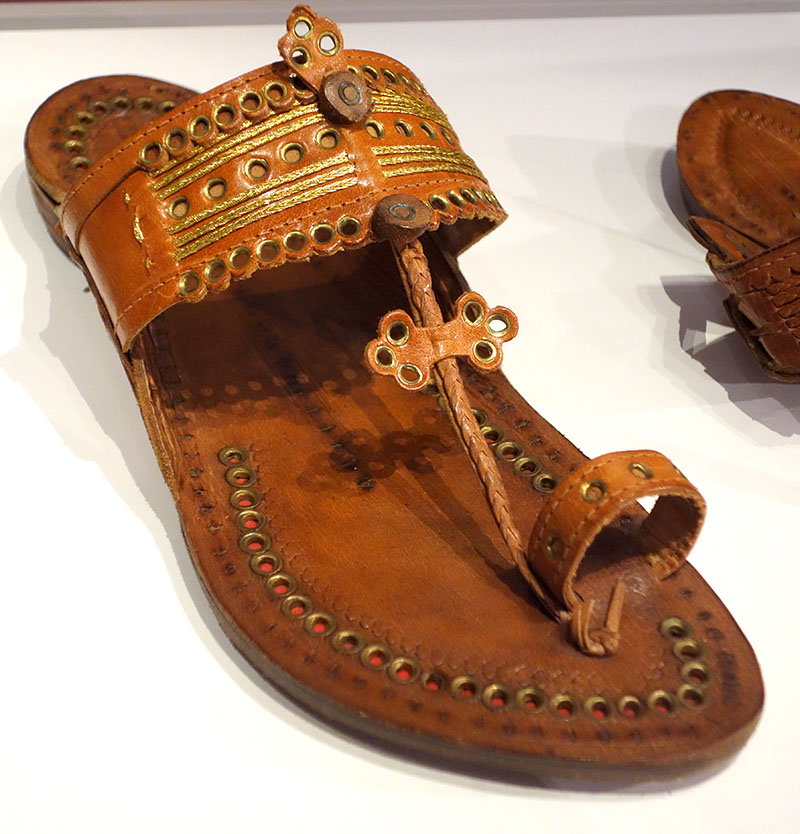
A flat leather sandal made by artisans of the Chamar community in southwestern India, the Kolhapuri chappal (‘sandal’) is named for Kolhapur in Maharashtra, where it has historically been made.
Design
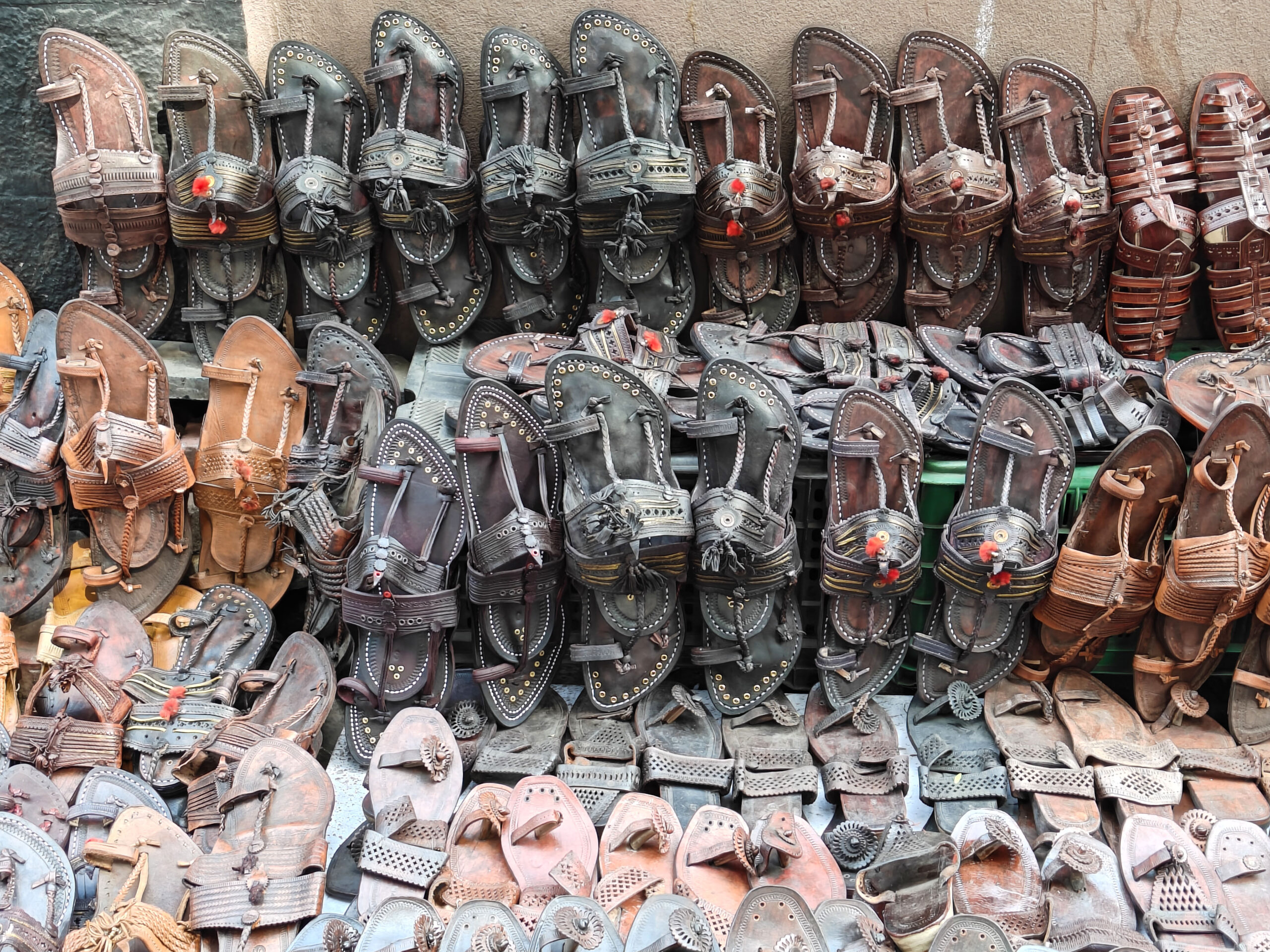
The Kolhapuri chappal typically features a thin, hard sole and a broad strap over the instep that is connected to a toe loop via a thin, braided strap — often with additional braids, trims, punched designs, and tinsel threads (zari). Today it is produced in parts of both Maharashtra and Karnataka with an expanding variety of designs and colours.
Historical background
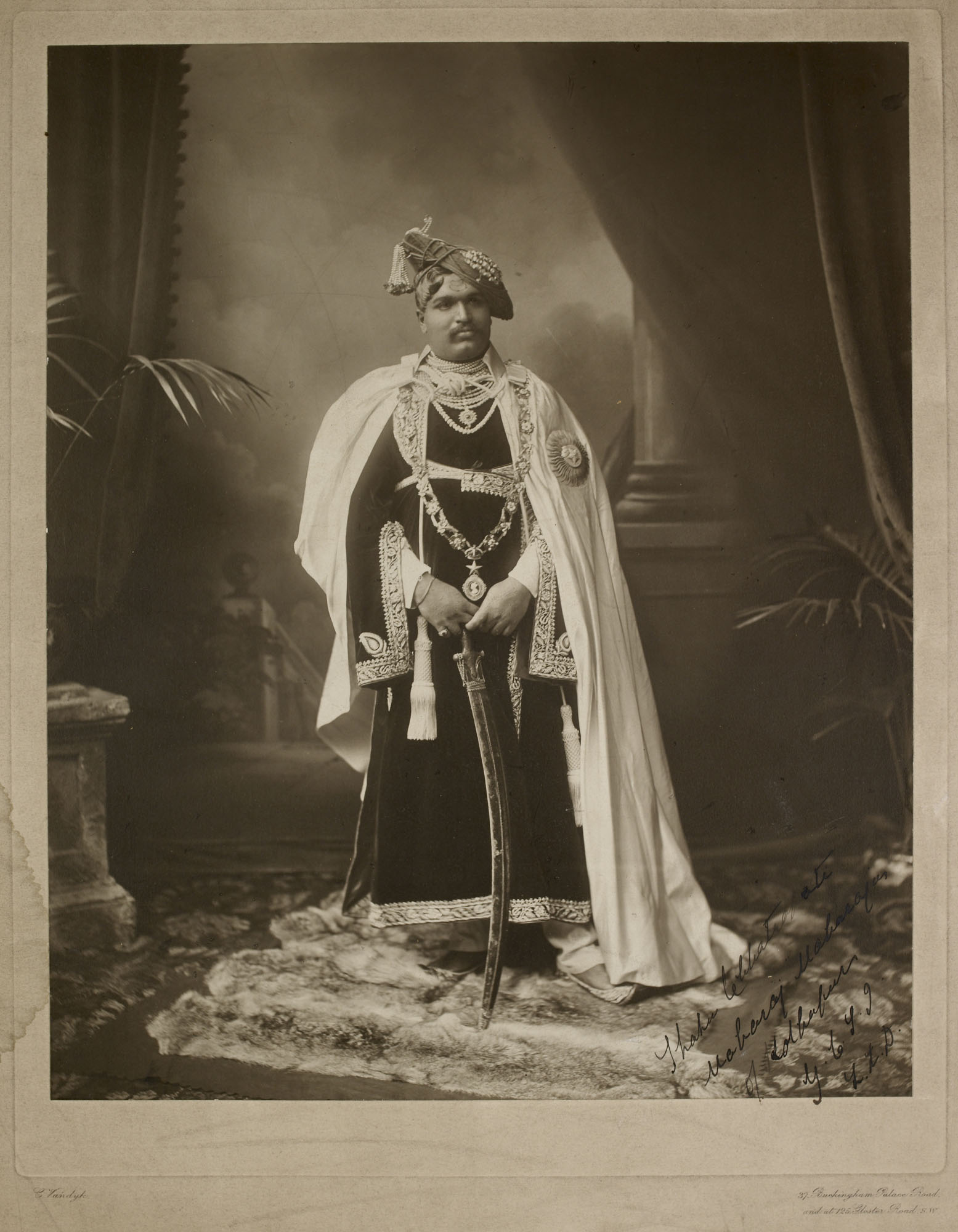
The historical origins of the Kolhapuri chappal are unclear. A leather industry developed in the erstwhile princely state of Kolhapur in the early twentieth century, during the reign of Chattrapati Shahu IV (r. 1894–1922) of the Bhonsle dynasty. Artisans credit Shahu with allocating land for tanneries in Kolhapur city and patronising the trade. This allowed them to preserve their technique of bag-tanning amid the expansion of the modern leather industry and the widespread adoption of European leatherworking methods.
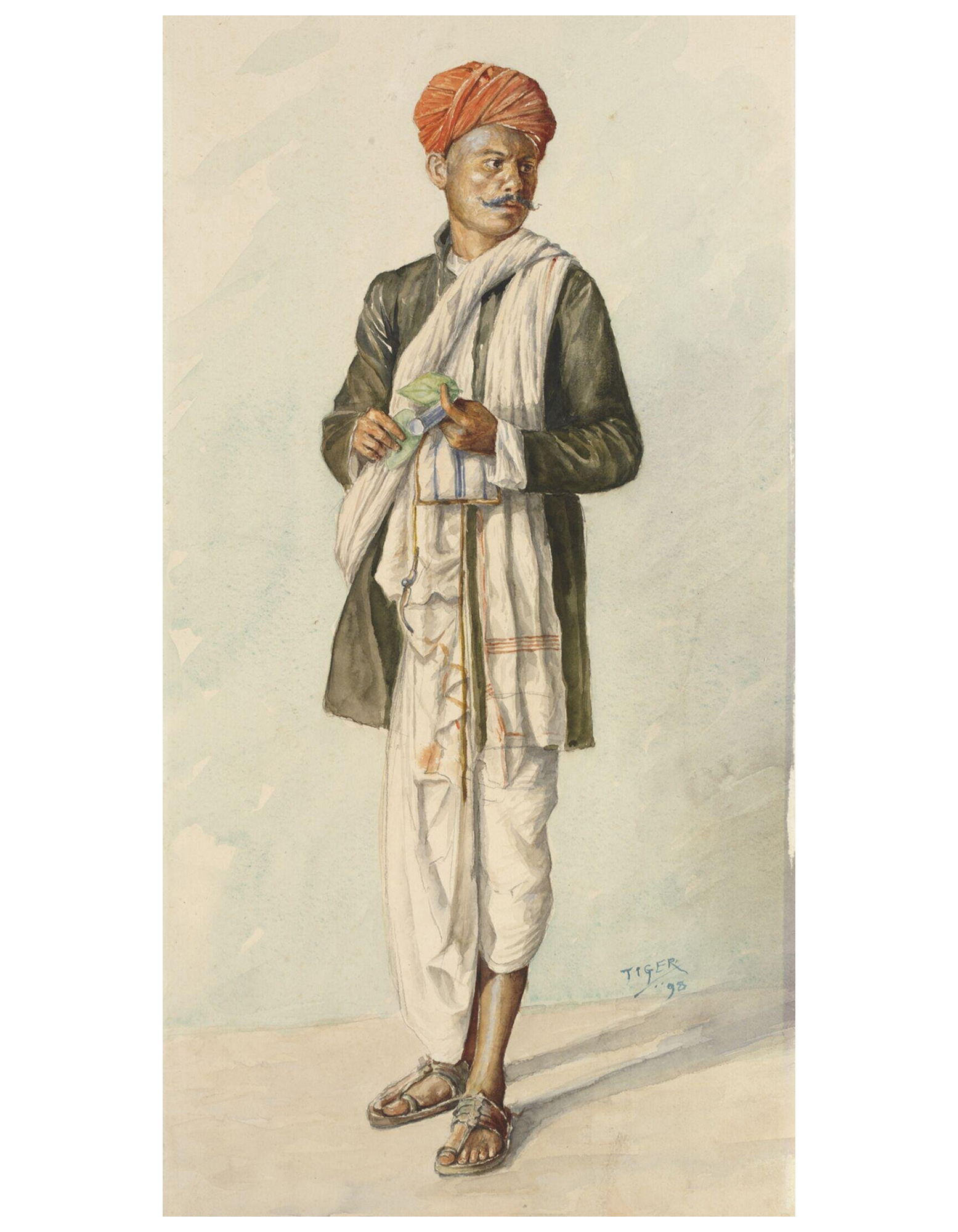
Scholarship attributes the superior quality of leather goods in the Pune-Satara region of Maharashtra to a specialised caste division of labour absent elsewhere: the Mahar community was responsible for skinning, the Dhor community for tanning, and the Chamar community for stitching footwear; whereas in other parts of the subcontinent, a single community would typically be responsible for all stages of the process. All three of these communities are Dalit. Mahars are restricted to Maharashtra; Dhors are a subgroup of the Chamar, who are diverse and live in many other states, including Uttar Pradesh, Punjab, Gujarat, and Karnataka. Although each community has engaged in a variety of occupations, they came to be closely identified with work involving leather and carrion in the latter half of the nineteenth century, and have historically been stigmatised for their contact with materials considered impure or polluting by Hindus.
Process
Buffalo hide is usually used for making the chappal. Once the raw hide is procured, the process takes place in two phases — first the hide is tanned, traditionally with the bag-tanning method, though now chemically tanned hides are also used; then the artisan buys the hide and crafts the sandal.
The raw hide is first washed and soaked for several days in a solution of salt and slaked lime (calcium hydroxide) to soften it. For bag-tanning, the hide is stitched into an open ‘bag’ using sisal fibres (Agave sisalana); this is filled with a solution of babul bark (Acacia arabica) and crushed myroloban nuts. The bag is suspended over a pit, with water and the solution poured repeatedly into the opening. Tanning occurs through the slow penetration of this mixture into the deeper layers of the hide. The bag is then turned inside out and the process repeated, taking as long as sixteen days. After the tanning, the hide is sun-dried on a bed of crushed myrobalan nuts and stored in a dry place. The remaining fat and hair on the hide can then be removed with a khurpa (scraping tool) and the hide is cut into smaller, workable sections.
Now ready to be worked by the artisan, the leather is first softened with water. It is cut into patterns for the outsole and insole, leaving small flaps on either side for the straps to be attached later. While still damp, the sole layers are hammered flat; then they are sun-dried and polished with a porcelain cup or grindstone. They are then stuck together with an adhesive and stitched with a leather thread, all around as well as across the middle of the sole. The insole may be embellished with punch-marked designs. It is then painted with two coats of water-based colour, the second coat mixed with shoe cream. Usually the sandal is dyed shades of tan, brown or maroon. The straps are cut from the belly portion of the hide, which is softer, or sometimes from goat hide. Designs are punched onto the straps, and embellishments such as zari, cloth tassels or leather braids stitched or glued onto them. The straps are attached to the sole at the end.
Today, nylon thread is often used for the stitching and latex used to stick the soles and straps together. The Kolhapuri chappal comes in various designs, generally distinguished by the shape of the sole, the patterns decorating the straps and sole, and the addition of tassels or leather braids. Among these are kapshi, where the sole is pointed and the strap sports elaborate embroidery, the closed-toe banthe, and others known as bakkalnali, pukri, and paytaan — names that may have come from villages that once specialised in them. Modern innovations on these styles include the use of new colours, as well as the use of fabric or lace to decorate the straps.
Contemporary challenges
The industry relies on the hereditary transmission of knowledge, and has shrunk dramatically in recent decades as members of these communities migrate to other work. Pollution control laws and restrictions on cattle slaughter have led to the closure of tanning units in Maharashtra since the 1990s. Artisans now have to procure hides from other states, mostly Tamil Nadu or Karnataka, where they are tanned chemically; this has pushed costs up and artisans in Kolhapur face stiff competition from North Karnataka towns like Belagavi, where bag-tanning is employed locally and costs are lower. The Kolhapuri chappal received a Geographical Indication tag in 2018.
First published: 9 March 2026
Image Gallery
Bibliography
Baral, Bibhudutta, Divyadarshan CS, Lija MG, Vijay G, and Smitha S. “Kolhapuri Chappal.” D’Source. Accessed December 30, 2022. https://www.dsource.in/resource/kolhapuri-chappal.
“GI Application Number 169.” Geographical Indications Journal no. 109 (August 09, 2018): 7–12. Accessed December 28, 2022. https://search.ipindia.gov.in/GIRPublic/Application/Details/169.
Mishra, Garima Rakesh. “A Town Goes into Hiding.” Indian Express, November 6, 2016. Accessed December 28, 2022. https://indianexpress.com/article/lifestyle/fashion/a-town-goes-into-hiding/.
Ranjan, Aditi, and MP Ranjan. Handmade in India: Crafts of India. New Delhi: Mapin, 2007.
Rawat, Ramnarayan S. Reconsidering Untouchability: Chamars and Dalit History in North India. Bloomington: Indiana University Press, 2011.
Roy, Tirthankar. “Foreign Trade and the Artisans in Colonial India: A Study of Leather.” Indian Economic & Social History Review 31, no. 4 (1994): 461–90.
Sriram, Jayant. “The Last Original Kolhapuris.” Hindu, July 08, 2017. Accessed December 28, 2022. https://www.thehindu.com/society/the-last-original-kolhapuris/article19231770.ece.
Welankar, Parth, and Pratham Gokhale. “Iconic Kolhapuri Chappals in a Fight for Survival.” Hindustan Times, April 27, 2019. Accessed December 28, 2022. https://www.hindustantimes.com/mumbai-news/iconic-kolhapuri-chappals-in-a-fight-for-survival/story-OBvTgxmegJ0X0qobb1NQLL.html.
Feedback