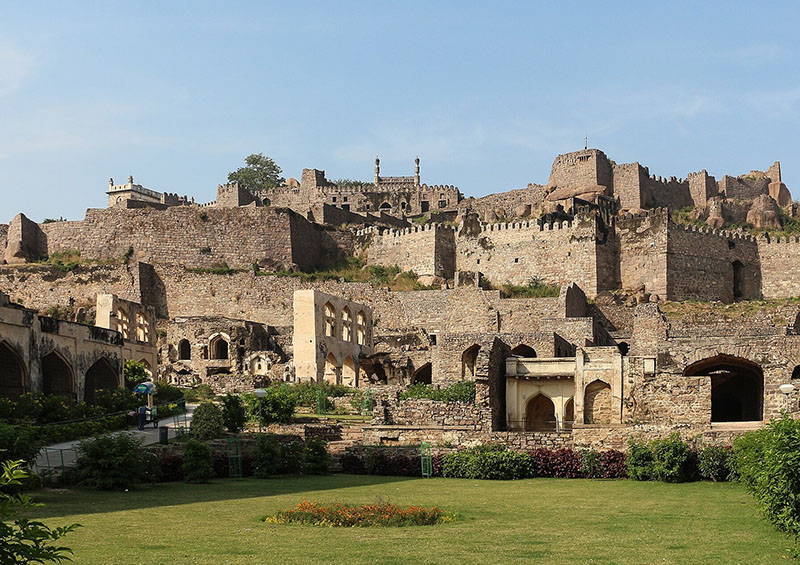
Muslim kingdom of the Deccan in India, founded in 1518 by Khawas Khan Hamadani, a Baharlu Turk who governed the region of Telangana under the Bahmani Sultanate (1347–1518), and ascended the throne as Sultan Quli Qutb-ul-Mulk. One of the five successor kingdoms of the Bahmani Sultanate, it spanned present-day Telangana and parts of Andhra Pradesh, with its capital in Golconda and later in the city of Hyderabad, built in 1591. Under the Qutb Shahi dynasty, who were Shia Muslims, the Golconda Sultanate flourished as a diverse centre for art, culture and commerce, resisting attacks from neighbouring sultanates, and later allying with Bidar, Bijapur and Ahmadnagar in overthrowing the Vijayanagara kingdom in the battle of Talikota (1565). Mughal pressure on the sultanate increased steadily from the early seventeenth century onwards, and the kingdom was annexed through treason by Aurangzeb in 1687.
More Definitions
Pulakesin I
Pulakesin I (r. 544–567 CE) was a king of the Badami Chalukya dynasty and is considered to be the dynasty’s…
Deva Raya II
Deva Raya II (b. n.d.; d. 1446) was a ruler of the Sangama dynasty, which founded and governed the Vijayanagara…
Afghan War (1978–1992)
After the emergence of an unstable communist government in Afghanistan in 1978, which soon faced coups and insurgency from various…
Abu’l-Fazl ibn Mubarak
An official in Akbar's court, Abu'l Fazl (b. 1551; d. 1602) was a close confidante of the emperor and wrote…
Indian National Congress
Political party formed in 1885 by British civil servants and elite Indian reformers to represent Indian interests to the colonial…
Tushaspha
A governor at Girnar in Junagarh, Gujarat, under the Mauryan emperor Ashoka. He is believed to have been of Greek…
Pala Dynasty
A dynasty that ruled over Bengal and Bihar from the eighth to the twelfth century CE, it was established by…
Vijayanagara Kingdom
Established in 1336, it was one of the dominant kingdoms of southern India in the late medieval and pre-modern periods,…