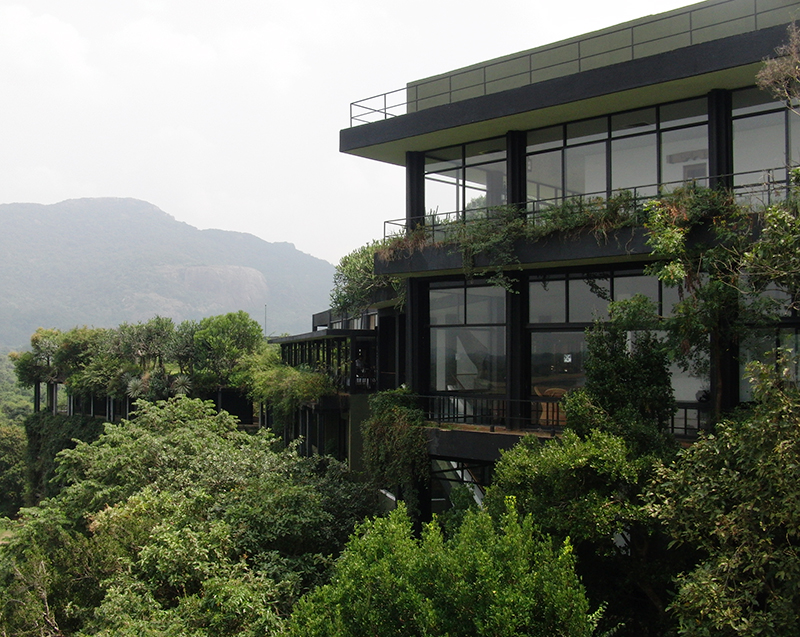
Architectural philosophy emphasising site-specific design that draws on local topography and climate, social and cultural influences, and traditional building knowledge to reconcile the universalising tendencies of Modernist architecture with the regional context. First coined by architects Alex Tzonis and Liane Lefaivre in 1981, the term gained popularity with architectural historian Kenneth Frampton’s seminal essay ‘Towards a Critical Regionalism’ (1983) as an alternative to Postmodernism. Frampton cited the Säynätsalo Town Hall (1949) by Alvar Aalto among early Critical Regionalist attempts, with its use of brick and wood and a Modernist reinterpretation of the traditional medieval European court-and-tower plan. Geoffrey Bawa’s Kandalama Hotel (1991), integrating the site’s topography and vegetation, similarly embodies key principles of the approach. Although less acknowledged in mainstream discourse, Critical Regionalism was preceded by architect Anthony Alofsin’s concept of Constructive Regionalism, which, unlike Frampton’s, positioned the architect as a collaborator with the community rather than the ‘expert’ interpreter of the local context.
Critical Regionalism
Link copied!