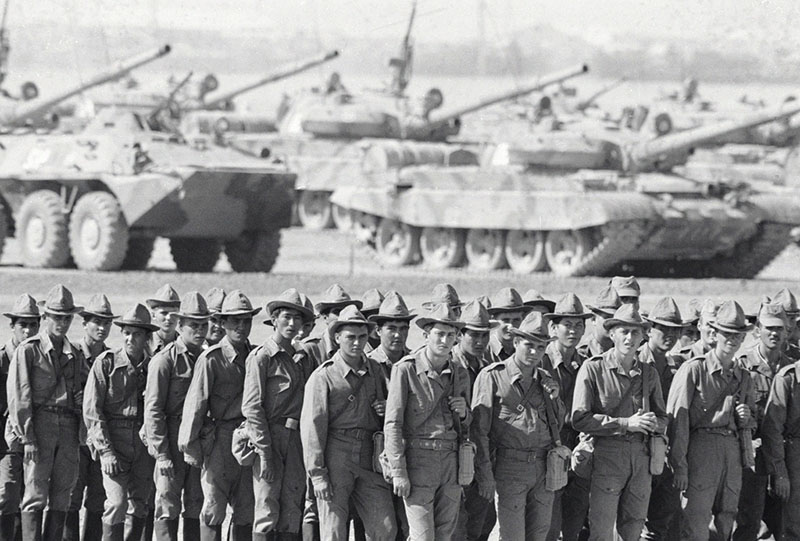
After the emergence of an unstable communist government in Afghanistan in 1978, which soon faced coups and insurgency from various local Islamic groups, the neighbouring Soviet Union invaded Afghanistan on December 24, 1979, with the intention of protecting communist influence and interests. The Soviets also aimed to preempt American intervention in the fragile political situation of the country, and installed a loyalist of theirs as the Afghan president. The Afghan War over the next decade saw continued internal conflict between the Soviet-backed Afghan government and US-supported Islamic guerrilla fighters (mujahideen); over 4 million Afghans fled to Pakistan and Iran. The Taliban emerged in the wake of Soviet withdrawal in the early 1990s. The war also eventually contributed to the collapse of the Soviet Union.
More Definitions
Devanampriya Priyadarshi
A title used by the emperor Ashoka to refer to himself, it derives from the Pali Devanampiya Piyadassi, meaning "He…
Tributary State
A form of pre-modern state which had a subordinate relationship to a superior state and maintained its sovereignty by making…
Mangalesha
Mangalesha (r. 598–610 CE) was a king of the Badami Chalukya dynasty, which ruled over parts of present-day Karnataka and…
Ngawang Namgyal
Ngawang Namgyal (b. 1594; d. 1651), also known by the title Zhabdrung (‘at whose feet one submits’), was a high-ranking…
Nizam Shah
Nizam Shah was a ruler of the Ahmednagar Sultanate from 1553 until his death in 1565. He led the coalition…
Murshid Quli Khan
Murshid Quli Khan (b. c.1660; d.1727) was the first Nawab of Bengal. He is known for introducing the mal zamini…
Shah Jahan
Shah Jahan (b. 1592; d. 1666) was the fifth Mughal emperor of India, reigning from 1628 to 1658. He was…
Muhammad bin Tughlaq
Muhammad bin Tughlaq (r. 1325–51) was the second sultan of the Tughlaq dynasty (r. 1320–1413), under whom the Delhi Sultanate…