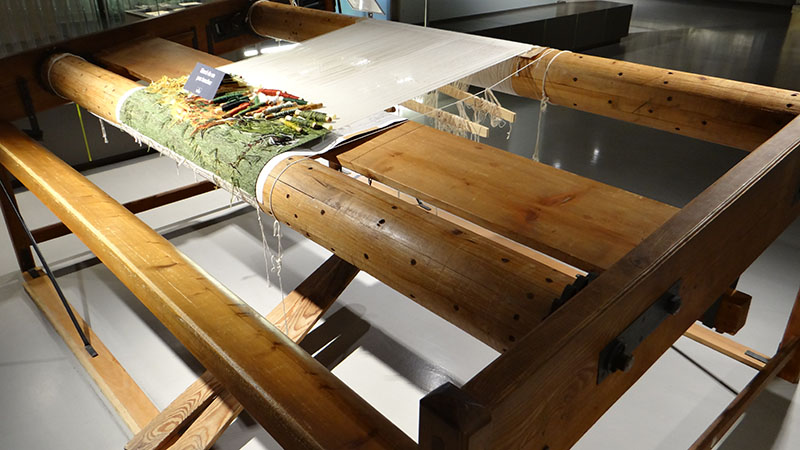
Handloom commonly used for traditional tapestry and carpet weaving, in which the warp threads are stretched parallel or nearly parallel to the ground between two rollers that help control the tension. The shed or gap for the weft threads to pass through is opened using treadles, leaving the weaver’s hands free and making the weaving process faster than with the hand-operated mechanism of the upright high-warp loom. The weaver works weft patterns into the back of the warp using a reference image placed underneath, typically viewed by tilting the frame or using a mirror.
More Definitions
darkroom
Light-sealed room used for chemically processing photographic film and making prints. While developing film requires complete darkness, prints are made…
Large Format Camera
Film cameras that produce images that are 9 cm x 12 cm or larger.
Brownie Camera
Also known as the Kodak brownie, it is a series of box cameras with a meniscus lens and roll film,…
stop bath
An acidic solution that is used to stop the development of photographic film once it is sufficiently developed. It acts…
fixer
In photography, a chemical solution used in the final stage of processing photographic film. It contains sodium or ammonium thiosulphate,…
Gadh
Also spelt gad, it is a type of block used in textile block-printing. The image in the block is carved…
High-Warp Loom
Upright handloom traditionally used for tapestry and carpet weaving, in which the warp threads are stretched vertically between roller-beams at…
Roller-Beam Loom
A vertical loom predominantly used to weave carpets in India, Iran and Turkey. The loom consists of two moveable beams…