-
ChicagoBacker, Thasil Suhara. "A Subversive Iconography of Apasmara the Dwarf." Impart Perspectives, August 4, 2026. https://imp-art.org/perspectives/features/a-subversive-iconography-of-apasmara-the-dwarf/
-
MLABacker, Thasil Suhara. "A Subversive Iconography of Apasmara the Dwarf." Impart Perspectives, Aug. 4, 2026, https://imp-art.org/perspectives/features/a-subversive-iconography-of-apasmara-the-dwarf/. Accessed 13 Oct 2026.
-
HarvardBacker, T.S. (2026) A Subversive Iconography of Apasmara the Dwarf, Impart Perspectives. Available at: https://imp-art.org/perspectives/features/a-subversive-iconography-of-apasmara-the-dwarf/ (Accessed: 13 October 2026).
A Subversive Iconography of Apasmara the Dwarf
Bodies that depart from the ideal tend to occupy marginal spaces in both classical Indian art and in society. But how does the dwarf Apasmara from the canonical Nataraja form disrupt that paradigm?
By Thasil Suhara Backer
Link copied!
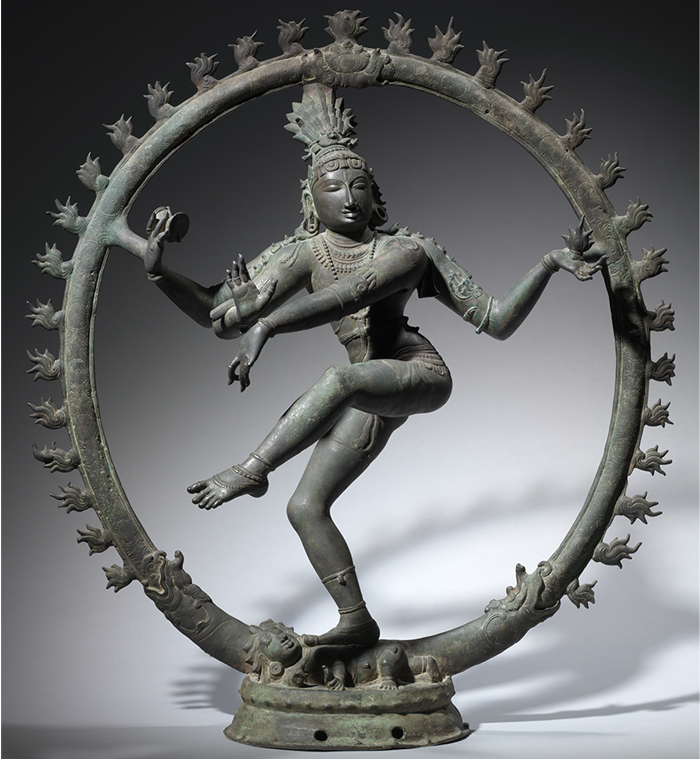
Nataraja (Shiva as the Lord of Dance) and Apasmara the dwarf; South India, Tamil Nadu; Chola period (900-1200s); Bronze. Courtesy The Cleveland Museum of Art
Among the most enduring visual formulations of the aesthetic ‘body ideal’ in South Asian art is Shiva as Nataraja (Lord of Dance). The dancing Shiva appeared in sculptural forms as early as the fifth century. It evolved into its present, recognisable form under the rule of the Cholas by the late tenth century. In Indian classical thought, Shiva’s primordial dance (Ananda Tandava) is celebrated as the rhythmic balance of the universe. As Vidya Dehejia reveals in The Body Adorned (2009), the Vedic hymn Purusha Sukta imagines the universe itself emerging from the anthropomorphic manifestation of the Divine Consciousness, the supreme Purusha. In doing so, this Rig Veda verse constitutes the perfected human form as the locus of aesthetic harmony, cosmic potency, and Divine power. The Chola bronzes of Nataraja give this ideal its most refined sculptural expression, and this same aesthetic standard of corporeal beauty and cosmic order permeates Indian poetry and performance practices.
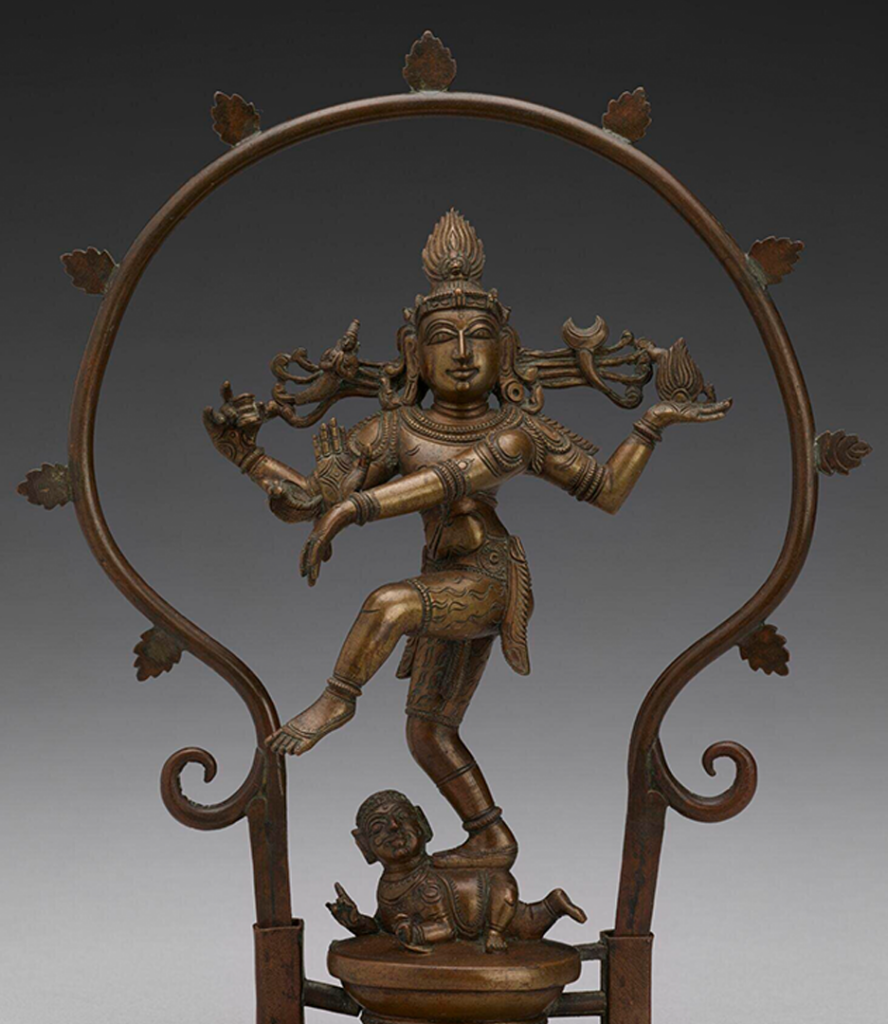
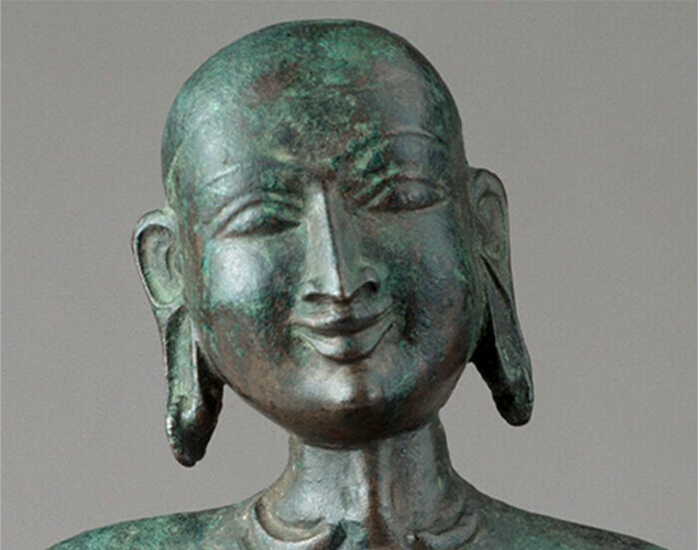
However, a signature element of the sacred iconography is also the dwarf figure of Apasmara being trampled under the deity’s right foot. His diminutive, prone form highlights the agility and athleticism of the able-bodied god balanced on one leg. Within dominant cultural and theological representations — including classical Indian art — the small or ‘imperfect’ body is often framed as symbolic of lack or loss, according to Dehejia. Therefore, in established interpretations of Chola bronzes, Apasmara, derived from apa (loss, or removal) combined with smāra (memory, or awareness) in Sanskrit, is the embodiment of ignorance. Yet, he appears with an uncanny calmness while holding a snake, sometimes even with a faint, knowing smile. He performs gestures, such as Tripataka Hasta Mudra or Katakamukha Hasta Mudra, suggesting not a body emptied of agency but one that is participating in the performative grammar of the image. To understand why Apasmara evades his categorisation as a ‘demon-dwarf’ subjugated by Shiva, we have to turn to sculptural and textual references older than the Chola bronzes.
Shifting Iconography
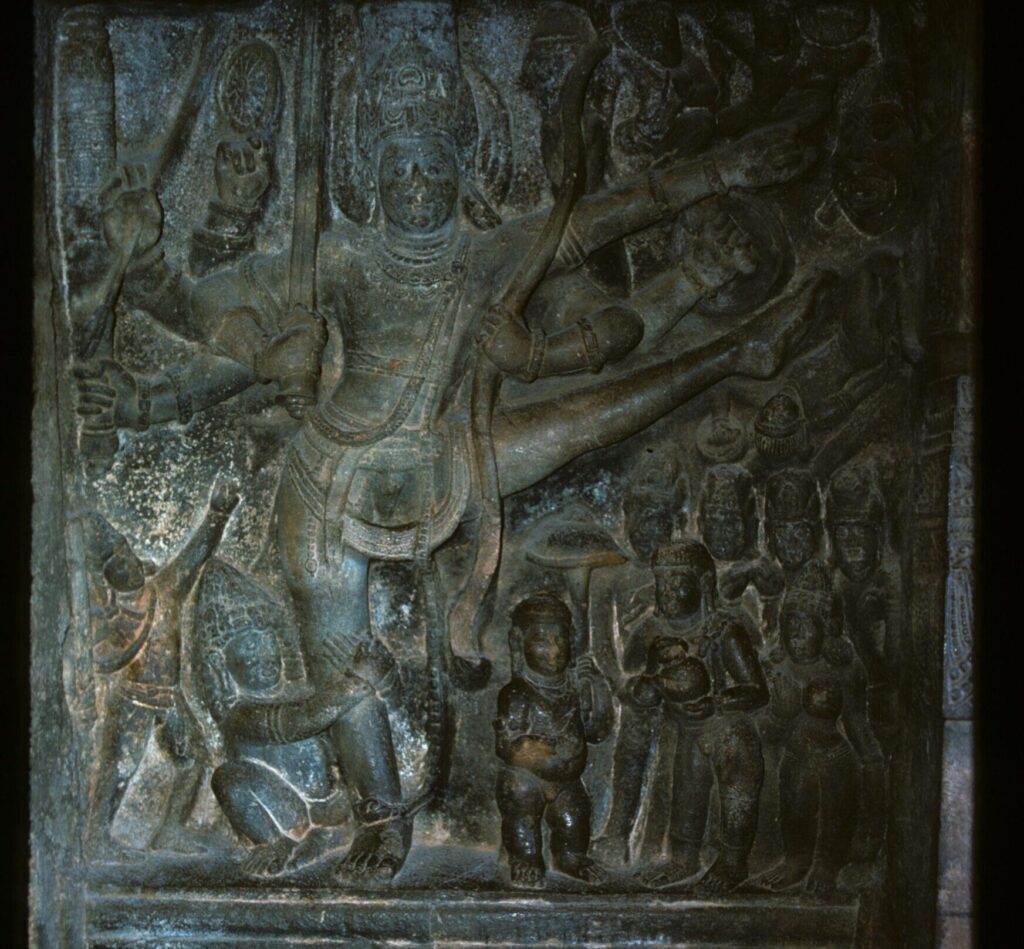
Padma Kaimal notes in her essay Shiva Nataraja: Shifting Meanings of an Icon (1999) that in the earliest surviving images of Shiva dancing (from the early sixth century to the early tenth century), many signature elements of the sacred iconography we are used to, such as the drum, the lifted leg crossed across the body, the flame — and the figure of the dwarf underfoot — are often missing. Instead, the deity appears in a variety of dancing poses, sometimes holding objects in four (or more) hands, and very often standing on a supporting pedestal or platform.
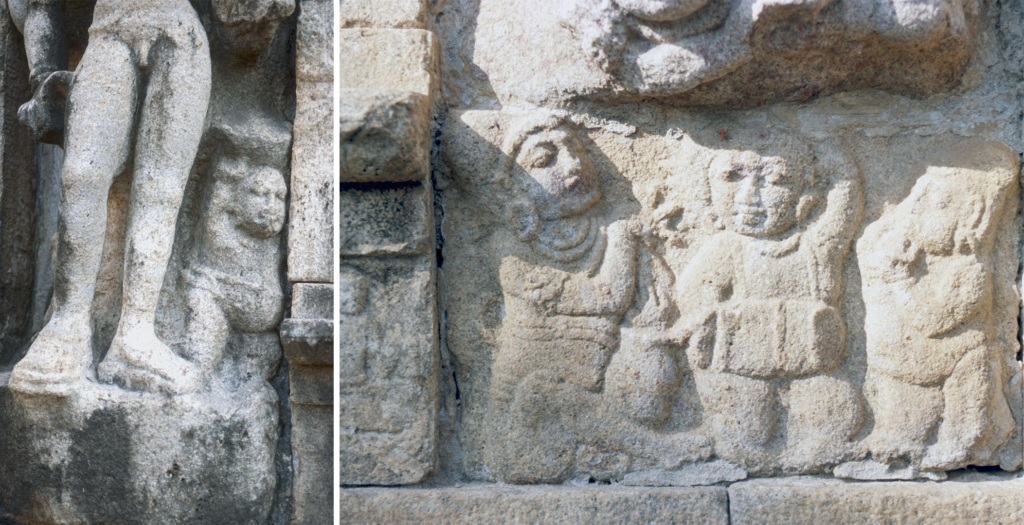
Kaimal also notes that using the dwarf motif in Shiva iconography was a well-established practice in itself, and came with its own visual tradition in the Tamil region, even before 900 CE. Plump, dwarf ganas, Shiva’s attendants, were often featured beside the deity, “crouching helpfully” in supportive stances. This type of dwarf motif provided an unmissable visual play of contrasts: short, rotund ganas helpfully propping up the perfectly proportioned Shiva, who assumed a vertical, elegant pose. In other representations, the dwarf is seen assisting the deity — for instance, carrying the begging bowl alongside ‘Bhikshatana’ Shiva or as a musician accompanying the dancing Shiva. In such manifestations, dwarf figures did not occupy an antagonistic or subjugated role — rather they sustained or supported Shiva’s actions as an indispensable ally, comparable to Shiva’s mount, the Nandi bull.
Literary traditions, likewise, preserve the agency of Shiva’s dwarf attendants. For instance, in Tirumantiram, an early-medieval Tamil Shaiva devotional and philosophical text, the dwarf is described as a fearsome eight-armed being. Kaimal rallies such textual and sculptural evidence to suggest that the dwarf’s identity in Shiva iconography was fluid before later theological traditions recast him in the role of the trampled Apasmara, the embodiment of ignorance.
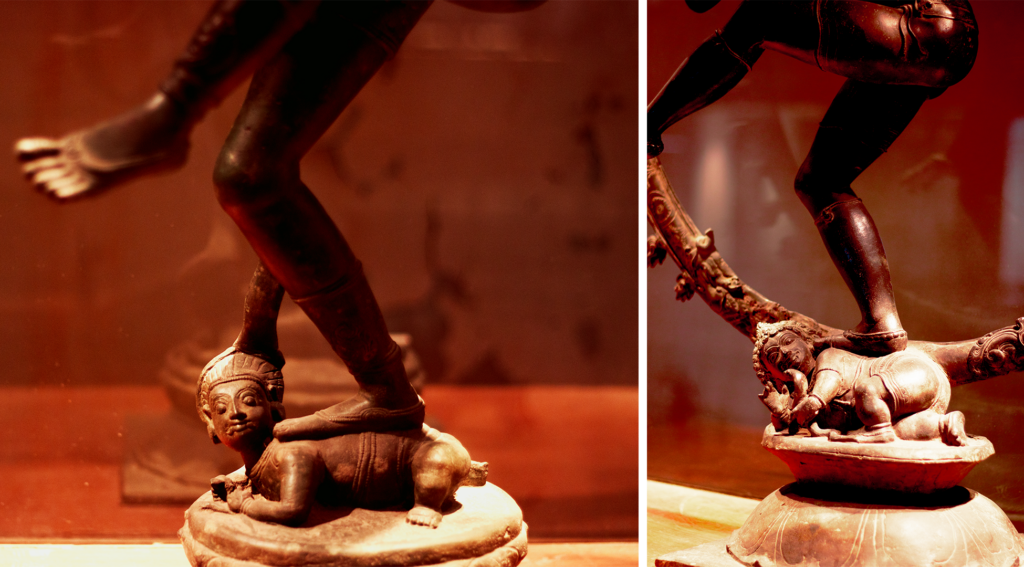
The emergence of the canonical Nataraja image marked both a stylistic and dynastic development. Kaimal notes that under the later Cholas, the compelling visual grammar of the dancing, vertical Shiva atop the horizontal, still dwarf consolidated different elements of existing Shiva iconography. The final form aligned with their aspirations for conquest and imperial supremacy. We see this in the Chidambara Mahatmya, a sacred text compiled and written around the 12th century, detailing the legends and spiritual significance of the famous Nataraja Temple in Chidambaram. In it, the dancing deity confronts a group of arrogant sages (rishis). When they send the dwarf of ignorance, Apasmara, against him, Shiva breaks the dwarf’s back with his dance and uses him as a pedestal. Under Chola patronage, the dramaturgical fluidity of the dwarf figure was reduced to serve as the state’s emblem of victory over rivals. Shiva’s dance was recast as a celebration of both cosmic and dynastic triumph, inscribing royal sovereignty within a sacred cosmological imaginary. The Nataraja form would become an important tool of royal image-building and eventually reshape the geographical connotation of the temple town of Chidambaram itself. It became known as the metaphysical centre of the universe, and the unique site of Shiva’s Ananda Tandava.
As Nataraja became intrinsically linked to the royal family, Shiva’s triumph over the forces of disorder and chaos became the most prominent, ‘divine’ metaphor for the reign of the Cholas. Inseparable from the political imagination of the Chola dynasty, the perfectly poised Nataraja and the trampled Apasmara under his foot also naturalised the social hierarchy between the rulers (temple patrons) and the ruled (ordinary devotees). However, despite the theological narrative of demonic ignorance, Chola sculptors fashioned Apasmara with remarkable care and vitality. Rather than a grotesque body, we find a figure affectively charged with the performative vocabularies of Natyashastra and the Rasa theory. There is a striking, subtle inflection of the shringara bhava in Apasmara, which quietly unsettles the binary opposition and absolute conquest of the iconographic script.
A Counter-iconographic Reading
Rosemarie Garland-Thomson’s concept of the normate brings the counter-iconographic possibilities of the Nataraja image into sharper focus. In Extraordinary Bodies (1997), Garland-Thomson illustrates how non-normative bodies in circuses, particularly short-statured people playing clowns, were simultaneously marginalised and commodified, transforming bodily difference into a spectacle that both destabilised and reinforced dominant social values. From this analysis, she develops the concept of the “normate”, identifying the idealised body against which all others are measured.
Even in Indian sculptural traditions, bodies that depart from the ideal occupy marginal or subordinate positions, while the well-formed human body has always occupied a privileged aesthetic position. Dehejia argues that bodily proportion and harmony function as the principal vehicle through which divine, royal, and aesthetic perfections are conceived in Indian classical arts. Sanskrit poets repeatedly invoke beauty in the context of the body through metaphors, such as “a drink for the eyes” (netrika-peya), “a festival for the eyes” (netrotsava), or that which “steals the heart” (hridaya-chaura). The ideal body is a visual condition through which social, political, and metaphysical hierarchies assume corporeal form.
Physical variations cease to be ‘just’ anatomical and become embedded within a cultural system that assigns bodies unequal social value. Dehejia’s account of classical Indian aesthetics shows that what is deemed ‘normal’ in our society is historically and culturally constructed. Far from remaining confined to the Sanskritised sanctum or ‘classical’ oeuvre, this representational paradigm continues to organise the everyday social hierarchy of bodies, even in the present.
An example is the case of Dr Ganesh Baraiya, who was born short-statured. His body made him a spectacle in his village and an easy target for jokes. A circus troupe even made an offer to his family to purchase him so he could be trained as a clown. There happens to be a long history in the Indian subcontinent of treating dwarfs as entertainers, reflected in popular representations — from Shiva ganas in temple reliefs to the dwarf Vidushaka, the palace jester, in the Natyashastra.
Later, when Baraiya cleared the National Eligibility cum Entrance Test (NEET), he was still denied entry into medical practice because institutional gatekeepers, reflecting the bias baked into the system, deemed his body incompatible with the profession. Only after a prolonged legal struggle did he secure recognition as a medical officer. His dwarfism did not make him incapable — rather institutional and social structures faithfully reproduced the social script about non-normative bodies being incapable of ‘serious’ work. Baraiya’s social value was ascertained against the normate — the idealised, ‘able’ body.
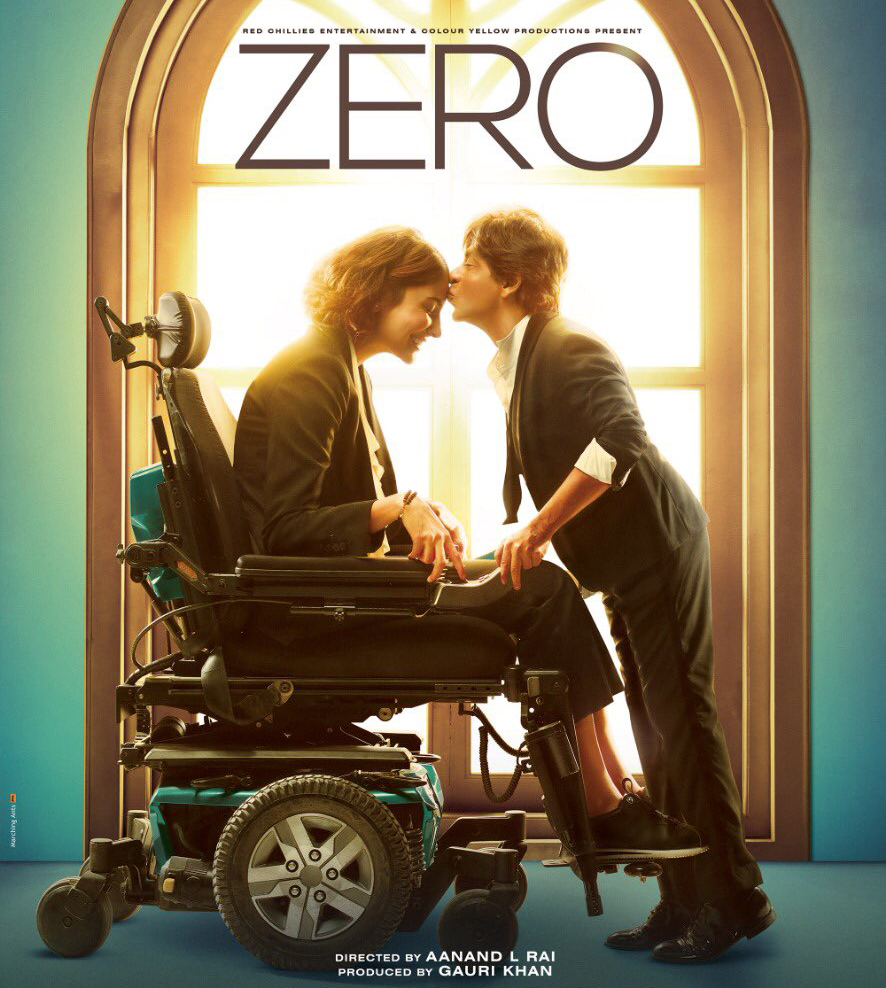
Similarly, in the contemporary performance context, we find dwarf actors in popular Hindi and regional cinema relegated to providing background comic relief, their physical form acting as the punch line in most instances. However, in serious representations of bodies that don’t fit the norm, such as the 2005 film Black or the 2018 film Zero — we repeatedly see ‘ideal’ actors enacting bodily differences as performance, rather than as lived experience. Contemporary disability and theatre studies point out that such representations, which do not emerge from embodied experiences, transform the disabled body into an object of narrative while withholding authority from those who inhabit it.
What has changed across history, from the times of the Cholas to now, are the mechanisms and institutions through which social hierarchies are enforced between ‘normal’ and ‘different’ bodies. Whether through theological designation, professional gatekeeping, or representational substitution, the non-normative body is rarely permitted to exist on its own terms and is continually made to conform to moral, aesthetic, or societal standards. Institutions with very different historical and cultural trajectories, such as the medical board or film companies, seem to reproduce these analogous hierarchies.
Jasbir Puar’s concept of debility, developed in The Right to Maim, offers a framework for understanding how bodily difference is governed through exclusion and also through the continuous ‘grading’ against what is ideal. Power, in Puar’s account, does not simply reject non-normative bodies; it distributes recognition, mobility, labour, and value unevenly, maintaining bodies in graduated relations within a hegemonic social hierarchy. In this way, the non-normative body is continually in competition with other, ‘less ideal’ bodies, chasing ‘mainstreaming’ as the goal. However, ‘different’ bodies are rarely in a position to challenge or disrupt the dominant paradigm that privileges ‘normal’ bodies.
We see this in the interpretations of Apasmara, which have largely followed two trajectories. Classical philosophical interpretations, such as Ananda Coomaraswamy’s The Dance of Shiva and Dehejia’s The Body Adorned, work largely within the theological identification of the dwarf as the embodiment of loss, of lack, of ignorance. This leaves its iconographic position largely uninterrogated. Alternate readings, such as the ones Kaimal puts forward, demonstrates the historical and colloquial instability of the dwarf figure’s iconography that shifts between supportive and adversarial depictions. But this does not, by itself, unsettle the iconographic hierarchy. Whether cast as a defeated demon or a loyal attendant, Apasmara continues to occupy the subordinate position through which Shiva’s ideal body is composed. Overlaying Apasmara with a multitude of identities only diminishes its subjective relevance, neutralises its sculptural ambiguity, and reinforces the myths induced by class-caste divisions, and sustains Brahmanical narratives of violence and control.
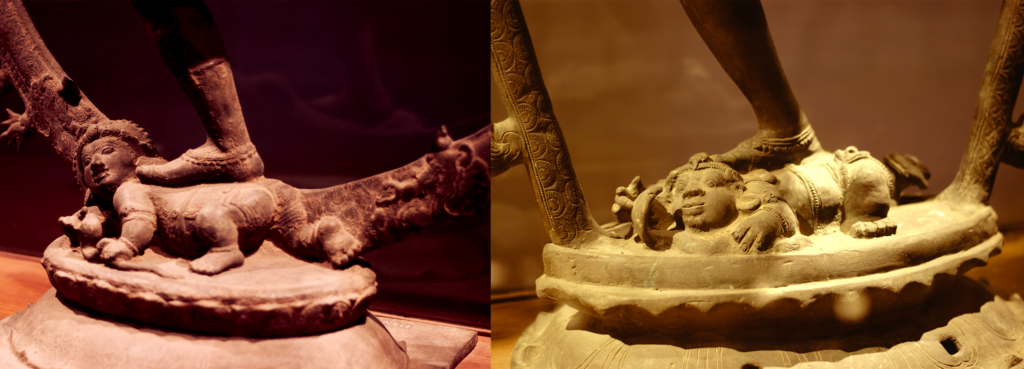
The question then is not who Apasmara is or was, but what meaning does the Apasmara figuration convey to us? This calls for a counter-iconographic reading that harnesses radically different imaginaries to contend with the normate.
In Scenes of Subjection (1997), Saidiya Hartman coined the term “genealogy of refusal” to refer to the “inventory of everyday practices, fugitive acts, and subtle resistances through which enslaved and marginalised people reject total domination.” Beneath the surface of imposed submission lies an interior life — a quiet persistence of selfhood that evades total capture. The subjugated may turn themselves into an entertaining spectacle for survival or practice passivity and indifference. They oppose an oppressive order through “subtle resistances” in their “ways of doing.” This secular reading can be applied to the Nataraja form to release it from its theological history.
However, it is only the extraordinary imaginative intelligence of the sculptors commissioned to make Nataraja bronzes that make such an interpretation even possible. They were able to render Apasmara with such tenderness that it unsettles the didactic binary of knowledge triumphing over darkness within the canonical form. Thus, a viewer can interpret the dwarf’s slight smile as quiet rebellion, a subtle mockery of the very order that claims to subdue him; seemingly joyous-romantic even while subjugated. His serene presence can be read as ironic endurance — a gesture of disidentification that haunts the very metaphysical order that seeks to erase him.
The unresolved residual ambiguity of the Apasmara figure allows the canonical Nataraja form to exceed the historical conditions of its making and continue to speak across different moments, bodies, and against dominant social hierarchies.
First published: August 4, 2026