-
ChicagoSaikia, Deeplakshmi. "The Word at the Centre: How an Assamese Painting Reimagines Krishna’s Rasa Lila." Impart Perspectives, August 28, 2026. https://imp-art.org/perspectives/dispatches/the-word-at-the-centre-how-an-assamese-painting-reimagines-krishnas-rasa-lila/
-
MLASaikia, Deeplakshmi. "The Word at the Centre: How an Assamese Painting Reimagines Krishna’s Rasa Lila." Impart Perspectives, Aug. 28, 2026, https://imp-art.org/perspectives/dispatches/the-word-at-the-centre-how-an-assamese-painting-reimagines-krishnas-rasa-lila/. Accessed 15 Oct 2026.
-
HarvardSaikia, D. (2026) The Word at the Centre: How an Assamese Painting Reimagines Krishna’s Rasa Lila, Impart Perspectives. Available at: https://imp-art.org/perspectives/dispatches/the-word-at-the-centre-how-an-assamese-painting-reimagines-krishnas-rasa-lila/ (Accessed: 15 October 2026).
The Word at the Centre: How an Assamese Painting Reimagines Krishna’s Rasa Lila
A mid-seventeenth century Assamese manuscript painting, which depicts Krishna's divine 'rasa lila', has sacred words narrating the cowherd god's actions as its central element that redirects the focus of the viewer's devotion.
By Deeplakshmi Saikia
Link copied!
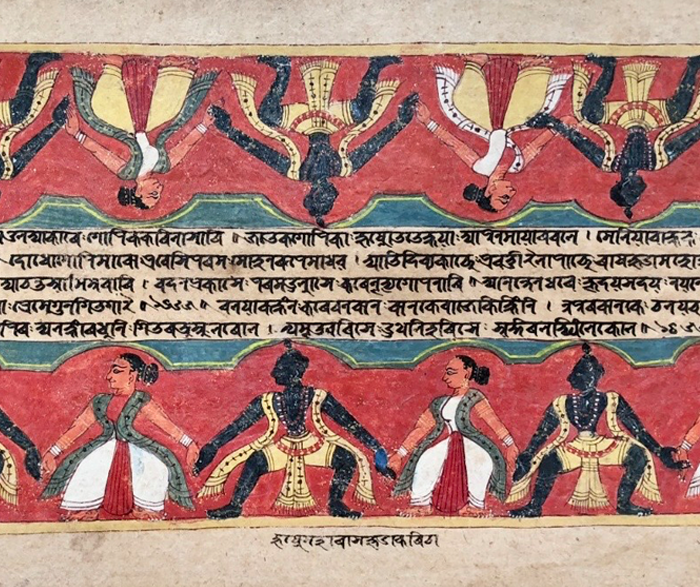
Assamese Bhagavata Purana (tenth canto) manuscript painting of the rasa lila (detail); mid-seventeenth century. Courtesy Bali satra, Nagaon
The dance of Krishna with the gopis of Vraja on the full moon night of Karttika, the eighth month of the Hindu lunar calendar, is the Bhagavata Purana’s most exalted expression of bhakti. Referred to as rasa lila, the Hindu god’s romantic dance with his devotee-lovers is a beloved and repeatedly referenced scene in Vaishnavite devotional literature and in art from Gujarat, Rajasthan, Himachal Pradesh, the Delhi-Agra region, central India, the Deccan, Odisha, and Bengal. Each region’s visual culture has interpreted and presented the rasa lila themes quite differently, resulting in a variety of highly diverse compositions. Yet, one painting stands out from among them for offering a distinct theological and aesthetic interpretation of the event. It is from a mid-seventeenth century Bhagavata Purana (tenth canto) manuscript from Assam that expounds the neo-Vaishnavite doctrine of Eka Sharana Nama Dharma (which literally means: ‘the religion in which the sole refuge is the name of god’).
It was in the fifteenth century that the religious preceptor and scholar, Shankaradeva, introduced the doctrine — a strand of the pan-Indian bhakti movement — in Assam. The introduction of Eka Sharana Nama Dharma to the region inspired a literary-artistic movement which involved the composition, production and illustration of a large number of manuscripts based on the Vaishnavite Puranas and the epics. One of the earliest surviving examples is the seventeenth century Bhagavata Purana manuscript, which was found in Bali satra, Nagaon, Assam. Made on tulapat (pressed cotton), the manuscript consists of 156 folios (each measuring 48 cm x 20 cm) and 322 paintings. But perhaps the most important and revolutionary painting in this manuscript is the one depicting the rasa lila or rasamandala with multiple implications.
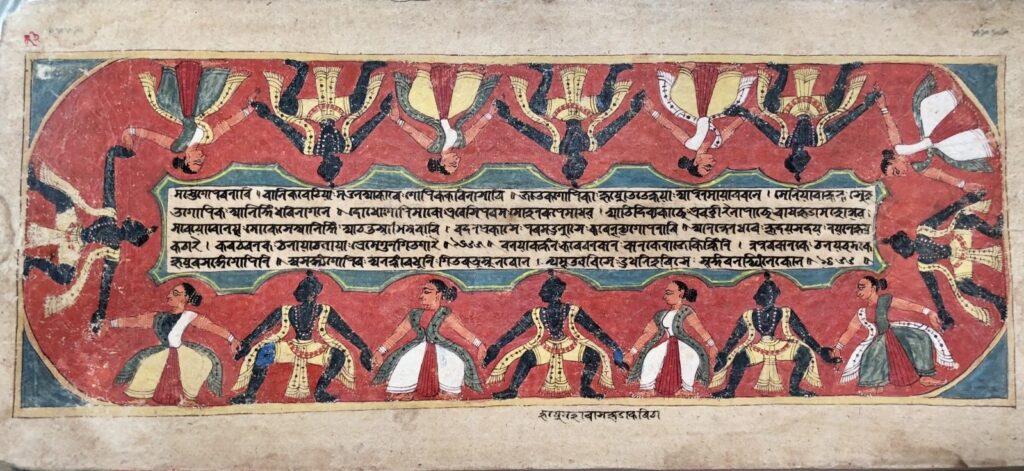
As is typical of early neo-Vaishnavite paintings, the figures in the folio are placed against a red monochrome background, on a horizontal plane and under arches. The caption beneath the painting reads, ‘Krishna performs the maharasakrida (great rasa festival)’. True to the description of the rasa lila in the Bhagavata Purana (as well as the inscribed text), the painting shows Krishna, who has, through illusion, multiplied his form and placed himself between each gopi, holding each one of their hands. The dance circle creates a personal relationship between the deity and each of his devotees. The gopis wear garments of different colours symbolising diversity. But the blue-bodied Krishna, clad in yellow, appears — according to the Bhagavata Purana (tenth canto, Chapter 33, Verse 10) — as “a precious sapphire strung between a pair of gold beads.” The painting is an expression of unity where the community of believers embody collective devotion, tied together by their love for Krishna. Each of the gopis in the painting looks forward to the Krishna in front of her, a slight smile playing at her lips. But each version of Krishna also looks at the gopi in front of him, meaning that the deity reciprocates the love of his devotees with equal attention and affection.
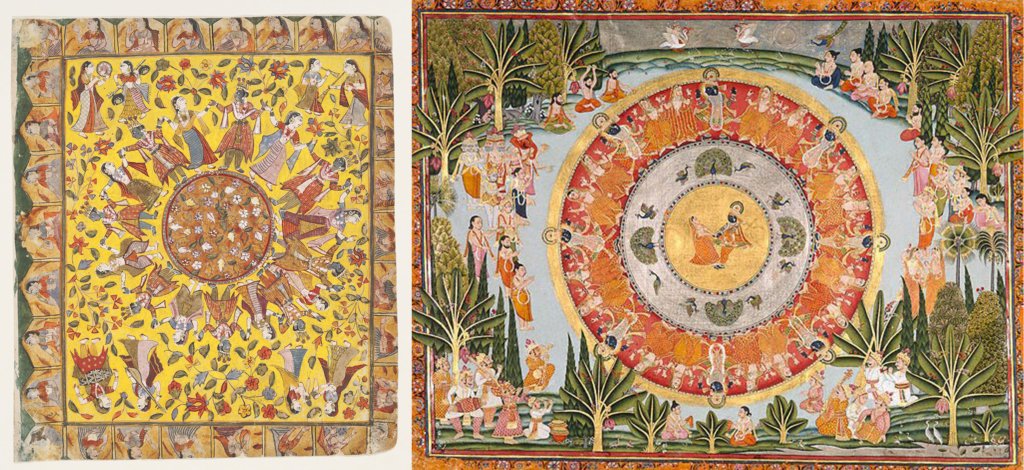
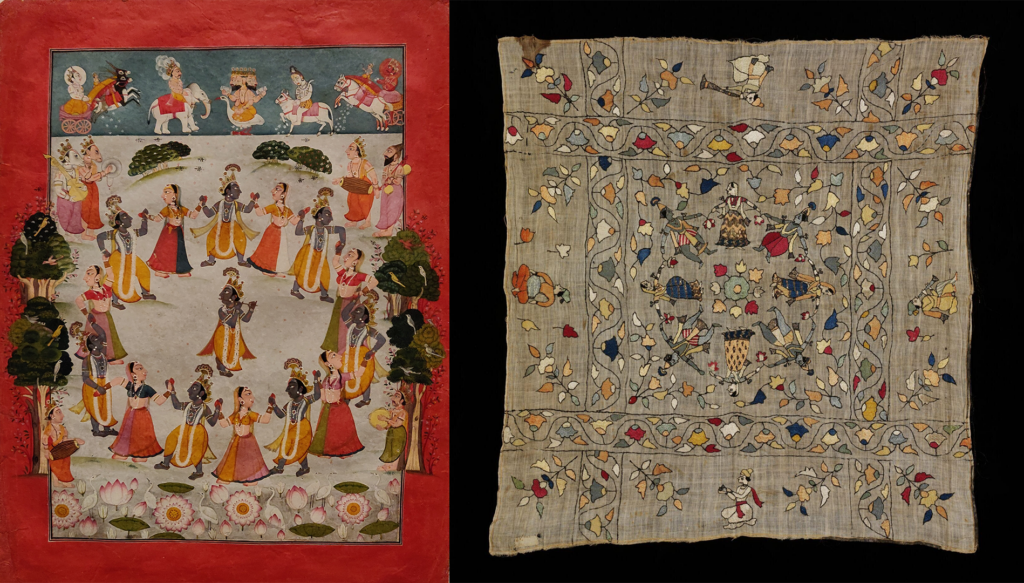
The rasa lila has been the subject of inspiration for artists since the 16th century and parallels can be drawn between the composition of the Assamese painting and other painted, embroidered and sculptured depictions of the cosmic dance. For instance, the sixteenth-century Bhagavata Purana from the Delhi-Agra region, the 1648 Bhagavata Purana by Sahibdin from Udaipur, the c. 1720 Rasa lila from Gujarat, the eighteenth century Rasa lila from the Deccan, the 1836 Brahmavairta Purana from Assam, the c. 1850 Rasa lila from Bundi, and the twentieth century Chamba rumals, all depict the dance in garland-like formations, omitting perspective and making the figures appear as if they are lying down and the painting is a view from above. However, in these representations, it is common to show Krishna standing at the centre of the circular dance, sometimes accompanied by a gopi. When Krishna is absent, the centre space is occupied by a floral mandala or natural elements of the Vraja landscape in which the dance takes place.
In the Assamese rasamandala, on the other hand, the centre space is occupied by the text in Brajawali. The text describes Krishna arranging the gopis in a row so they resemble a mandala. Thereafter, through illusion, he multiplies himself and embraces each gopi to satisfy her. The gopis, overjoyed, look at Krishna as his body glows under the moonlight. In this way, singing love songs and moving their feet, they perform rasa. Thus, it is also the word that sets the divine dance in motion. The arches, framing the dancing Krishna and gopis, simultaneously act as a decorative border for the text enclosed within a rectangular box. At the same time, like the spokes of a wheel connect its hub to its rim, these arches connect the text to the dancing Krishnas and the gopis alike.
The centrality of the text also reflects the tenets of Eka Sarana Nama Dharma, where devotion is associated with nama or the holy name that carries within it the essence and qualities of the Divine. The doctrinal treatises by the neo-Vaishnavite preceptors, such as Bhakti Ratnakara by Shankaradeva, Nama Ghosha by Madhavadeva, and Bhakti Viveka by Bhattadeva, indicate that devotees should view the manuscript itself as a form of god. Indeed, in many of the neo-Vaishnavite monastic institutions in the Assam region, called satras, it is the ‘manuscript idol’ that is worshipped.
Moreover, both the Bhagavata Purana and the folio’s text describe the rasa lila as a mahotsav or ‘great festival’, teeming with blooming flowers, fruit-laden trees, and humming honey bees as the air fills with the sounds of celestial beings singing and playing musical instruments in tune with the tinkling of bracelets, anklets and waist belts of the dancing gopis. We also have descriptions of gods, such as Brahma, Rudra, Indra, watching the enchanting nighttime scene, lit by numerous stars and the glowing rays of the full moon. But the unknown Assamese artist, who places the text in Brajawali at the centre of the rasa lila, does away with these extraneous elements in their composition. Instead, they hope the viewer’s eka (sole) focus while seeking sharana (refuge as a way to surrender to god) should either be the painted forms of Krishna and the gopis, or on the nama (holy name) centred as part of the text in the composition.
The rasa lila represents the climactic moment where the romantic devotion of the gopis is finally rewarded by a reciprocal gesture of love by the cowherd god. Philosophically too, it is the most important dance that Krishna performs, in the form of a miracle that sees him multiply himself to respond individually and personally to each devotee. Celebrated as one of Assam’s state festivals, devout locals emulate the rasa lila every year in accordance to the date of the Karttika full moon, which falls in the October to November period. Without any beginning or end, the rasa lila is an eternal dance but in this particular painted folio, it is also a quiet dance. By centring the sacred word, the painting aligns visual form with the theological primacy of nama in neo-Vaishnavite devotion to reimagine how to encounter the Divine within the rasamandala.
First published: August 28, 2026