-
ChicagoMishra, Abhinav. "The Way of the Yogi: The 19th Century Nath Paintings of Jodhpur." Impart Perspectives, August 21, 2026. https://imp-art.org/perspectives/dispatches/the-way-of-the-yogi-the-19th-century-nath-paintings-of-jodhpur/
-
MLAMishra, Abhinav. "The Way of the Yogi: The 19th Century Nath Paintings of Jodhpur." Impart Perspectives, Aug. 21, 2026, https://imp-art.org/perspectives/dispatches/the-way-of-the-yogi-the-19th-century-nath-paintings-of-jodhpur/. Accessed 15 Oct 2026.
-
HarvardMishra, A. (2026) The Way of the Yogi: The 19th Century Nath Paintings of Jodhpur, Impart Perspectives. Available at: https://imp-art.org/perspectives/dispatches/the-way-of-the-yogi-the-19th-century-nath-paintings-of-jodhpur/ (Accessed: 15 October 2026).
The Way of the Yogi: The 19th Century Nath Paintings of Jodhpur
Pivoting from depictions of elite pleasures and mythological stories, Marwar's court artists under Man Singh's patronage adopted a minimalist aesthetic to represent yogic and tantric principles.
By Abhinav Mishra
Link copied!
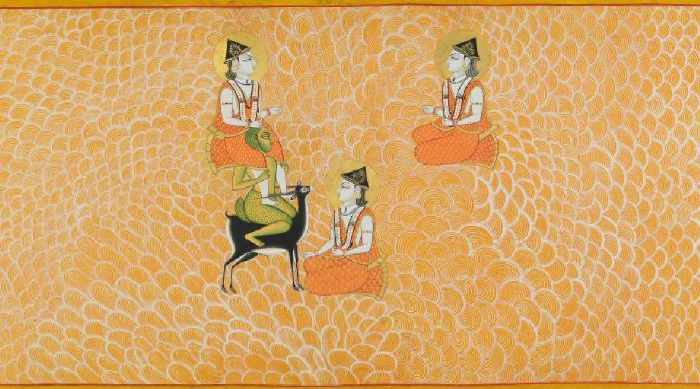
Cosmic Oceans (detail), one of seven folios from the Nath Charit; Attributed to Bulaki; 1823. Mehrangarh Museum Trust, Wikimedia Commons
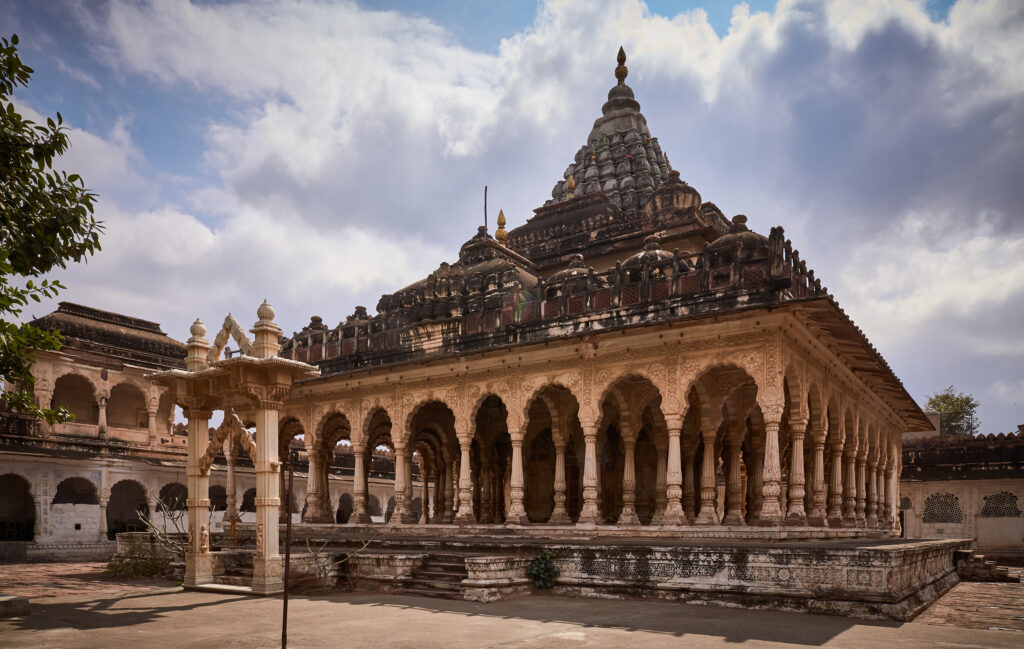
As the sound of the school bell trills and children start running to and from their classes, an imposing white temple stands amidst the chaos. The Mahamandir complex, just outside the main city of Jodhpur, doubles as a government school and while the initial hubbub may distract you, there is nothing quite like the first glimpse of the many-pillared structure of Mahamandir (The Great Temple), an architectural masterpiece that is more than 200 years old. Behind it lies the tale of a miraculous prophecy that helped Man Singh (r. 1803-43) win the throne of the Rajput kingdom of Marwar.
Favoured by his grandfather Vijay Singh (r. 1752-1793), Man Singh was named the heir apparent when he was just a child. But Vijay Singh’s death on July 17, 1793, unleashed a full-scale war of succession among the late king’s sons and grandsons that saw Bhim Singh, Vijay Singh’s eldest grandson, seize the throne. For his own safety, Man Singh was spirited away to Jalore (also called Jalor), which happened to be an important centre for the Nath Sampradaya, a Shaivite (Shiva-worshipping) religious order associated with supernatural yogic powers. The sect, also known as the kanphatas (split ears), practiced Hatha Yoga and Tantra and exercised a strong influence on several Rajput clans.
In the summer of 1803, Bhim Singh, having killed or maimed every other strong contender to the throne, laid siege to Jalore Fort, determined to kill Man Singh too and secure Marwar’s throne. The standoff persisted for months. By October, Man Singh’s supplies had dwindled to nearly nothing and the morale of his troops were at an all-time low. The young prince was on the verge of surrender. This was when Ayas Dev Nath, the leader of the Nath yogis at Jalore, would come to him with a prophecy — Man Singh was destined to become king if he continued to fight for just a few more days. The prediction came true when Bhim Singh unexpectedly died on October 19, and Man Singh finally inherited his kingdom — that too in the holy week of Diwali, the festival that celebrates the Hindu deity Rama’s return to Ayodhya to claim his kingdom. The grateful Man Singh would, as a result, become a devoted, lifelong follower of the Nath sect.
In the 40 years of his rule, the Nath doctrines would effectively be established as the state-sponsored religion. Jallandharnath, thought to have lived in the 13th century or earlier and regarded as one of the “Navnaths” — the nine prominent spiritual masters worshipped by the Nath Sampradaya as legendary, immortal mahasiddhas — became the focus of Man Singh’s devotion. Meanwhile, his Nath guru, ‘king maker’ Dev Nath, and later his successors, began to act as the de facto power behind the crown. This upset earlier power configurations established in the kingdom by powerful Rajput nobles and Man Singh would consequently face opposition from them, and later, the British East India Company, about the Nath sect’s influence over administration. The sect’s ascendancy would eventually lead to the assassination of Dev Nath in 1815, which not only created a power vacuum and internal divisions within the Nath sect, but also pushed the depressed Man Singh into seclusion, leading him to, temporarily, withdraw from state affairs.
But all these events were yet to come. In 1803, the vindication of Dev Nath’s prophecy was a rosy start to the young king’s rule over the Rajput kingdom of Marwar. As a token of his gratitude to his guru and the sect, Man Singh would commission the building of the huge Mahamandir temple complex in April 1804. Constructed with great speed, it would be completed in less than a year, by February 1805, and would cost the king a staggering sum of 10 lakhs. The main shrine was dedicated to Jallandharnath who, besides being one of the Navnaths, was also considered the main disciple of Matsyendranath (founder of the Nath Sampradaya), and the guru of Kanhapa (also ‘Kanifnath’ and ‘Kanipa’) — another one of the Navnaths. The mythologised saint already had several important pilgrimage spots associated with him — such as Jogi Tilla in Punjab, Jallandharnath peeth (hermitage) in Jalore and Jallandharnath’s meditation cave in Niwai, Tonk in Rajasthan, but the Mahamandir was different because of its sheer scale.
The temple complex was described by the 19th-century army officer and author A.H.E. Boileau as a “walled town of a thousand houses with a hundred and twelve shops in its marketplace,” giving an idea of the size of this Nath stronghold. The shrine itself he described as “conspicuous,” visible from great distances, because of the “dazzling whiteness of the fine marble lime” with which it was covered. According to Boileau, the “pure-looking material” covered not only the entire building but also the small, cloistered courtyard in which it stood. The entire fortified complex, built as a planned temple township, had the capacity to accommodate more than 2,500 people, and included those granted sanctuary by the Naths. It became the headquarters for the sect, attracting Nath yogis from all parts of India, and gradually became an economic and strategic centre for them.
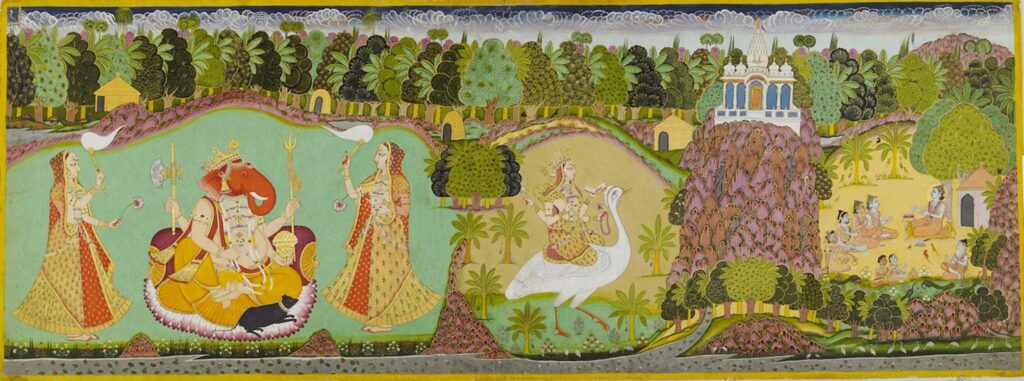
After the construction of Mahamandir and with the ascendancy of the Nath sect, Jallandharnath’s image began acquiring “fixity and legibility” in the paintings produced by Jodhpur’s artists, according to scholar Debra Lynn Diamond. Before Man Singh’s reign, there were devotional songs sung about Jallandharnath in the region. But the devotee king’s desire for darshan, which he expressed in his poems, saw the court artists creating hundreds of devotional paintings with Jallandharnath as a key figure. They aimed, as Diamond says in her book Garden and Cosmos: The Royal Paintings of Jodhpur, to construct Man Singh as the saint’s supreme devotee. Countless repetitions concretised the key visual iconography for Jallandharnath, arriving at a “matured archetype” by 1810 that showcased “crisply contoured, two-dimensional” images of the saint with ash-smeared, pale-looking skin, dreadlocks, rudraksha beads, and a fringeless triangular hat.
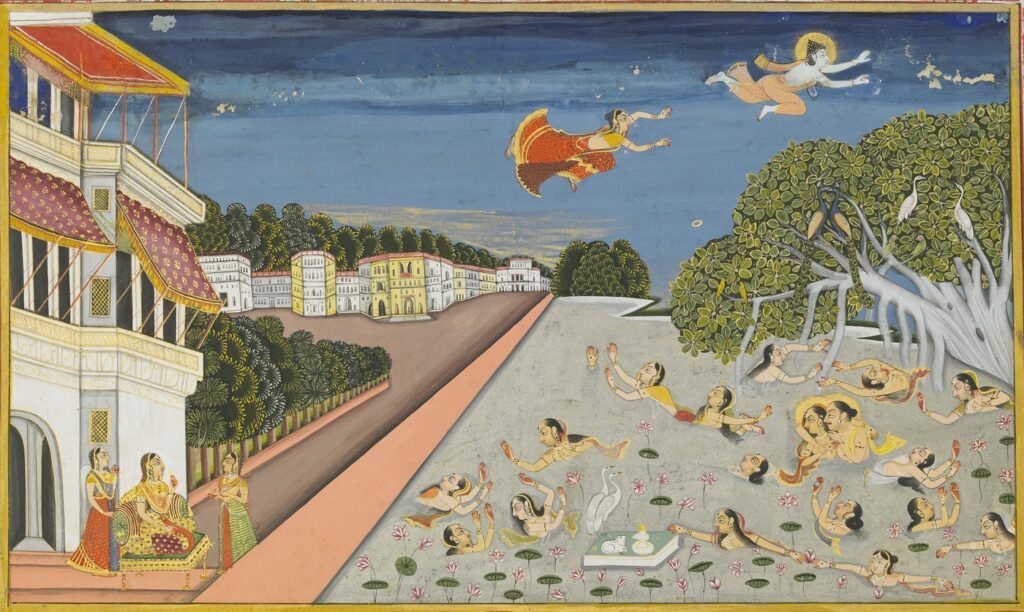
Notable works included Jallandharnath at Jalore (c. 1805-10) by Amardas Bhatti, which visualised the poetic descriptions of what the saint’s hermitage (peeth) in Jalore may have looked like during the saint’s lifetime; Jallandharnath and Maharaja Man Singh on Diwali (c. 1820-25) by artist Shivdas Bhatti, which commemorated the 1803 ‘miracle’ prophecy; and Jallandharnath and Princess Padmani fly over King Padam’s Palace (c. 1830) by Amardas. The last painting was part of the illustrated vamshavali (dynastic narrative) called Suraj Prakash, commissioned by Man Singh during an uneasy truce with Marwar’s Rathore nobility. It depicted a highly-regarded clan ancestor, King Padam, as a figure who had also received Jallandharnath’s divine grace. According to Diamond, this was an attempt to pacify the nobles opposed to his alliance with the Naths.
Very early in his reign, in 1805, Man Singh would also establish a library, Pustaka Prakash, collecting Nath texts and treatises brought to him from all over India, before directing his court artists to illustrate them. Therefore, the paintings and murals commissioned by him collectively reconstituted a large number of existing older texts on yoga and tantra significant to the sect. This included the Matsyendrasamhita, a foundational tantric yoga text that the Nath sect had built on to reinvent Hatha yoga; this reformed version did away with the complex and often transgressive tantric rituals and rites and relocated these concepts as contained within the body, prescribing bodily practices and techniques that could be performed by the individual yogi to become a mahasiddha like Jallandharnath.
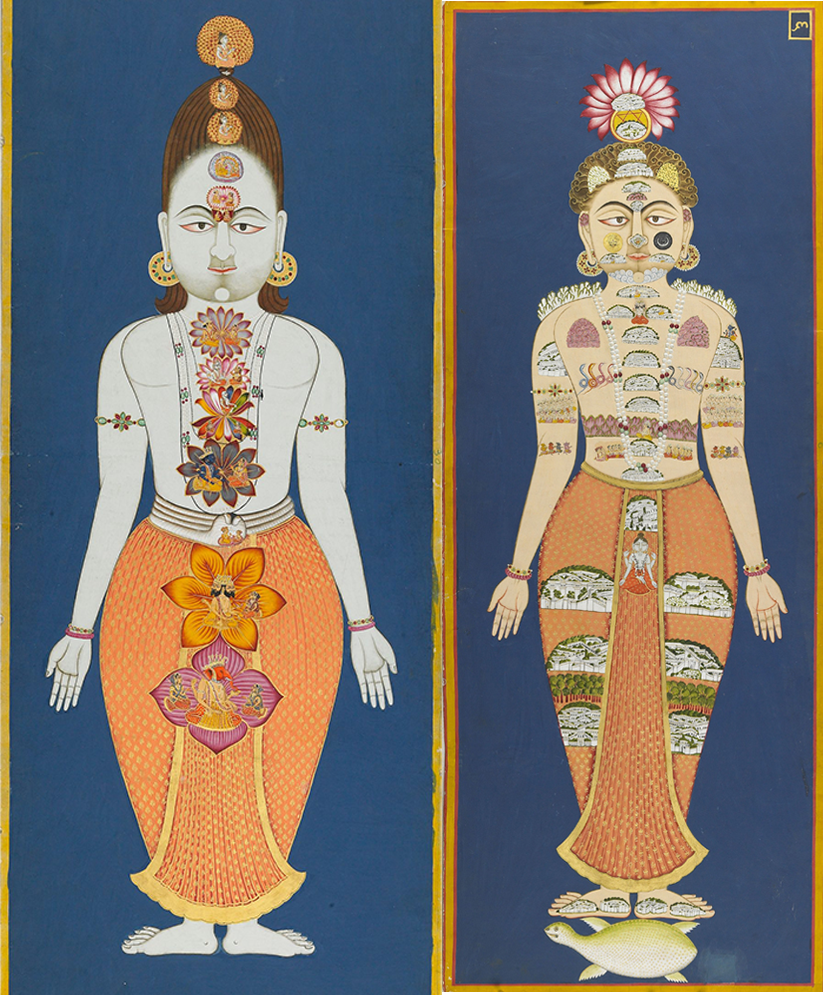
Overall, there was a dramatic shift in the output of the Jodhpur atelier under Man Singh in the 19th century. Pivoting away from depictions of elite pleasures in palace and garden settings, mythological stories, and Vaishnava-oriented devotional compositions, court artists under Man Singh’s patronage — such as Amardas Bhatti, Bulaki, and Shivdas Bhatti — adopted a minimalist aesthetic to depict yogic and tantric principles.
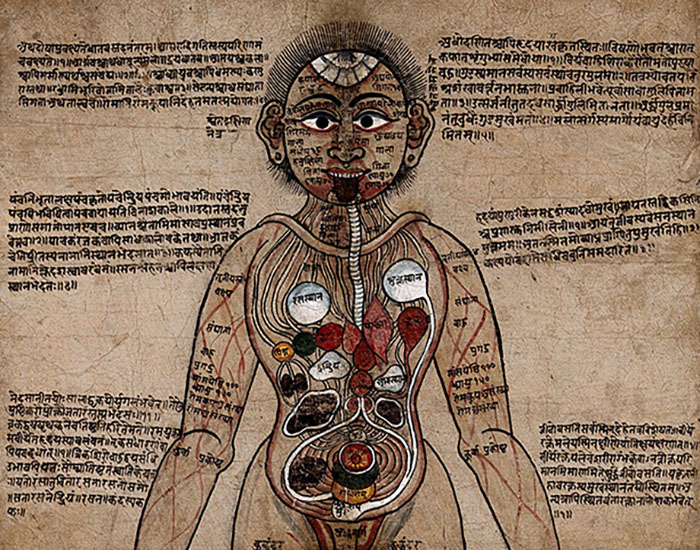
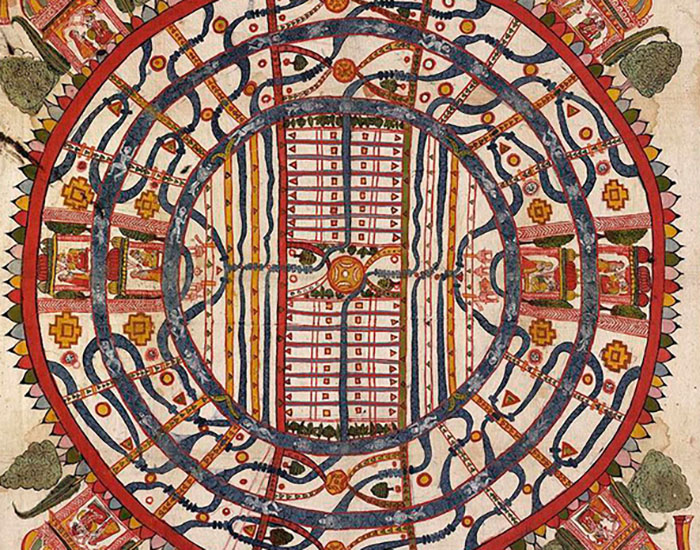
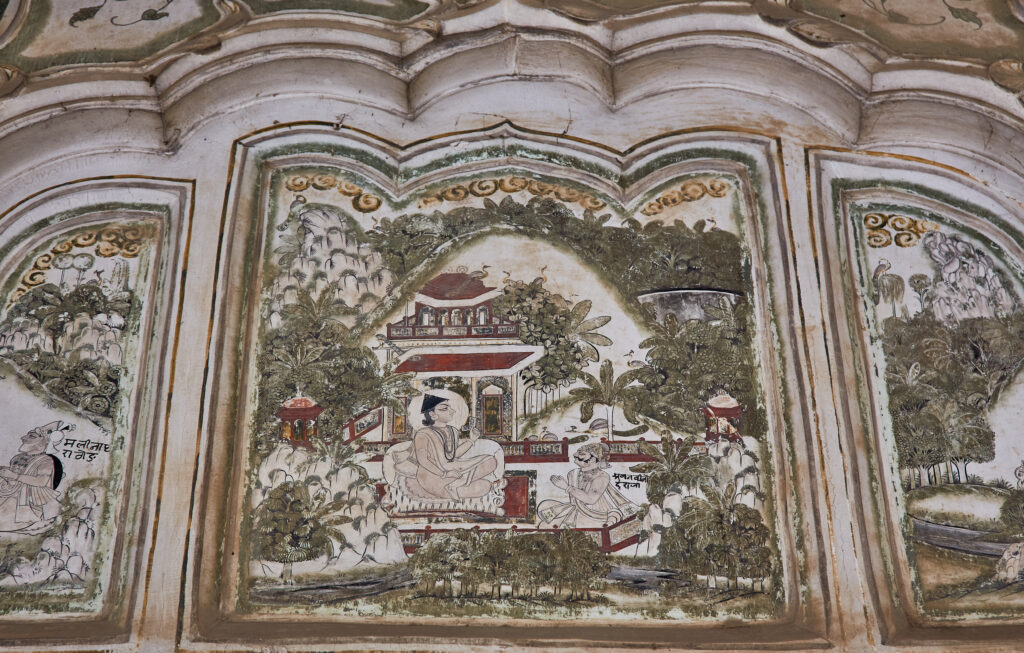
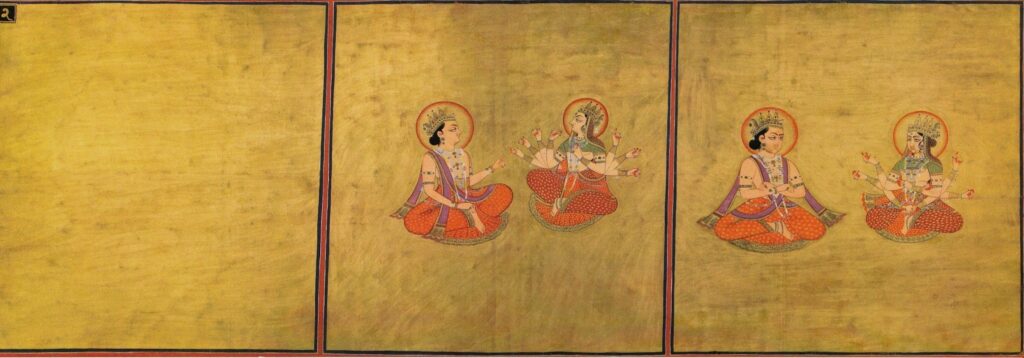
The king would commission more than 1,000 paintings, which included not only new manuscripts but also the wall murals of Mahamandir. The themes for these paintings ranged from devotional ones, depicting the king in the company of Nath gurus and saints, to ones that represented the metaphysical principles and teachings of the Nath saints. Subjects included musings about the nature of the Self and the creation of the universe, the subtle body and its energy pathways in the form of chakras (energy centres) and nadis (energy channels), mandalas (cosmic maps) and asanas (yoga postures). According to Diamond, the Nath school of paintings are possibly the first examples of visual art devoted to depicting esoteric and philosophical Hatha yoga concepts from textual sources. To do so meant the court painters and artists of the Jodhpur atelier invented new iconographies and visual techniques, including abstraction, to represent the formless Brahman (as a luminous gold canvas), Purusha and Prakriti (as male and female figures), and the ‘Vishwarupa’ rendering of the human body perfected through yoga.
The painted murals at Mahamandir show 84 key yogic postures inside the shrine as well as scenes depicting nobles paying respect to the Nath Yogis, using a ‘shading’ technique (pardaja), attributed to Amardas by scholars, but it is quite possible that other court artists also worked on the murals. Though at first glance the mural panels in the sanctum may appear to depict general yoga positions, the careful analysis of Jason Birch and Jacqueline Hargreaves, scholars of South Asian traditions, reveals something much deeper. Each of the nineteen painted panels contains four or five Nath ascetics performing advanced, complicated yogic asanas. They are shown inside or just outside their huts. The huts’ interiors, either blue or red, are the perfect backdrop, highlighting their postures clearly, while the exterior landscape showed lush forests and wild terrains instead of palace gardens. The asanas being performed by these yogis are possibly inspired by the yoga manuals, namely Jogapradipika (1737 CE) and Yogasanmala (1790 CE), according to Birch and Hargreaves. The former was composed by Jayatarama, describing the 84 asanas incorporating health and spirituality, while the latter was more of a parallel record with 108 asanas, out of which 41 are identical in both texts.
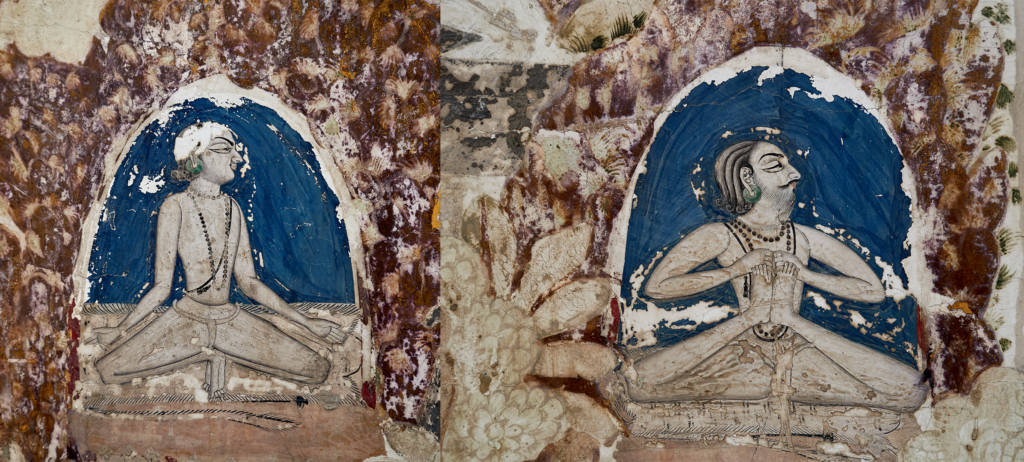
The murals at Mahamandir are not merely decorative, enhancing the temple’s aesthetic, but rather a visual manual. This manual helps us to trace the yoga precepts widely circulated among different ascetic lineages, including the Naths, but which only became a part of the vibrant visual culture of Jodhpur because of a prophecy and one spiritually-inclined king’s devotion to a saint.
First published: August 21, 2026