-
ChicagoRoy, Spandita. "The Radical Politics of Love in Chittaprosad’s Art." Impart Perspectives, August 25, 2026. https://imp-art.org/perspectives/dispatches/the-radical-politics-of-love-in-chittaprosads-art/
-
MLARoy, Spandita. "The Radical Politics of Love in Chittaprosad’s Art." Impart Perspectives, Aug. 25, 2026, https://imp-art.org/perspectives/dispatches/the-radical-politics-of-love-in-chittaprosads-art/. Accessed 15 Oct 2026.
-
HarvardRoy, S. (2026) The Radical Politics of Love in Chittaprosad’s Art, Impart Perspectives. Available at: https://imp-art.org/perspectives/dispatches/the-radical-politics-of-love-in-chittaprosads-art/ (Accessed: 15 October 2026).
The Radical Politics of Love in Chittaprosad’s Art
Chittaprosad, in his series of linocuts depicting lovers embracing, harnessed the political dimension of radical love and caring in the face of hate and oppression.
By Spandita Roy
Link copied!
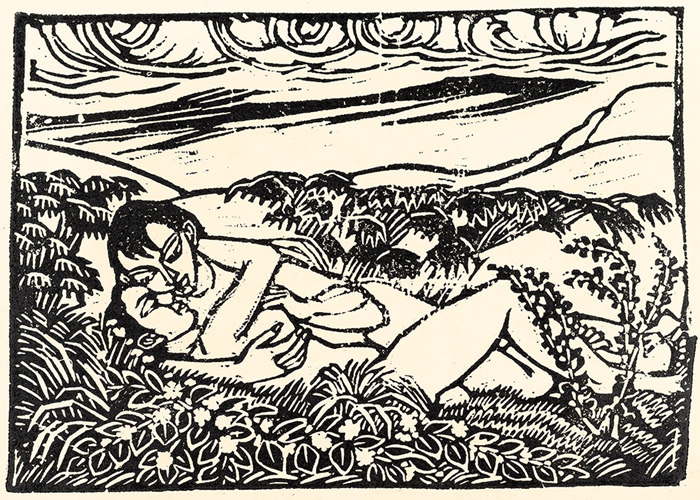
Untitled; Chittaprosad; Linocut on paper. Courtesy DAG Collection
Born in 1915 at Naihati in British-occupied Bengal, Chittaprosad Bhattacharya (d. 1978) is best known for his visual documentation of the notorious Bengal Famine of 1943. The self-taught artist officially joined the Communist Party in 1940 and some of his earliest published works were satirical pen and ink sketches that caricatured politicians and colonisers in the Party’s weekly newspaper, People’s War (later renamed People’s Age).
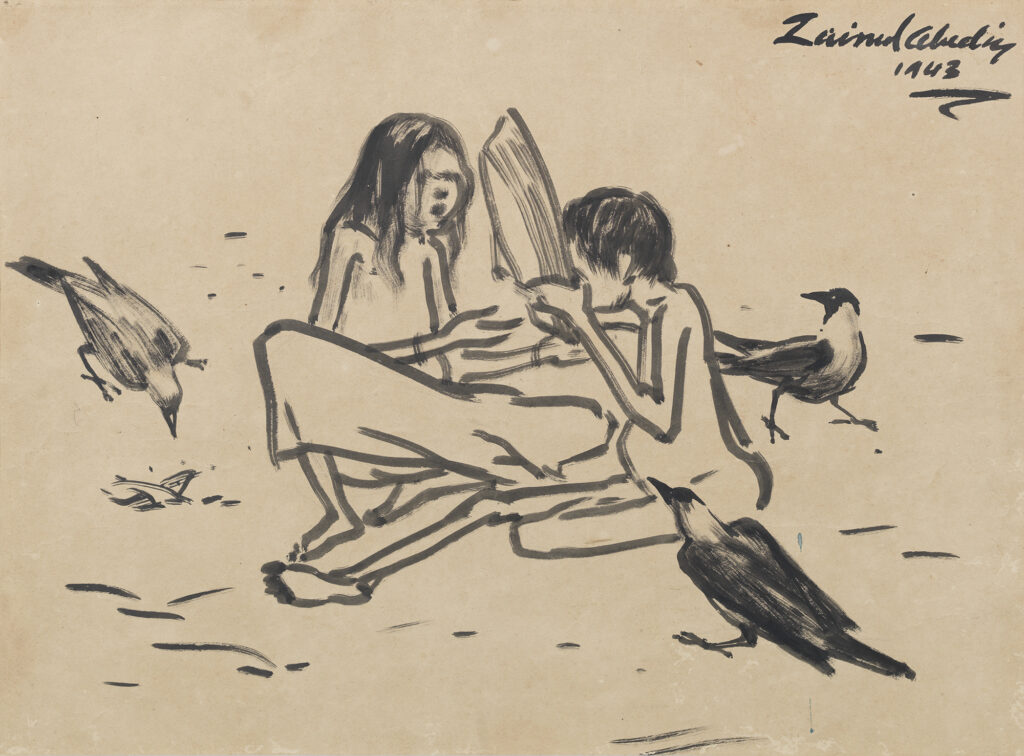
But his rise to fame as a political artist came a few years later when he was commissioned by the Communist Party to travel to Midnapore as a reporter to file illustrated ground reports about the Bengal Famine of 1943 and the starving conditions of the rural poor. The weekly publication of his black-and-white sketches, depicting the hunger-ravaged peasantry of rural Bengal, revealed starkly the extent of the catastrophe. Twenty-two of his eyewitness sketches were collected and compiled into a book — Hungry Bengal: A Tour Through Midnapur District (1943). The stark objectivity of his art was so damning of the extractive colonial regime that the British banned the book, and then attempted to destroy every single of the 5000 copies printed. Only one copy is known to have survived — the one sent by the artist to his mother, who kept it safe.
While protest art made him famous, his later oeuvre shows him invested in imagining a better, more hopeful future, especially for children — he did this by creating artwork for UNICEF and UNESCO, and illustrating children’s books. He also released a poignant series of linocuts, Angels without Fairy-tales, about children deprived of their childhood, and founded Khelaghar, a puppet theatre group to entertain children who lived in the slums near his home in Andheri, Bombay (now Mumbai). He also made a series of linocuts that celebrated ideal love, happy families, and the communal pleasures of village life — this was art for the masses performed to counter his profound feelings of alienation in post-independence India.
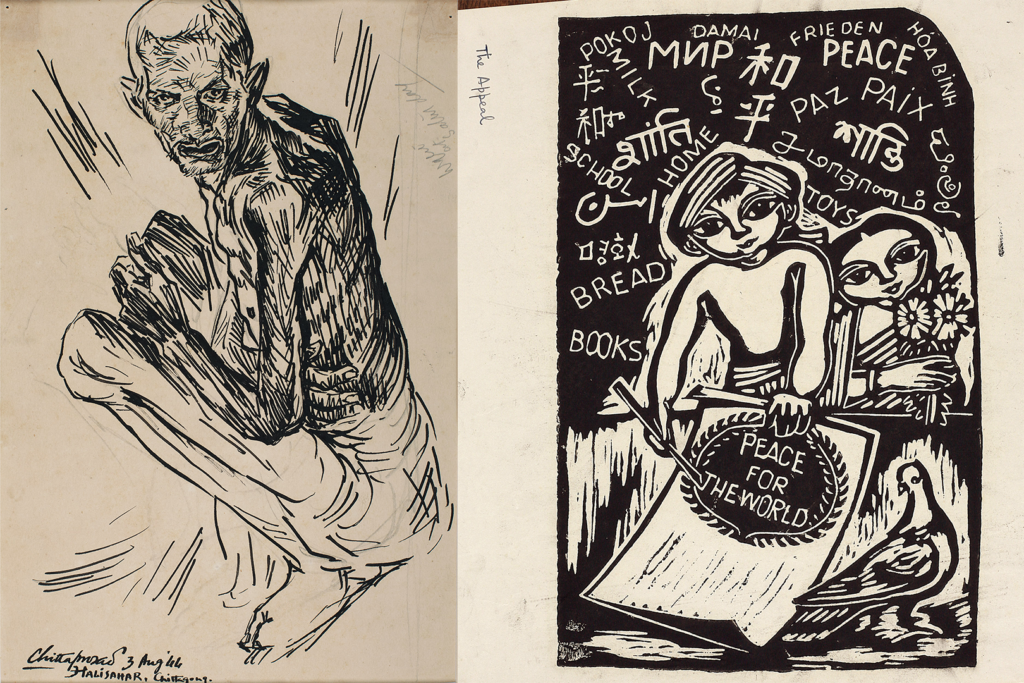
By the 1950s, the artist had already stepped away from active politics and visual reporting. He had grown disillusioned with Marxist politics in the country after his mentor PC Joshi was expelled from the Communist Party. Despite withdrawing to Bombay, an important hub within the cultural circuit of postcolonial India, the predominantly commercial nature of commissions left the artist cold, and mostly apathetic to the opportunities that did come his way. This was in stark contrast to Chittaprosad’s heady days as part of the Left’s cultural movement in the 1940s, where he was recognised as one of its most influential artists and hailed for the socialist realism of his works. But after independence, his work was sidelined with next to no patronage.
Chittaprosad countered this loss of relevance domestically by engaging with the communist global movement for world peace and expounding more universal, humanist articulations of solidarity instead. In Chittaprosad’s letters, dating from between the early 1950s to the early 1970s, we see him writing to new friends and admirers in the United States, Denmark and in Prague in attempts to form transnational solidarities, and continue his engagement with socialist art on his own terms. He also wrote to former comrades and his family, mainly his mother and sister. Sanjukta Sunderason, in her essay A Melancholic Archive: Chittaprosad and socialist art in postcolonial India, commenting on the artist’s correspondence after he disassociated with the Communist Party, says his letters were “steeped in his wishes, plans, frustrations and euphoria” that revealed “his loneliness and disillusionment.”
The artist, during this period created several portrayals of love, in all its forms and expressions, which were a significant departure from his earlier work. These ranged from the erotic to familial and maternal affection as well as bonds of community. His powerful and emotive art, which depicted lovers embracing, mothers hugging their children, and idyllic rural scenes of domesticity and communal forms of living can be read as Chittaprosad’s longing for solidarity and companionship and an attempt to cope with his isolation.
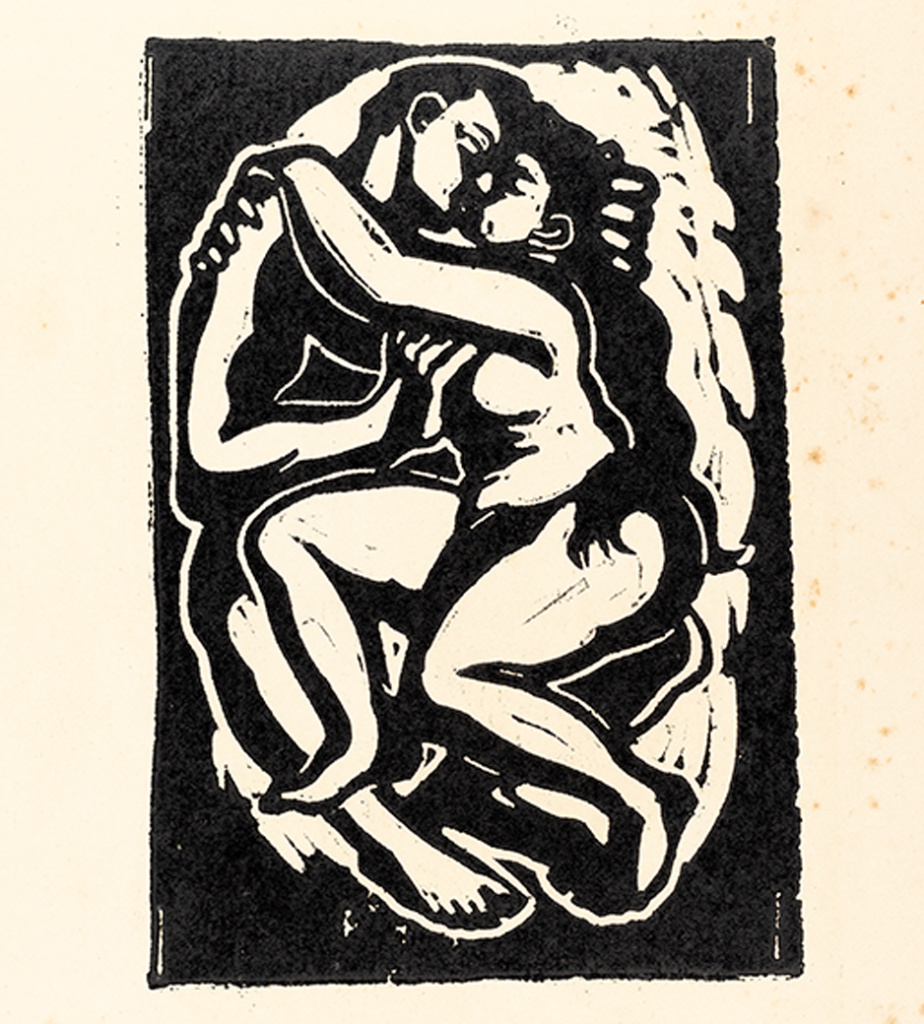
Far removed from the grotesquerie of his famine iconography, Chittaprosad’s linocut prints of couples capture moments of intense, sexual connection as well as quiet moments of togetherness. Stylistically, we find the figures of the man and woman in these monochromatic compositions drawn with bold, thick lines, bereft of colour, unembellished, and stripped off tonal exaggerations with very few identifying details, unlike his famine illustrations of real people. They come across as timeless, allegorical figures that are symbolic of the male-female union, and representative of the smallest unit of harmonious co-existence within the familiar constructs of marriage, family, community, and nation. In one of his compositions, the man and woman embrace each other and framed within the protective circle of their arms is a baby — the fruition of their union. Together, they make the conventional, foundational family unit. In that sense, his renderings of lovers embracing can be placed in the same category as his works depicting utopian rural communities living in harmony and plentitude.
What Chittaprosad did in these depictions was harness the political dimension of affection and tenderness — love as an antidote to hate. The acts of intimacy, if read through the medium of the artist’s lexicon of dissent, liberates the idea of the Self being Othered. The style of his linocut drawings reflected Chittaprosad’s deep love for folk art and possibly also folk depictions of sexual union, fertility and motherhood as natural dimensions of life. By challenging prevailing attitudes shaped by Western mores and by using the ‘unsophisticated’ artistic stylings of rural artisans, Chittaprosad’s linocuts can be read as attempts to decolonise Indian modern art. He also reimagined intimate, physical moments between lovers as everyday acts of radical love that affirmed the power of human bonds — the kind that could heal the scars of emotional impoverishment, of being dehumanised and debased by colonial policies.
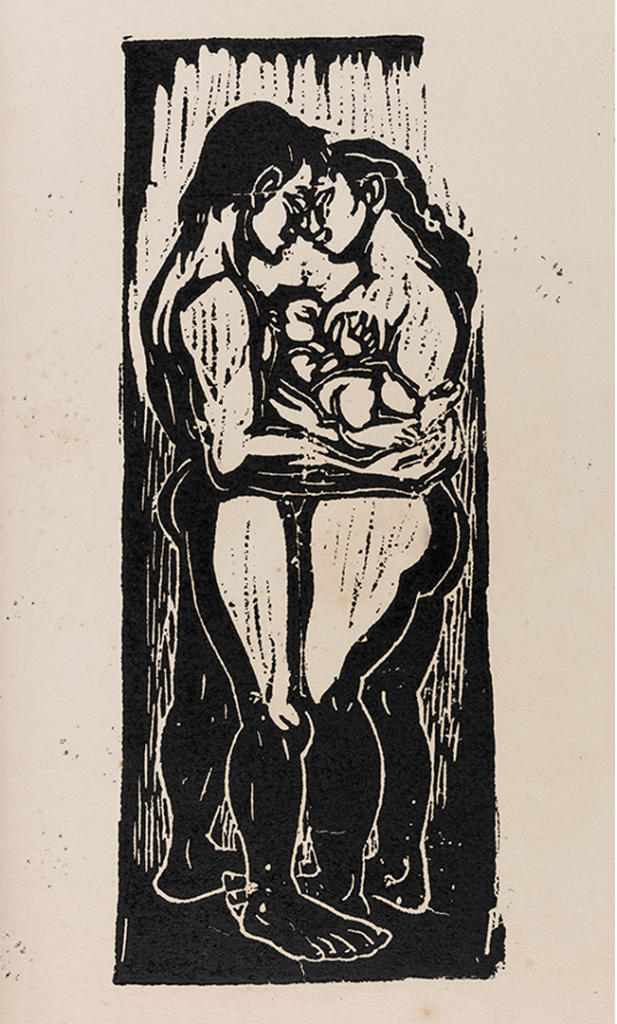
Having endured years of divisive politics and the trauma of a bloody Partition, the populace of the newly-independent India was a divided one. At the same time, the nation’s leaders were still debating how to self-rule — How to implement Swaraj? How to utilise this hard-won freedom from colonial oppression? This is where Chittaprosad’s art offered a vision of love as the essential building block of community and nation. It is a sentiment that is echoed in the seminal essay by feminist literary critic bell hooks, titled, Love as the Practice of Freedom.
According to hooks, “Without love, our efforts to liberate ourselves and our world community from oppression and exploitation are doomed. As long as we refuse to address fully the place of love in struggles for liberation, we will not be able to create a culture of conversion where there is a mass turning away from an ethic of domination.” Chittaprosad too deconstructed the notion of love as not just intimacy but also a form of political subjectivity. In the light of this contention, Chittaprosad’s portrayals of love captures aspects of self-making through romantic love, through kinship, and the love for one’s nation that guarantees your freedom because you are a citizen — a political participant in a united community that self-governs itself. His representations of love fall neatly within this ethos of self-determination and liberation.
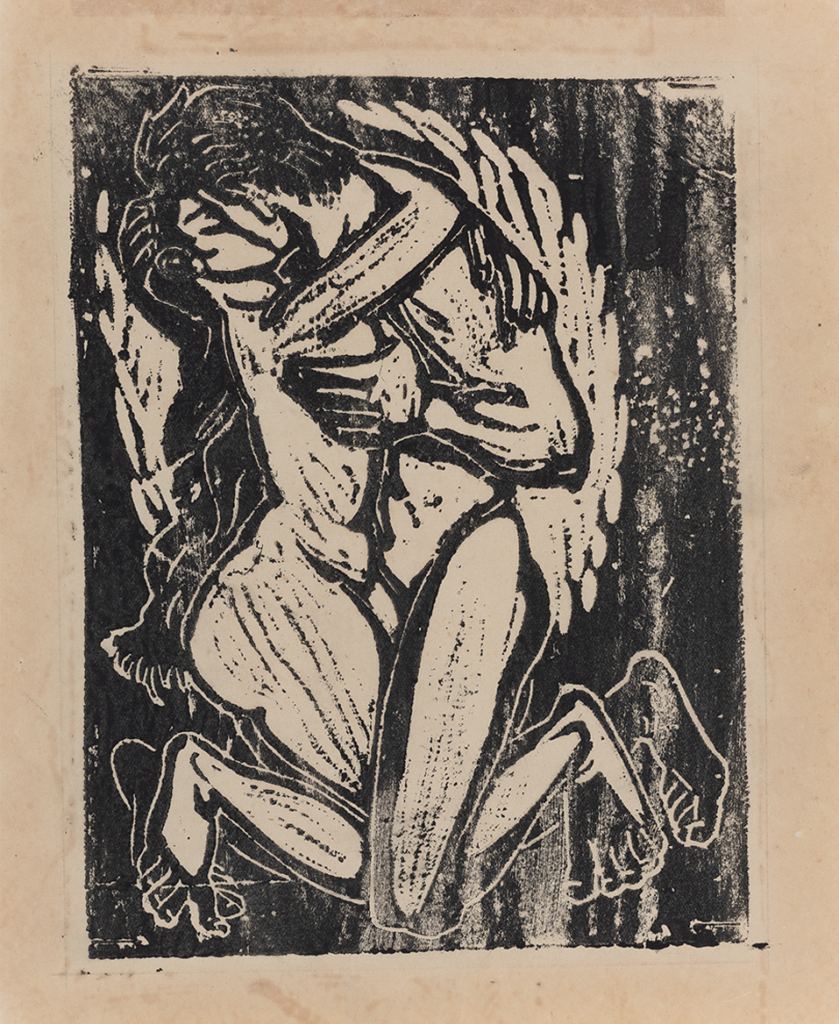
In his 1909 book Hind Swaraj, MK Gandhi had propounded that if India were to adopt a “doctrine of love” as an active part of her religion and also introduce it in her politics, “Swaraj [freedom in the form of self-rule] would descend upon India from heaven.” This framework of a scalable politics of love which Gandhi upheld was analogous to Chittaprosad’s vision of cultivating affection for the self, the lover, and the nation. Such a radical practice to love and be loved circles around an accommodation of Bhakti (devotion) towards a formerly enslaved nation that was rebuilt to centre secular, nationalist ideals in opposition to engineered communal hate between communities. If anything, then this particular subset of Chittaprosad’s oeuvre hints at the inauguration of the nation’s decolonisation process — of choosing community over capitalist individualism, echoing hooks’ and Gandhi’s political articulation of love and non-violence as a means to achieve liberation of the self and the nation.
First published: August 25, 2026