The Katar: From Weapon to Icon
Art historian Rachel Parikh explores the evolution of the katar in South Asia and what the stylistic and functional choices reveal about its makers, wearers and wider socio-cultural impact.
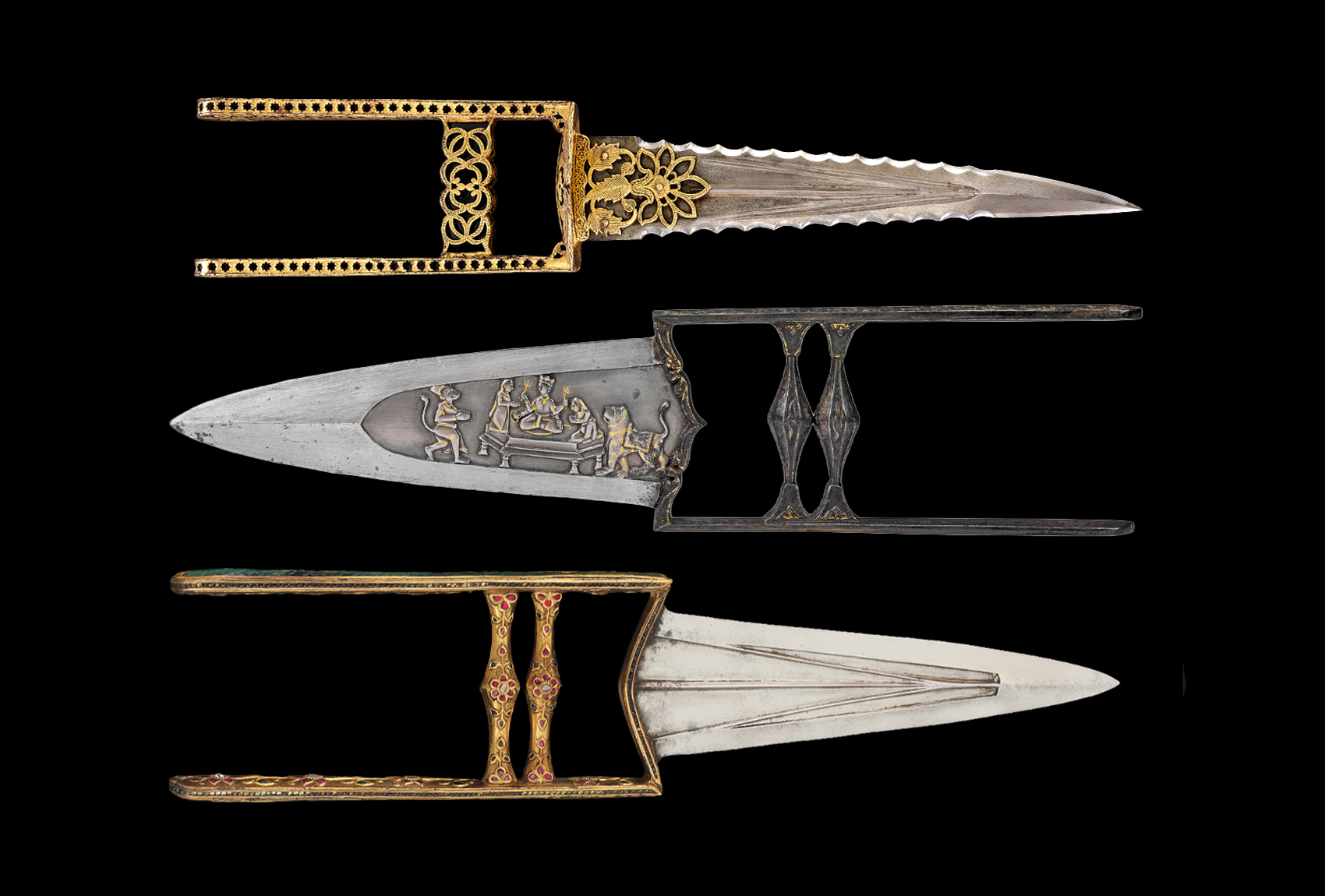
Top: Katar with sheath; Possibly Deccan, India; Early 18th century; Steel, and gold. Mengdiexuan Collection. Center: Katar; Mughal period; India; 18th century; Steel and gold; 38.1 cm. Royal Armouries, Leeds. Bottom: Emerald inlaid and gem-set katar and detailed views; India; 19th century; Steel, gold, emerald, diamond, and ruby; 40.3 cm. © 2019 Christie’s Images Limited.
The katar is arguably the most iconic Indian weapon. It is a type of punch- or push-dagger used at close range and in hand-to-hand combat.
Although designed for fighting, the katar became far more than an effective weapon. Renowned for its distinctive form, it played an important role in kingship, ritual, hunting, and artistic expression, ultimately emerging as an enduring symbol of power, authority, and sovereignty, and as one of the defining icons of the Indian subcontinent’s martial and artistic heritage.
Developed in the Indian subcontinent, it is distinguished by an H-shaped hilt, consisting of two parallel bars running along the sides of the user’s wrist and lower forearm, and two, sometimes three crossbars. The wielder grips the crossbars in a closed fist, positioning the knuckles directly above the double-edged triangular blade.
The design makes the weapon into an extension of the arm, allowing for swift and agile movements. Although it can be used for cutting and slashing, the katar was primarily intended to deliver forceful thrusts.
Capable of inflicting deep, often fatal wounds, the katar could also be employed defensively, to parry a sword.
In battle, it was commonly carried alongside a second katar, a sword, or a shield, like this example.
Some examples, as seen here, feature blades with reinforced, thickened points that resist bending on impact. Known as “armour-piercing” katars, they could penetrate a variety of armour, including textile, mail, and mail-and-plate.
Although the precise origins of the katar remain uncertain, sculptural evidence suggests that early forms of the weapon existed by the tenth century. Written references appear several centuries later, including in the travel accounts of the Moroccan scholar Ibn Battuta (1304–1368/69), who encountered the weapon during his journeys through India.
A remarkable example features prominently in the sculptural decoration of the Sesharaya Mandapam (dated c. 16th century) at the Sri Ranganathaswamy Temple in Srirangam, Tamil Nadu, where warriors wield katars against leaping tigers.
It is also described in Mughal manuscripts and depicted in paintings from the Mughal Emperor Akbar’s time (r. 1556-1605), including the Hamzanama (Story of Hamza), dated to c. 1564–69, a folio of which is shown here. A detail from the painting shows a figure mounted on a white horse and wearing an orange jama (robe). Tucked into his red patka (waist sash) is a gold katar.
As the weapon spread across the Indian subcontinent, most likely due to a variety of factors such as war, military campaigns, migration, and trade, regional workshops adapted its form while preserving its distinctive method of use. Although many variations exist, katars can generally be classed into three broad categories.
The earliest category is the Vijayanagara katar, named after the South Indian Vijayanagara Empire (1336–1646), where the type is generally believed to have originated. The weapon is characterised by a long, triangular blade with a broad base that tapers to a sharp, reinforced point. Its blade often features multiple fullers (longitudinal grooves), which reduce weight while maintaining strength.
Its defining characteristic, however, is the exquisitely crafted hooded handguard. It is typically fashioned as a naga (snake), a makara – a crocodile-like creature of Hindu mythology – as seen here, or as another mythological or divine figure. Since the naga and makara are broadly considered protective beings and the katar would be in such close proximity to the wielder’s body, touching the wrist and lower arm, it was akin to “wearing” a talisman.
The second category, also from South India, is the Thanjavur katar, associated with the Nayaka kingdom of Thanjavur (1532–1673).
Prized for their elaborate craftsmanship, these katars commonly bear intricate hooded handguards. In some instances, the handguards are associated with mythological or divine figures. The rearing cobra in this example is believed to represent the Hindu god Shiva.
This punch-dagger’s elaborate peacock is thought to symbolise Paravani, the god Kumara’s (also known as Kartikeya and Subramanyam) vahana (vehicle). Religious icons were part of a larger effort to bring blessings and protection to the wielder. In this case, the wielder most likely made this specific request, which in turn sheds light on his identity and beliefs.
There are also examples of Thanjavur katars that do not have hooded handguards. Instead, they often have highly sculptural hilts that are intricately chiselled with decoration.
Another hallmark of Thanjavur katars is the frequent use of imported European blades, particularly those from Solingen, Germany, one of the world’s leading centres of blade production between the seventeenth and nineteenth centuries. Such blades came to the Indian subcontinent through the expansion of maritime trade routes, European trading companies, and especially Portuguese merchants. They were locally desired for their exclusivity and expense, which reflected the status and wealth of the wielder.
Sometimes, Thanjavur katars were combined with other weapons. This katar incorporates two bichuwas, daggers whose recurved blades resemble a scorpion sting.
The final group consists of katars that were produced in North India. Unlike most of their southern counterparts, these weapons lack hooded handguards and instead exhibit narrower, less sculptural hilts paired with broader, more proportionate and well-balanced blades. Many of these blades feature a medial rib, a ridge that runs down the centre, and/or a bib, a panel in the centre of the blade.
Bibs are commonly made of iron or a different type of steel than the blade’s edge and often beautifully decorated. Here, the bib contains vignettes of hunting scenes. A charming detail is that the animals’ eyes are set with small rubies.
Under the Mughals (1526–1857), the greatest Indo-Islamic dynasty to rule South Asia, the North Indian katar was known as a jamadhar (lit. death tooth). The term appears in the Ain-i-Akbari (Administration of Akbar), a detailed account of the Mughal Empire’s administration under Emperor Akbar, compiled between 1589 and 1596.
Beyond the three broad categories of Vijayanagara, Thanjavur, and North Indian katars, the weapon also developed distinctive regional characteristics. Katars from Kutch, Gujarat, for example, are distinguished by a hilt comprised of addorsed, curved, parallel bars, and elaborately shaped, moulded crossbars.
Off the battlefield, the katar played an important role in social and political customs at both Hindu and Indo-Islamic courts.
The Mughals and Rajputs, who ruled the present-day state of Rajasthan, for instance, hunted predatory game, such as tigers, lions, boars, and bears with the katar. The close-combat with such dangerous beasts allowed them to demonstrate their bravery and martial skill.
Furthermore, they considered this dangerous method of hunting a rite of passage for young princes, who began training with the katar as early as five years old. The example here is one of a small group to survive that would have belonged to a young boy around the age of five to ten.
Across the courts of India, royalty and nobility also tucked extravagant versions of the katar into their patka (waist-sash) when appearing in official settings.
This included darbar (formal assemblies); ceremonial processions; dignitary, ambassador, and envoy visits; festivals; as well as celebrations, such as weddings.
The punch-dagger’s simple, geometric form made it an ideal canvas for a variety of decorative techniques, materials, and ornamentation. Thus, ceremonial katars were often lavishly embellished, for instance, with gold and silver overlay and inlay; enamelling; jewelled settings; precious and semi-precious stones; carving and piercing work; and finely forged blades.
Through the choice of materials, craftsmanship, and decorative motifs, nobles and officials carefully curated visual identities that conveyed rank, wealth, taste, and ambition while also signalling proximity to the emperor and distinction amongst peers. For royalty, such weapons demonstrated the power, prestige, and wealth of the kingdom.
In this example, the inner bars and crossbars are decorated with emeralds, rubies, and diamonds in the form of blooms.
The gems are set in gold through a technique known as kundan. What makes this example, produced under the Mughals, particularly spectacular and rare is that the outer bars are inlaid with emeralds that are carved with flowers in low relief. The quality of the craftsmanship and the opulent materials, especially the significant number of emeralds, which were imported from Colombia, strongly suggests that this katar was owned by a member of royalty, or perhaps even the emperor himself.
In some cases, katars can feature figural imagery, inscriptions, and symbolic motifs that also provide insight into the identity, interests, and beliefs of their owners. One of the most impressive examples is this katar decorated with the ten avatars of the god Vishnu, forms that he embodied on earth to protect it from powerful demons and to maintain cosmic order.
The avatars are featured in order of their appearance on earth. The bar shown here on the left depicts Matsya, the fish; Kurma, the turtle; Varaha, the boar; Narasimha, who is half-man, half-lion; and Vamana, the dwarf. The other bar shows the remaining avatars: Parashurama, the warrior with an axe; Ram; Krishna; and the Buddha.
While the tenth and final avatar of Vishnu is traditionally understood to be Kalki, the warrior who will appear in the future on a white horse, this katar instead depicts Hayagriva, a horse-headed incarnation of Vishnu. Hayagriva is widely worshipped in South India, where he is associated with knowledge, wisdom, and learning. With its elaborate decoration and sacred imagery, this katar was likely created for ceremonial and devotional purposes rather than practical use. It could have been used in religious rituals and as a vehicle to invoke Vishnu to venerate him, as well as to seek guidance, blessings, and protection.
The symbolic power of the katar was not limited to figural imagery; inscriptions could also transform the weapon into a statement of identity, authority, and belief. On one side of the blade of this punch-dagger is the following inscription: “Bundijaram, Lord of Bundi, will protect with this dagger, [for] when it pierces, is like the tongue of death.” The other side bears the Vikram Samvat date of 1909 (1852 CE).
“Lord of Bundi” refers to the kingdom’s ruler, Maharao Raja Ram Singh (r. 1811-1889), while the remainder of the inscription reveals the weapon’s intended purpose: to serve as an instrument of protection and martial authority. By invoking the power of death itself, the inscription presents the katar as an extension of the ruler’s authority, capable of defending its owner while intimidating those who faced it.
There are also examples of punch-daggers with imagery and inscriptions that shed light on the interests, pursuits, and ambitions of their wielders. This katar’s blade is embossed with a scene of elephant combat, a popular royal spectacle in Mughal India that formed an important part of elite martial culture.
Taken together, these examples reveal the katar as far more than an instrument of warfare. Through imagery, inscription, and material, the katar can offer a glimpse into the world of the person who commissioned or carried it.
In this way, the weapon became not only a marker of martial identity but also a canvas upon which personal, religious, and political aspirations were displayed.
This combination of function, symbolism, and artistic possibility encouraged artisans to not only experiment with the decoration of the katar, but also with its very form.
By the late eighteenth century, court workshops, particularly in Rajasthan, transformed the weapon into a showcase of technical ingenuity and artistic creativity, producing innovative designs that blurred the boundaries between weapon, ornament, and courtly display. These became symbols of prestige; in Rajasthan, particularly Jaipur, workshops had tremendous royal support which inspired artistic expression and creativity.
This example is known as a kenchi or “scissor” katar. When the crossbars are squeezed, a spring mechanism causes the central blade to split in two to reveal another, concealed blade. Some believe it was used to pierce armour or as a parrying weapon. However, it was most likely produced as a luxury item, intended to be collected, displayed, and revered for its creativity.
One of the most telling examples of the transformation of the katar is the ingenious integration of other weapon forms, such as other daggers, knives, swords and even pistols. This combination katar, which also belonged to Maharao Raja Ram Singh of Bundi, has a percussion pistol mounted on each of the hilt’s parallel bars.
The barrels are rifled to spin the bullets, making their trajectories more accurate, while the hammers, which strike the percussion caps to fire the pistols, are deeply knurled to create more grip for the user’s thumb or finger when cocking them. The pistol’s triggers fold discreetly into the inner sides of the hilt’s bars.
While theoretically functional, weapons such as this were generally impractical for the battlefield. Instead, they occupied an important place within royal collections and ceremonial displays. Their value lay not in their military effectiveness, but in their capacity to astonish viewers through mechanical complexity, inventive design and exceptional craftsmanship.
By the nineteenth and twentieth centuries, the katar had become more than a weapon of war or a marker of courtly identity. Its distinctive silhouette, long association with power and valour, and enduring presence in royal and religious contexts transformed it into a visual symbol of authority and sovereignty.
It appeared on coins, heraldic devices, and emblems associated with Indian states and princely families.
Due to its deep cultural and religious associations, the katar continues to play a role in ceremonial contexts today. Weapons remain important symbols in many Indian traditions, where they are carried during processions, festivals, and rituals as expressions of protection, honour, and devotion.
Today, the katar’s recognisable form, dramatic method of use, and legendary reputation have made it a well-known symbol of Indian martial culture in global visual media, appearing in Indian cinema, in films such as Asoka (2001), Jodhaa Akbar (2008), and Bajirao Mastani (2015), as well as in international movies, including Indiana Jones and the Temple of Doom (1984).
More recently, the punch-dagger has entered global fantasy and gaming worlds, and has inspired weapons in the role-playing-game Dungeons and Dragons, as well as in video and computer game franchises such as Assassin’s Creed, Diablo, and Mortal Kombat.
From the battlefield and hunting grounds to royal courts and religious ceremonies, the katar has occupied a remarkable range of roles throughout its history.
Preserved in museum collections and reimagined in popular entertainment, it endures as an object that transcends its original purpose.
Its distinctive form embodies the intersection of martial tradition, artistry, spirituality, power, and identity. Few weapons have traveled across time, geographies, and cultures, as successfully as the katar, which became one of the most recognisable symbols of India’s cultural heritage.
Rachel Parikh is a specialist in Indian and Islamic painting as well as arms and armour. She serves as the Marguerite S. Hoffman and Thomas W. Lentz Curator of Islamic Art at the Dallas Museum of Art. Prior to her current role, she held curatorial positions at the Art Institute of Chicago; the Metropolitan Museum of Art, New York; and the Harvard Art Museums. In addition to her curatorial work, Parikh serves as a consultant to major public and private collections of arms and armour, including the Wallace Collection in London (2015-2018). Parikh recently curated the exhibition, Might and Magnificence: Ceremonial Arms and Armour Across Cultures (November 2024–February 2025). She has presented her research at both national and international forums and has published widely, including her book The Khalili Falnamah (2022). Parikh is currently writing her second book on Indian arms and armour. She received her PhD from the University of Cambridge.
Abu’l Fazl. The Akbarnama. 3 vols. Translated by Henry Beveridge. Royal Asiatic Society, 2010.
Alexander, David G., with Stuart W. Pyhrr and Will Kwiatkowski. Islamic Arms and Armor in The Metropolitan Museum of Art. The Metropolitan Museum of Art, 2016.
Ibn Battuta. The Travels of Ibn Battuta, A.D. 1325–1354. Vol. 4. Edited by H. A. R. Gibb. Hakluyt Society, 1971.
Elgood, Robert. Arms & Armour at the Jaipur Court: The Royal Collection. Niyogi Books, 2015.
Elgood, Robert. Rajput Arms and Armour: The Rathores and Their Armoury at Jodhpur Fort. 2 vols. Niyogi Books, 2017.
Kaoukji, Salam. Precious Indian Weapons and Other Princely Accoutrements: The Al-Sabah Collection, Kuwait. Thames & Hudson, 2017.
Parikh, Rachel and Libby Lai-Pik Chan, eds. Might and Magnificence: Ceremonial Arms and Armour Across Cultures. City University of Hong Kong, 2025.
Parikh, Rachel. “The Forged and the Divine: Weapons and Goddess Worship in Hinduism.” Orientations 49, no. 1 (2018): 88–95.
Parikh, Rachel. “The Thrill and the Peril: The Royal Hunt in India at the Harvard Art Museums.” Orientations 50, no. 6 (2019): 80–91.