Kantha o Kahini: Textiles and Storytelling
Art historian Pika Ghosh explores a selection of historic kantha from the Karun Thakar Collection.
On this Journey, use the icon atop the images to learn more about each work.
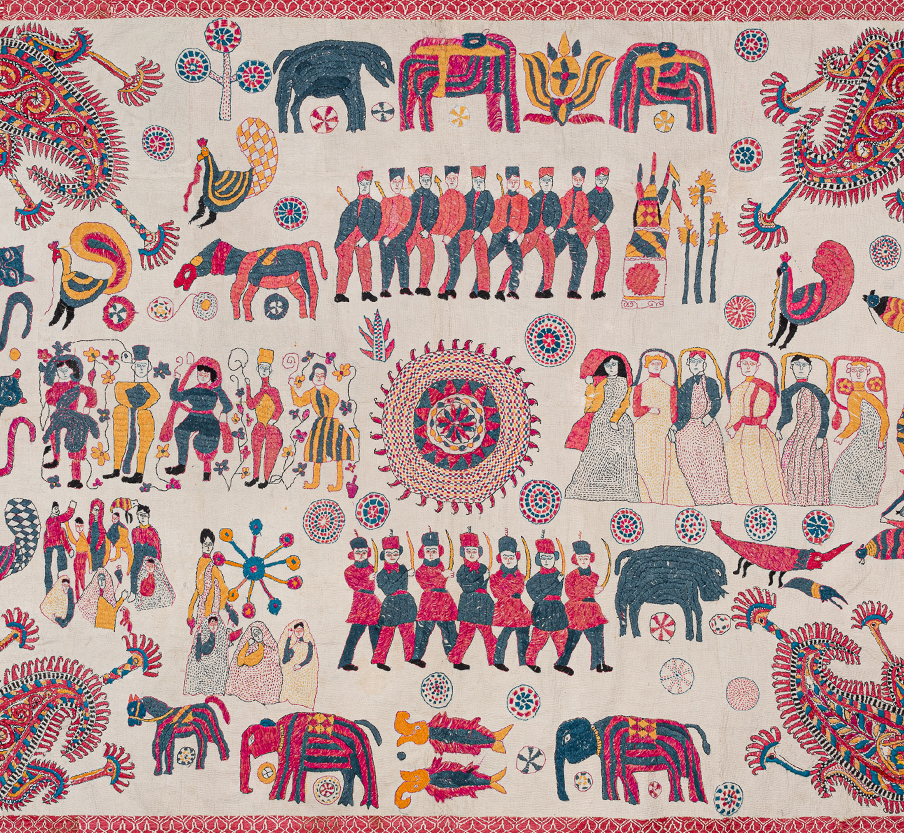
Kantha (detail); Undivided Bengal; Early 20th century; Cotton plain weave ground with cotton embroidery; 127cm x 99cm. Photograph: Desmond Brambley, from The Karun Thakar Collection
Traditional kantha were, and continue to be, created from used, worn fabric, usually extracted from women’s saris and men’s dhotis. This base white fabric is darned, patched, layered, smoothed, and secured with running stitches in white thread to create the new textile. The running stitch, along with a few others, can be used to create exquisite patterns and pictures in coloured threads.
Kantha have typically been made by women, and the older examples from the nineteenth and early twentieth centuries are often the only traces of their lives to have survived. We see their extraordinary skill in transforming something ordinary that has lost its utility into a new, useful, and beautiful thing. A closer look at the embroidered images and patterns gives us access to their choices, and hence their thinking. This makes the textiles important material archives.
They are usually created and used in domestic environments. The repurposed-cloth shawls or wraps, blankets, bedspreads, seating mats, infant receiving sheets, and diapers are integrated into the lives of Bengali families for everyday household rituals, and more formal ceremonies.
Traditional kantha are a social media of their times. Their surfaces tell many stories that may be shared variously among makers, viewers and recipients. As they moved from maker to recipient, kantha often gathered more stories. While some are visible on the surfaces, others may be private, sometimes even hidden in plain sight.
This kantha, for example, engages in a conversation with other textile practices in the deliberate play with patchwork, and the representation of other ordinary things like the jati (betel cutter) and kajol lata (kohl container).
On this textile fragment, probably half of the original rectangular kantha, the embroidery reveals how women pondered the deaths of others around them. Three scenes display variations on the theme of torture and murder of women.
The severed neck is a distinctive feature of representations of the beheading of Elokeshi by her husband, Nabin Banerjee. He attacked her with a boti (knife) when he learned of her seduction and/or rape by the mahant (chief priest) of the Tarakeshwar Temple.
These events of 1873 became headline news. They were represented in Kalighat paintings and Battala prints. Comparing women’s embroidered images to others in water colour, wood cuts, plays and farces – predominantly by male artists and writers – discloses significant variety across these versions.
Kantha versions sometimes foregrounded the woman’s body with a wealth of detail.
Such imagery reveals the nuances that women introduced. Using needle and thread to work out their thoughts and opinions, they may have stitched what wasn’t easy to verbalise, perhaps responding to the vulnerability of young women.
Unlike Elokeshi, the dead woman on this kantha is flanked by two men. One seems to reach out to support her from behind, the second, shrinking – his arm withdrawn. Neither displays the attributes associated with the imagery of Elokeshi’s murder, suggesting that such motifs were employed to comment on the fate of other women, real or imagined.
An adjacent panel presents a similarly contorted woman, and a man whose raised hand suggests he is recounting the events.
Yet another woman is contorted in the same pose on a third panel on the same kantha. Here the man bears what may be a weapon in his left hand, distinct from the knife usually held by Nabin, Elokeshi’s husband, in his raised right hand. With the bird and smaller girl or woman crouching at the corner, it offers a third variation on the theme.
Namabali kantha, typically thin chadar or shawls, were ornamented with the name (nama), most often Vishnu/Krishna, repeated through the field of the textiles, thus visualising a verbal (boli), aural, and meditational practice. On this kantha, it is the Gaudiya (Bengali) Vaishnava Mahamantra: Hare Krishna Hare Krishna, Krishna Krishna Hare Hare, Hare Ram Hare Ram, Ram Ram Hare Hare.
The mantra is believed to be so efficacious that it can instantiate the divine, melt the heart and transform the singer or listener viscerally. It has been sung as kirtan since the Bengali saint Chaitanya Mahaprabhu initiated the practice in the sixteenth century. The first kirtan sessions were conducted at the home of his devotee Sribas in Nabadwip but gradually overflowed into the streets.
Kirtan processions swept the local community and were visualised in the temples of the Gaudiya Vaishnava tradition that were constructed subsequently in the seventeenth century.
This kantha depicts a kirtan session with devotees playing various instruments as they sing and dance around the icons of Radha and Krishna carried on a bullock cart.
Here, the performance includes the use of cymbals (kartal) and drums (khol/mridanga and dhaak).
On this namabali kantha, the mantra is presented as if sung in a kirtan session. Each set of the 32 sacred syllables is differentiated by alternating colours. The repetition reinforces the sense of multiple voices articulating the mantra in a seamless transition and invoking its power.
The choice of backstitch creates a continuous, even appearance for the words, much like handwriting.
Each iteration is punctuated by the sacred footprints as a line break rather than the vertical line (dandi) used in Bangla.
The footprints (Haricharan or Vishnupada), instantiate the feet of Hari (Krishna), the promise of access to the deity’s feet offered by the mantra.
The arrangement of figures suggests the emission of the sacred Mahamantra from their practice, reverberating in concentric rectangles around the Vishnupada at the center.
Some of the figures wear more fitted clothes, like that of the bands hired for celebrations.
Others wear billowing robes.
Despite such differentiation, they share a feature — shaven heads with prominent flying tiki (pigtails).
The inclusion of real hair, stitched onto the head of the mostly bald figures, is quite unusual. It may be part of a more personal communication between maker and recipient, perhaps protective or aspirational.
Regardless, it suggests that the intimacy of repurposed cloth, held close to the body even before it is stitched, may hold more relationships than those disclosed overtly.
The Vaishnava sacred mark (tilak) is cleverly suggested on his forehead, coinciding with the continuous line from eyebrows to nose. Such witticisms are the mark of a highly creative designer.
Such intimate details distinguish embroidered versions of namabali from those woven in silk Baluchari or imprinted with wood blocks.
Printed versions on cotton cloth are worn by priests for ritual performances in the Vaishnava community.
Some kantha embroidered with prayers depict Vaishnava motifs including the shankha (conchshell), chakra (disc), matsya (fish), and flowers.
Others incorporate the mantra into a temple or ratha (chariot) form.
All these variations indicate the importance of visualising Krishna’s celestial realm by kantha-makers.
Embroidery thus suggests the convergence of two kinds of meditative practices, one sung or silently invoked, and the other bringing mind-to-hand and body coordination in the act of stitching, engaging in the rhythm of wrist and fingers with cloth and needle.
This square kantha presents popular local narratives around the central lotus. While the organisation is conventional, the designer incorporates details that entice us to look closely to appreciate her interpretive skills.
The romance of Bidya-Sundar, best known from the eighteenth-century version of the Annadamangal Kabya, occupies one scene.
The figures are labeled with their names, although the inked lines have not been stitched.
Sundar, a prince from the southern kingdom of Kanchi, obtained a boon from the goddess Kalika to marry Princess Bidya of Bardhaman. He journeyed to the kingdom with a parrot given by the goddess. There, he wooed the princess with love letters and paintings sent through a flower seller. Sundar is seen riding a horse, and the woman behind him may be the go-between.
Sundar then managed to meet Bidya through an underground tunnel. Here, he is framed under the right arch of the dalan style (flat-roofed) building. His horse is tethered to the pillar.
Above, on the rooftop, the couple enjoy each other’s company. The location suggests the illicit nature of their meeting.
They sit facing each other on chairs, like the European couple on this Battala print.
The European furniture suggests the new social customs of the colonial period, as was also used to depict Bengali babus and their bibis.
With the rise of Shakta devotion and nationalist visions of the goddess, the bloodthirsty goddesses came into prominence alongside the rallying cry of Bande Mataram in the second half of the nineteenth century.
The goddess Kali is naked but for her skirt of dangling arms. She holds a severed head in one of her hands, and tramples another underfoot as she advances with weapons raised.
The resonances with prints from the Calcutta Art Studio are unmistakable.
Here, for example, Kali, wearing a skirt of arms and a garland of heads, stands astride two versions of Shiva.
The enemies/demons that Kali combats have varied with historical context. The visual trope was adapted during the colonial period to map the growing resistance to British imperialism.
Along with the sword-wielding figures on elephant and horseback is a shotgun-bearing man, aiming from his treetop perch near the upper right corner.
A second goddess with a protruding tongue grabs a man by his feet to devour him, visualising the episodes of the battle against evil in the popular narrative text Devi Mahatmya.
Playful animal figures also abound in the imagery of this period.
Similar scenes were also painted in the nineteenth century. This Kalighat painting, annotated ‘Nishambhu badh’ (the killing of Nishambhu), refers to the Devi Mahatmya episode of the Goddess slaying the demons Shumbha and Nishumbha.
Elsewhere in the kantha, Vishnu lies with his head on the coils of Ananta or Shesha, dreaming the cosmos into existence. Brahma sits on the pink lotus rising from his navel and Shiva next to him. Below, Lakshmi massages his foot.
The same snake’s head serves as a pedestal for Krishna, who dances atop the defeated Kaliya. A figure raises his hand, drawing our attention to the creative use of the snake to bring the two narratives — that of Ananta Shayana, and Kaliya Daman — into one frame.
The designer has skillfully drawn on the corner tree to suggest the Vastraharana scene — Krishna’s theft of the clothes of the bathing gopis (cowherd women) — and Krishna’s play with the gopas (cowherds) and cows in the pastures. Krishna stands on its uppermost branches, playing his flute, while gopas and cows gather at its base. The gopis raise their arms, a gesture reminiscent of their plea for the stolen clothes.
Some kantha reveal their relationship to the older embroideries called colchas (Portuguese term for bedspread), created in Bengal for the long-distance luxury trade, most notably with Iberia.
While none of the older colchas survive in Bengal, these kantha reveal relationships with the long practice of making embroideries for trade. In these kantha, the choice of indigo and red-coloured thread, and the sinuous patterns created using continuous backstitched lines recall the styles seen most commonly in colchas.
This aesthetic is shared with other kantha of different shapes and functions.
Unfinished areas and underdrawings in kantha tell us about the thought processes involved in making of these textiles.
While some of the inked lines indicate parts that have not yet been stitched, others reveal changes as the work moved from drawing to embroidery. If the draughtsperson wasn’t the same as the needleworker, these divergences can tell us about their differences of opinion.
Some kantha address the recipient directly; in this case, Mohammad Mollah, whose name is inscribed with a blessing, ‘Allah is the refuge’ (bharsha).
Sree sree Alahi bharsha
Sree Mohammad Molla
Sakim Jolseria
On digital platforms, our encounters with these textiles are mediated through photographs. We can only sense the textures of the surfaces and the looseness or tightness of stitches with our eyes.
They invite us to feel the thickness and softness of the cloth and the textures of stitches with our hands.
However, photographs also serve other functions.
In the past, women went from house to house to pick up stitches and motifs to make kantha.
More recently, pioneering revivalists such as Ruby Palchoudhuri have taken embroiderers to museums to study older examples.
Similarly, photographs allow kantha-makers access to older kantha styles and techniques. This circulation of photographs has supplemented earlier ways of learning and passing on designs.
The maker of this kantha practiced stitches, style and iconography based on the original kantha shown above, which belongs in the Stella Kramrisch Collection at the Philadelphia Museum of Art.
The kantha also incorporates the words Bemal Kamini, likely the signature on the original.
The Karun Thakar Collection thus gives us access to a wonderful range of women’s practices and traces of their creativity. These include the departure of stitchwork from underdrawing revealing a series of choices; the economy visible in the use of the same figure to tell multiple stories; the study of an older kantha; and the intriguing insertion of hair onto the bald pate of embroidered kirtaniyas.
I thank Desmond Brambley for his photographs of the Karun Thakar Kantha Collection.
Pika Ghosh is a scholar of South Asian textile histories whose research on kantha began with her work on the exhibition curated by The Philadelphia Museum of Art, Kantha: The Embroidered Quilts of Bengal (2009). The accompanying catalogue received the Alfred H. Barr Prize for Museum Scholarship from the College Art Association in 2011 and led to her monograph Making Kantha, Making Home: Women at Work in Colonial Bengal. Since 2025, she is pursuing a comparative study of kantha and colcha through an IARTS research grant at the Royal Ontario Museum, examining the origins of kantha and its connections to related regional textile traditions.
Basak, Sila. Nakshi Kantha of Bengal. New Delhi: Gyan Publishing House, 2007.
Bhattacharya, Asutosh. Bangla Mangalkabyer Itihas. Calcutta: A. Mukherji, 1989.
Bhattacharya, Malini, and Abhijit Sen, eds. Talking of Power: Early Writings of Bengali Women. Calcutta: Stree, 2003.
Bhattacharya, Rimli. Public Women in British India: Icons and the Urban Stage. New Delhi: Routledge, 2020.
Dutt, Gurusaday. Folk Arts and Crafts of Bengal: The Collected Papers. Calcutta: Seagull Books, 1990.
Ghosh, Pika.“Processing the Death of a Young Woman in Kantha Embroidery,” Special Issue, Indian Journal of Gender Studies: Pushing the Boundaries of Gender Studies edited by Geraldine Forbes and Malavika Karlekar, 2025 forthcoming.
Ghosh, Pika.“Stitching Spectacles: A Visual Culture of Bodily Prowess and Muscular Nationalism in Colonial Bengal,” In Chakshudana or Opening the Eyes: Seeing South Asian Art Anew edited by Pika Ghosh and Pushkar Sohoni, 206-230. London and New Delhi: Routledge, 2024.
Ghosh, Pika.“Unrolling Krishna’s Life-Story: Scrolling as Performance in Bengal” In Continuous Page: Scrolls and Scrolling from Papyrus to Hypertext edited by Jack Hartnell, London: Courtauld Books Online, 2020.
Ghosh, Pika. Making Kantha, Making Home: Women at Work in Colonial Bengal. University of Washington Press, Global South Asia Series, 2020.
Ghosh, Pika.“Embroidered Temples in Bengal” in Prasada-nidhi: Papers Presented to Professor M. A. Dhaky edited by Parul Pandya Dhar and Gerd J. R. Mevissen, 432-448. New Delhi: Aryan Books International, 2016.
Ghosh, Pika.“Swayed by Love: Dance in the Vaishnava Temple Imagery of Bengal,” In Dance Matters: Performing India edited by Pallabi Chakravorty and Nilanjana Gupta, 150-169. London and New Delhi: Routledge, 2010.
Ghosh, Pika.“From Rags to Riches: Valuing Kanthas in Bengali Households” In Kantha: The Embroidered Quilts of Bengal from the Jill and Sheldon Bonowitz Collection and the Stella Kramrisch Collection of the Philadelphia Museum of Art edited by Darielle Mason, 30-57. Philadelphia: Philadelphia Museum of Art, 2009.
Ghosh, Pika.“Embroidering Bengal: Kantha Imagery and Regional Identity” In Kantha: The Embroidered Quilts of Bengal from the Jill and Sheldon Bonowitz Collection and the Stella Kramrisch Collection of the Philadelphia Museum of Art edited by Darielle Mason, 80-113. Philadelphia: Philadelphia Museum of Art, 2009.
Ghosh, Pika.“Krishna’s Dance and Devotional Practice in the Temple Courtyards of Seventeenth-Century Bengal” In Performing Ecstasy: The Poetics and Politics of Religion in India edited by Pallabi Chakravorty and Scott Kugle, 49-89. New Delhi: Manohar, 2008.
Jain, Jyotindra. Kalighat Paintings. Images from a Changing World. Ahmedabad: Mapin Publishing Pvt. Ltd, 1999.
Jasimuddin. Nakshi Kanthar Maath. (trans. E. M. Milford), The Field of the Embroidered Quilt: A Tale of Two Indian Villages. Oxford University Press, 1939.
Kramrisch, Stella. “Kanthas of Bengal.” Marg 3, no. 2 (1949): 18-29, 37.
Kramrisch, Stella. “Kanthā.” Journal of the Indian Society of Oriental Art 7 (1939): 141-167.
Paul, Ashit. ed. Woodcut Prints of Nineteenth Century, Calcutta: Seagull Books, 1983.
Sanyal, Hitesh Ranjan. Bangla Kirtaner Itihas. Calcutta: Centre for Studies in Social Sciences by K.P. Bagchi, 1989.
Sarkar, Tanika.”Talking about Scandals: Religion, Law and Love in Late Nineteenth-Century Bengal.” In Hindu Wife, Hindu Nation: Community, Religion and Cultural Nationalism, edited by Tanika Sarkar, 53-94. Indiana University Press, 2001.