India Belongs Only to Me: Amrita Sher-Gil
An exploration of the life and works of Amrita Sher-Gil, one of the most pioneering and influential figures in modern Indian art, by art-historian Dr Beth Citron as part of Impart’s online course ‘Modern & Contemporary Indian Art’.
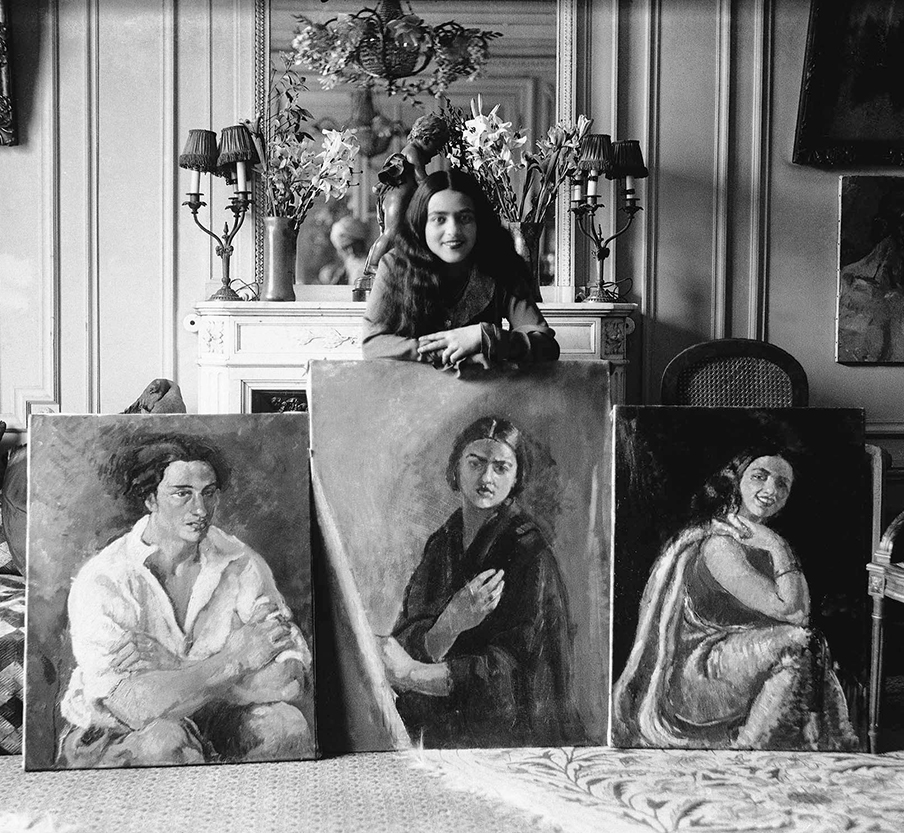
Amrita Sher-Gil with 3 paintings; Umrao Singh Sher-Gil; c. 1930s. Wikimedia Commons
Known for her evocative paintings, half-Indian, half-Hungarian artist Amrita Sher-Gil (1913–1941) explored complexities surrounding cultural heritage, identity, gender and social inequality, across her practice.
Her oil painting, Self-Portrait as Tahitian (1934), marks a critical turning point in her artistic career.
Depicting herself in the nude, Sher-Gil’s pensive self-portrait looks beyond the frame of the picture. Her long black hair is tied loosely, flowing down the length of her back.
Standing upright with her arms crossed over her body, her posture conveys a firm and measured stance.
Inserting herself within the Western canon of modern art history, she seems to be directly responding to paintings by the French artist Paul Gauguin (1848–1903), known for exoticising nude Tahitian women. Gauguin’s works have been critiqued for imposing an objectifying and subjugating lens on the non-western female body.
In contrast, Sher-Gil reverts the gaze of the male European artist by self-consciously playing up her own exoticism as an Indian woman. Exploring the tensions within her identity, being half-European and half-Indian, she uses her naked torso, brown skin and long, straight hair to evoke Gauguin’s portraits, but stands with a sense of pride and assuredness not granted to his subjects.
Sher-Gil was born in 1913, to an aristocratic family, and spent her childhood in Hungary before relocating to her family’s home in Shimla, India in 1919. At the age of 16, she was admitted to the prestigious École Nationale des Beaux-Arts in Paris, where she studied for the next five years.
We see her academic training reflected in the under-studied painting Self-Portrait with Easel (1930), which she painted in her second year in Paris. With this work, she succeeds in fashioning herself as a serious artist, even though she is depicted without any artists’ tools and her draped red clothing seems too elegant for the messy work of painting.
In spite of her European education and upbringing, she longed for the memories of her childhood in India and sought to trace her lineage in the Indian past. By 1932, she began to experiment with representations of the non-western brown body, as we can see in her painting, Nude (1933).
While much of her work that examines corporeality and the body is grounded in self-portraiture, in this painting the artist represents her younger sister Indira in the nude. She appears vulnerable in a way that Sher-Gil’s representations of herself often are not.
Next to her is a pink cloth or blanket that seems to feature a representation of a dragon on it, echoing Indira’s beautiful hair but also notable as a stereotypical symbol of Asia (mostly East Asia). In this way, in addition to locating her work back to her roots, she also references diverse cultures.
This period of reflection upon her own identity and Indian heritage marked an important point in her artistic career. As she once stated, “Towards the end of 1933 I began to be haunted by an intense longing to return to India, feeling in some strange inexplicable way that there lay my destiny as a painter.”
Sher-Gil returned to India at the end of 1934 when the country was still under British colonial rule. Although she had previously distinguished herself as an Indian artist in Europe, her affluence, aristocratic family background and European upbringing set her apart from other colonial subjects at the time.
Over the next few years, she would integrate different dimensions of Indian visual culture and daily life into her work, and begin to imbue her paintings with what could be considered a typically Indian sensibility.
Cultivating a space for herself in the art world as an ‘Indian’ modernist, she once famously remarked, “Europe belongs to Picasso, Matisse, Braque and many others. India belongs only to me.”
She would go on to draw inspiration from art forms such as the murals at the Ajanta Caves, Mughal and Rajput miniature paintings, as well as medieval sculptures and frescoes from palaces and temples. Her paintings from this time reflect her ambition to create a style that was at once quintessentially Indian yet entirely her own. Centering Indian figures, particularly women, she began to simplify the forms of her subjects and eliminate extra details. Broadly, her paintings of rural life also took on a warmer, earthier tone than her earlier oils that had reflected a Western palette.
In her letters, Sher-Gil expressed her disdain for contemporary representations of India which often depicted beautiful landscapes while acknowledging the suffering of the poor only as a sentimental picturesque detail. In contrast, her own paintings focussed on people rather than their surroundings, particularly examining the domestic lives of women.
Sher-Gil would go on to produce a number of works exploring the lives of women — touching upon themes of leisure, rest, household work and community — representing their inner world as had never before been considered in Indian painting.
Sher-Gil passed away on December 5, 1941, at the age of 28, after a brief illness. Her untimely death prevented her from witnessing the independence of India in 1947.
Within a short span of time, she had catalysed a modernist revolution in Indian art. Unapologetically reclaiming her subjectivity as a woman, she also carved a space for generations of women artists to come, in India and internationally.
This Journey is a part of Impart’s free online course ‘Modern & Contemporary Indian Art’. Sign up here.
Dr Beth Citron is the Curator of Modern and Contemporary Asian and Asian Diaspora Art at the Asia Society Museum in New York. A 2019 recipient of the Asian Cultural Council Fellowship for research on the curatorial history of modernist art from India, she was the Founding Curator of Modern and Contemporary Art at the Rubin Museum of Art until October 2019. She holds a PhD in Art History from the University of Pennsylvania and has taught in South Asian contexts as well as at the Art History Department at New York University, where she earned her BA in Fine Arts.
“Amrita, in Her Own Words.” Mint, March 19, 2010. https://www.livemint.com/Leisure/ZFztgbfWuk5StdcAQkVrhM/Amrita-in-her-own-words.html
Dalmia, Yashodhara. Amrita Sher-Gil: A Life. New Delhi: Penguin Books, 2006.
Mathur, Saloni. “A Retake of Sher-Gil’s Self-Portrait as Tahitian.” Critical Inquiry 37, no. 3 (Spring 2011): 515–544. https://doi.org/10.1086/659356
Mitter, Partha. “The Indian Discourse of Primitivism.” In The Triumph of Modernism: India’s Artists and the Avant-Garde, 1922–1947. London: Reaktion Books, 2007.
Rana, Subir. “Framing the Political, Rebellious and ‘Desiring’ Body: Amrita Sher-Gil and the ‘Modern’ in Painting.” India International Centre Quarterly 44, no. 2 (Autumn 2017): 35–53. https://www.jstor.org/stable/26317442
Sher-Gil, Amrita. “Evolution of My Art.” In Amrita Sher-Gil: Art & Life — A Reader, edited by Yashodhara Dalmia. New Delhi: Oxford University Press, 2014.
Sundaram, Vivan. “Amrita Sher-Gil — Life and Work.” Marg: A Magazine of the Arts 25, no. 2 (March 1972): 4–38.
Zahra, Orin. “Amrita Sher-Gil, Self-Portrait as a Tahitian.” Smarthistory, September 8, 2022. https://smarthistory.org/amrita-sher-gil-self-portrait-as-a-tahitian/