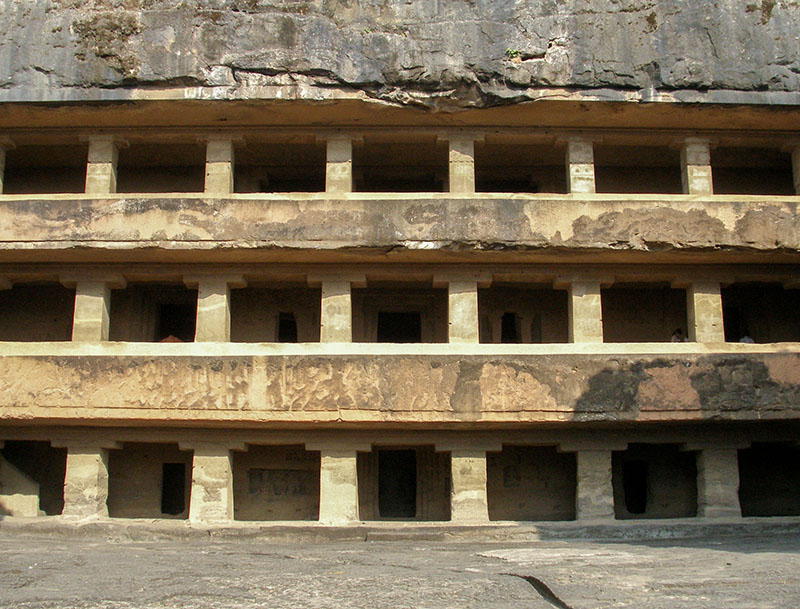
Referring to the act of leisurely strolling as well as a garden or dwelling place in Pali and Sanskrit, vihara is a Buddhist monastery and place of religious education. It typically comprises multiple residential cells for monks, connected to an open central court and an entrance porch. Initially serving as places of rest for wandering monks, the earliest surviving viharas are rock-cut structures accompanying early Buddhist cave temples in India dating to the second century BCE. These evolved into large centres of learning known as mahaviharas, such as Nalanda in India and the Shalban Vihara in Bangladesh.
More Definitions
amalaka
Ribbed or notched stone disk that is part of the crowning segment in Kalinga and Nagara temple architecture. The amalaka…
Entablature
A horizontal band resting on pillar capitals, they are divided into three parts — the architrave (the bottom), the frieze…
Double-Voluted
An architectural or design element consisting of two scroll-shaped ornamental figures mounted on pillar capitals. The curving shape is believed…
pediment
Triangular gable-like structure surmounting the end of a portico or doorway at the entrance of buildings, especially religious or other…
Frieze
The central section of the entablature (a capital on the top of a pillar), situated below the cornice and above…
gopuram
Towering, multi-storeyed gateway characteristic of South Indian Dravida temple architecture. A temple may have several gopurams, or gopuras, punctuating the…
Shala
Derived from the Sanskrit word broadly meaning "house" or "shelter", shala may refer to a covered pavilion, often oblong; a…
Ardhamandapa
A half-open pillared hall in Hindu temples. The ardhamandapa serves as an open porch at the entrance of the temple…