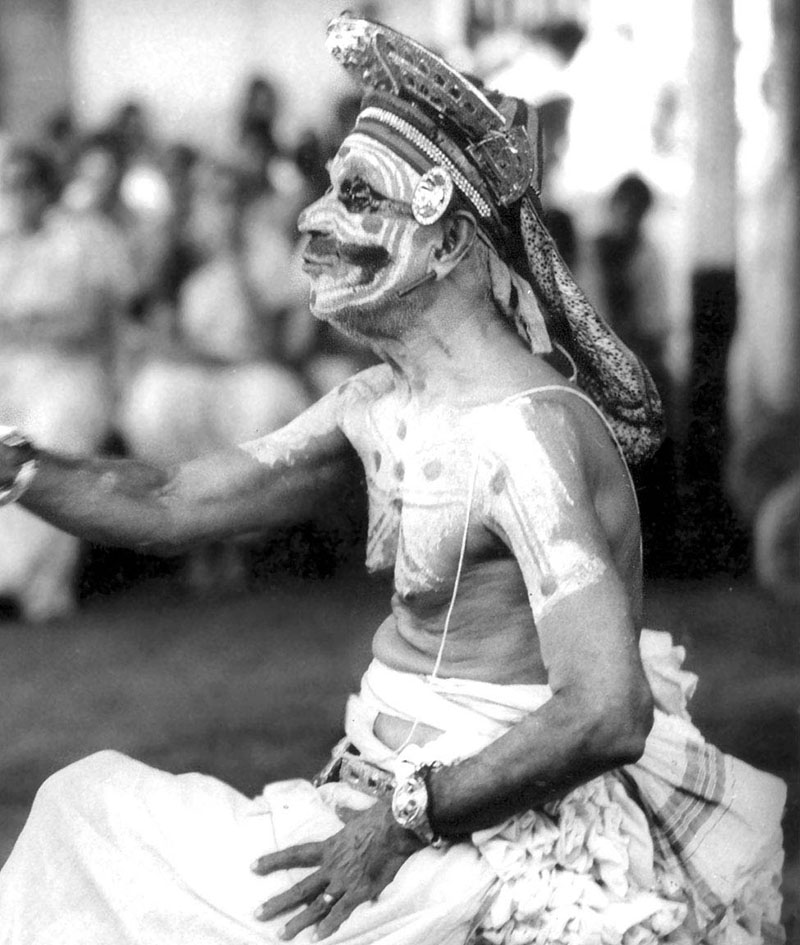
Within Sanskrit drama, it describes the good-natured jester or clown who often provides comic relief, usually through explicitly humorous action and gestures. It could also refer to a character that ridicules social norms. He is an essential part of the narrative and a close ally of the hero. According to Bharata, there are four kinds of vidushakas — Lingi or Tapasa, linked to the celestial hero; Dvija or Brahmin, the companion of a royal hero; Rajajivi, an employee connected with a minister (or merchant); and Shishya, a pupil who accompanies a Brahmin teacher.
More Definitions
Nayika
The heroine in dramatic representation, as outlined in the Natyashastra, who is represented in different scenarios with the nayaka, who…
Nadanta
An alternate name to describe the anandatandava, the cosmic dance of Nataraja, a form of the Hindu deity, Shiva.
Sutradhar
Literally meaning "thread-holder," it is the term for a stage manager and the character of a narrator within Sanskrit drama.…
Taala
Meaning “clap" in Sanskrit, it is a measure of rhythm or metre in South Asian musical traditions. It works in…
Strategic Management for the Art of Theatre (SMART)
Established in 2015, it is an initiative of the Bengaluru-based not-for-profit arts organisation, the India Foundation for the Arts. It…
Shringara
One of the nine rasas within Indian performing arts, it may be understood as the feeling of love, or as…
Abhinaya
According to the Natyashastra, it may be understood as a combination of two words — abhi meaning "towards" and naya…
Paryankasana
Composed of two parts — paryanka, meaning "bed" or "couch", and asana meaning "pose" –– it is a yoga pose…