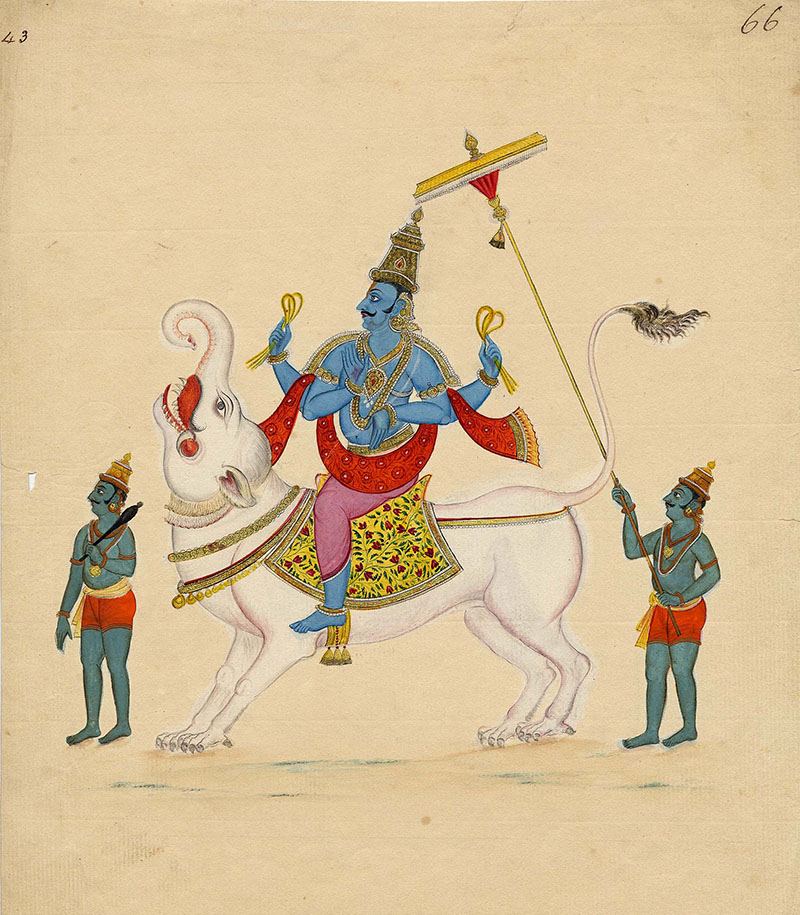
A Vedic deity associated with the moral values of rita (justice) and satya (truth), he also represents the natural elements of the sky and the ocean. The deity is typically represented with the head of a deer, legs of an antelope and the body and tail of a fish. His iconographic attributes include a nagapasha (noose) and his mount, the makara (a composite crocodile-like aquatic creature).
More Definitions
Simhanada
In Vajrayana Buddhism, one of the forms of the bodhisattva Avalokitesvara. Simhanada is depicted as sitting in the maharajalila posture…
Puranas
A genre of ancient and religious texts written in Sanskrit, Tamil and other languages. The texts are encyclopaedic and cover…
Chandesa
A devotee of the Hindu deity Shiva and one of the sixty-three Nayanars, he was a canonical poet-saint of Saivism…
Rigveda
Earliest extant text from the Vedic corpus, dated roughly between 1700 and 1200 BCE. Like the other Vedas, the Rigveda…
Vali
The king of Kishkindha and the elder brother of Sugriva in the Hindu epic Ramayana. He had a boon that…
Virupaksha
A form of Shiva, he was the tutelary deity of the Vijayanagara empire (1336–1646 CE). Within Hindu mythology, he is…
Vahana
An animal that is typically the mount or vehicle of deities in the Hindu pantheon. As mounts, they are often…
Kevala
A concept in Jainism that pertains to omniscience or the attainment of supreme wisdom. It is the last in the…