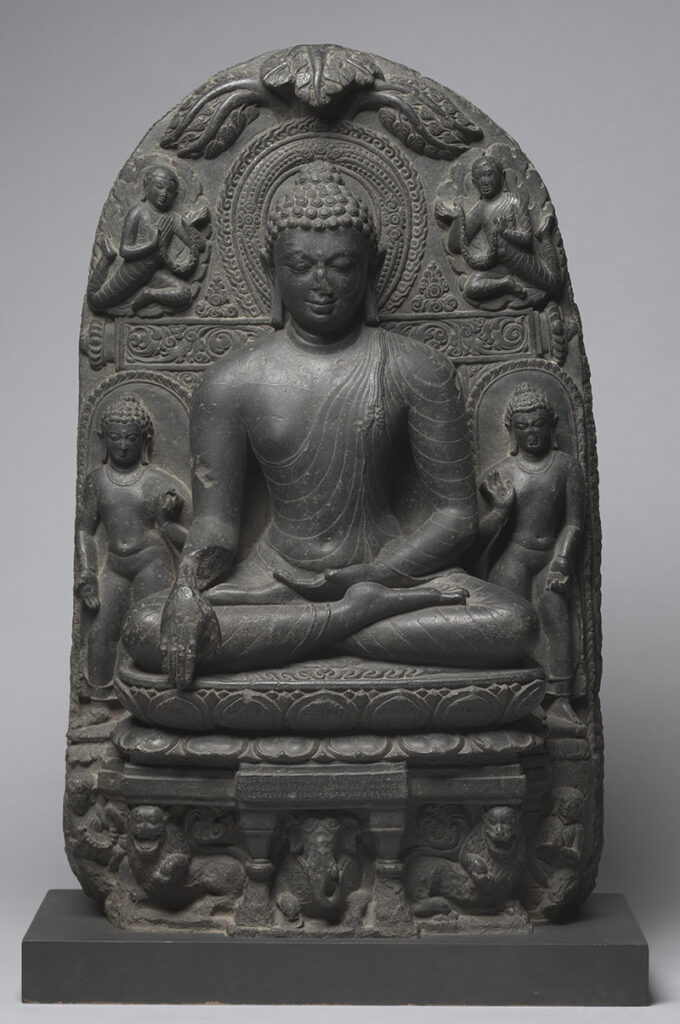
A term used by the Gautama Buddha to refer to himself or other Buddhas in the Pali canon. It is used to define someone who knows and sees reality as it is and is beyond all transitory phenomena. Early Pali texts refer to seven Tathagatas or great Buddhas, whereas Vajrayana Buddhism refers to five Tathagata Buddhas. The etymology of the term is widely contested, but it is generally thought to have derived from the Pali words tatha and gata, meaning “one who has thus gone” or “one who has thus come.”
More Definitions
Mahavidyas
A group of ten goddesses from the Tantric Hindu pantheon, consisting of Kali, Tara, Shodashi, Bhuvaneshvari, Chhinnamasta, Bhairavi, Dhumavati, Bagalamukhi,…
Yana
A metaphor for a mode or method of spiritual practice in Buddhism, which refers to the vehicles of teaching imparted…
Simhanada
In Vajrayana Buddhism, one of the forms of the bodhisattva Avalokitesvara. Simhanada is depicted as sitting in the maharajalila posture…
Hayagriva
The horse-headed avatar of Vishnu, he is the deity of knowledge and wisdom within the Hindu pantheon. He is usually…
Gurpurab
A festival of the Sikh religion, which marks important events in the lives of the Sikh gurus, including birth anniversaries…
madanika
Celestial figure of a young, beautiful woman in Indian art and mythology, often associated with nature. The Sanskrit term madanika…
Mahayogi
An epithet for the Hindu god Shiva where he is represented as an ascetic, sitting with his legs crossed and…
Vairochana
One of the five Tathagatas or the five transcendental Buddhas in Vajrayana Buddhism, Vairochana is a celestial buddha who is…