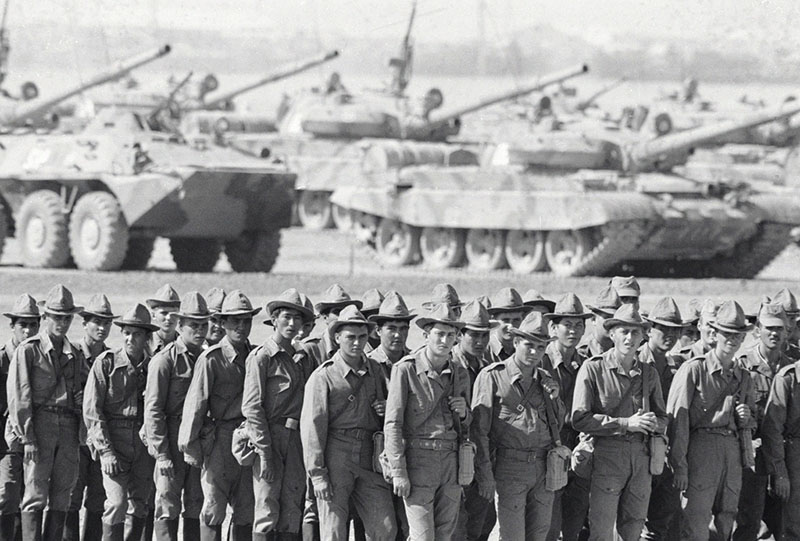
After the emergence of an unstable communist government in Afghanistan in 1978, which soon faced coups and insurgency from various local Islamic groups, the neighbouring Soviet Union invaded Afghanistan on December 24, 1979, with the intention of protecting communist influence and interests. The Soviets also aimed to preempt American intervention in the fragile political situation of the country, and installed a loyalist of theirs as the Afghan president. The Afghan War over the next decade saw continued internal conflict between the Soviet-backed Afghan government and US-supported Islamic guerrilla fighters (mujahideen); over 4 million Afghans fled to Pakistan and Iran. The Taliban emerged in the wake of Soviet withdrawal in the early 1990s. The war also eventually contributed to the collapse of the Soviet Union.
More Definitions
Raja Purna Varma
Raja Purna Varma (b. n.d. ; d. n.d.) was a local ruler, who is referenced in the chronicles of the…
Wajid Ali Shah
Wajid Ali Shah (b. 1822; d. 1887) was the eleventh and final ruler of Awadh, whose reign lasted from 1847…
Mangalesha
Mangalesha (r. 598–610 CE) was a king of the Badami Chalukya dynasty, which ruled over parts of present-day Karnataka and…
Anglo–Afghan Wars
Three wars (1838–42; 1878–80; and 1919) fought between the rulers of Afghanistan and the colonial British government in India. As…
Narasimhavarman II
Also called Rajasimha, he was a ruler of the Pallava Dynasty and ruled parts of present-day Tamil Nadu and Andhra…
India House, London
The premises of the High Commission of India in London, UK. The proposal for the building was put forward by…
Kalinga War
A war fought between the independent kingdom of Kalinga and the Mauryan empire under Ashoka, which ended in 261 BCE,…
Chakravartin
A title referring to an ideal ruler in Buddhist, Jain and Hindu traditions and often used for the Mauryan emperor…