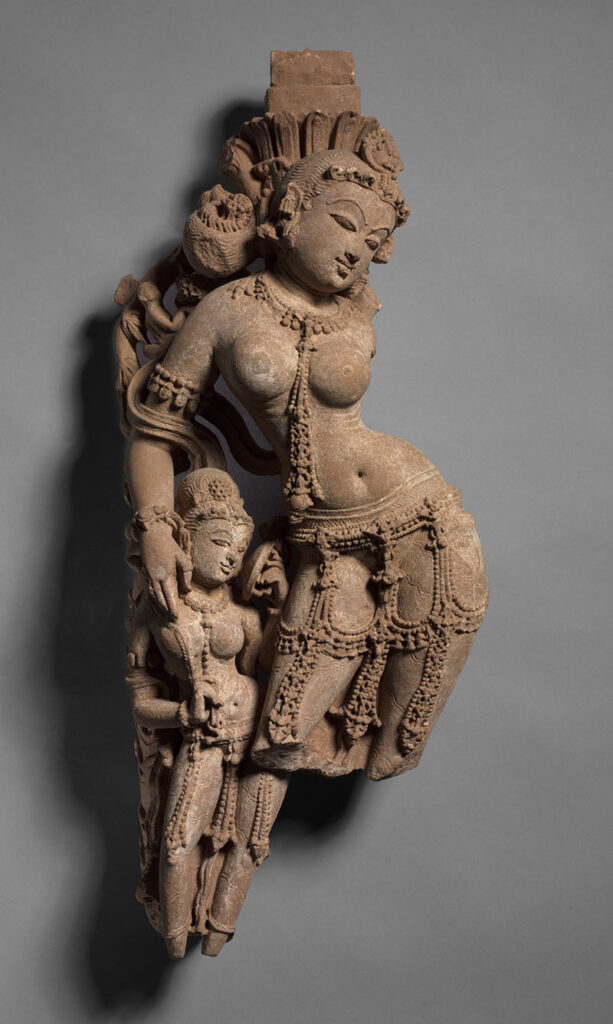
A prominent feature of Indian sculpture, it depicts a female deity with stylised and sometimes exaggerated feminine features, elaborate hairstyles and jewellery shown holding the branch of a tree, usually the sala tree, or standing near one. It is believed to have emerged from ancient Indian tree deities and signifying fertility. According to the Buddhist text Avadanasataka, the festival of salabhanjika parva was celebrated to mark the flowering of the sala tree. From the Sanskrit, meaning “breaking the branch of a sala tree”.
More Definitions
Vahana
An animal that is typically the mount or vehicle of deities in the Hindu pantheon. As mounts, they are often…
Taleju Bhawani
Mother goddess worshipped in Nepal and India. In Nepal, she has been worshipped since at least the twelfth century CE;…
rakshasa
Type of mortal being associated with evil and mischief, appearing first in Vedic texts and throughout later Brahmanical mythology. Typically,…
Paadal Petra Sthalam
A group of 275 shrines dedicated to the Hindu deity Shiva and concentrated in southern India. They are mentioned in…
Vajrayana
A form of Tantric Buddhism that developed in India in the medieval period and is currently widely practiced in Tibet,…
Pasupatastra
A destructive weapon attributed to the Hindu deities Shiva, Kali and Mahadevi. The weapon is considered powerful enough to destroy…
Bharthari
Also known as Jogi Sant Bharthari, he is a popular king from the folk legends of northern and central India.…
Aiyanar Sasta
The guardian deity of several folk and Hindu traditions in south India. Temples to Aiyanar Sasta are usually built at…