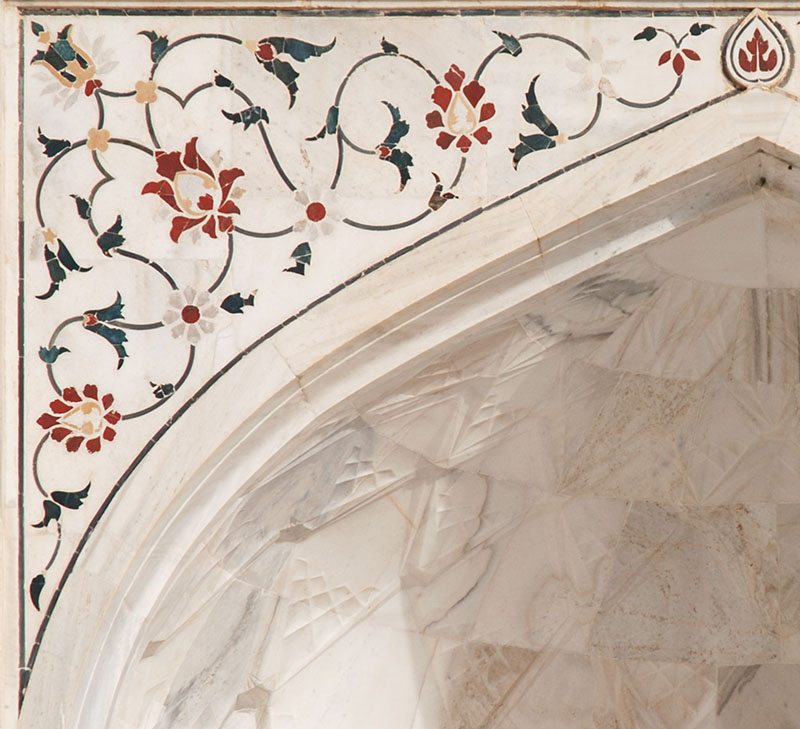
A form of mosaic work wherein hard semi-precious stones are inlaid onto stone to form images. The decorative technique flourished during the sixteenth and seventeenth centuries in Florence, Italy. A variation of the technique, known as parchin kari (mosaic work), was adapted by artisans in the sixteenth century, seen most prominently in the Taj Mahal, Agra. From the Italian pietre dure, meaning “hard stone.”
More Definitions
Weft
It refers to yarn or threads that pass horizontally over and under the fixed longitudinal warp to weave cloth and…
Stippling
A painting and drawing technique where a pattern of dots is used to produce the effect of shading.
Katorna
The process of trimming extra threads on the reverse side of a brocade after weaving. The term is derived from…
Kajli Siyahi
A technique associated with the Patna School, where paintings are rendered directly by paintbrush on the surface, without using pencilled…
Cross-Stitch
A type of sewing and embroidery that incorporates x-shaped stitches to create a design. It is considered to be one…
Illusionism
A technique in painting, sculpture and architecture where the artwork simulates the optical reality of the viewer by employing techniques…
Somak Weaving
A flat-weave tapestry weaving technique where weft yarns are wrapped over four warp threads before being twisted back under the…
Hand Stencil
The technique of imprinting human hands on rock surfaces, found in Prehistoric cave paintings. The process involves placing one hand,…