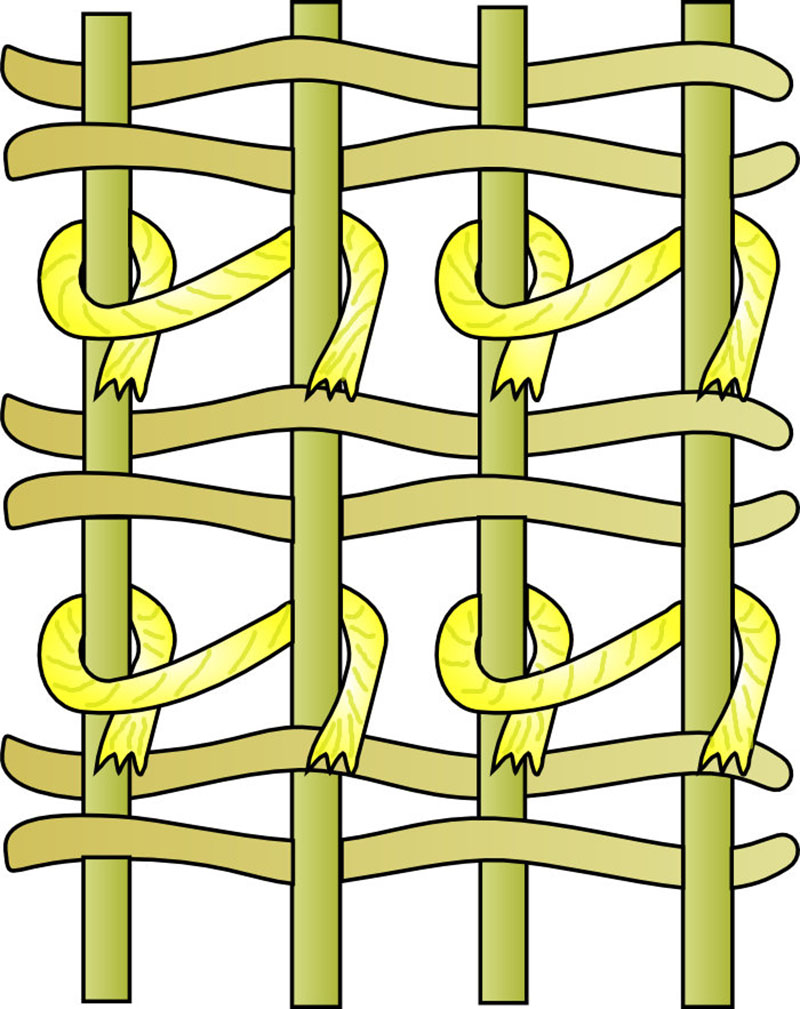
Also known as a Senneh knot, it is a technique of hand-knotting found in rugs from eastern Iran, India and Pakistan. Half of the weft thread is knotted tightly with the warp with the other end is left loose, resulting in an asymmetric knot, which can be manipulated further to create more complex designs. The technique is typically used to create rugs with high knot counts and detailed designs.
More Definitions
Kajli Siyahi
A technique associated with the Patna School, where paintings are rendered directly by paintbrush on the surface, without using pencilled…
Sapma and Thrima
Discontinuous patterning techniques in Bhutanese weaving, using supplementary weft to create single-faced motifs and patterns (invisible on the reverse of…
Parthian Shot
A cavalry technique wherein the horse-rider would retreat while the archer turns back and shoots at the enemy. It was…
Mola
Meaning “shirt” or “clothing,” it is a traditional textile made in reverse-applique technique by women of the Guna community of…
Kashika Vastra
Meaning “clothes from Kashi” in Sanskrit, it is a possible reference to the brocaded fabric produced in Kashi (now Varanasi).
Assemblage
Art made by assembling disparate elements from everyday or found objects. Assemblages are often associated with movements such as Dadaism,…
Darning Stitch
An embroidery technique in which running stitches are worked in straight rows to create a pattern. The stitches may be…
Kani
A term referring to both the weaving technique and the final textile created by this method. It may also refer…