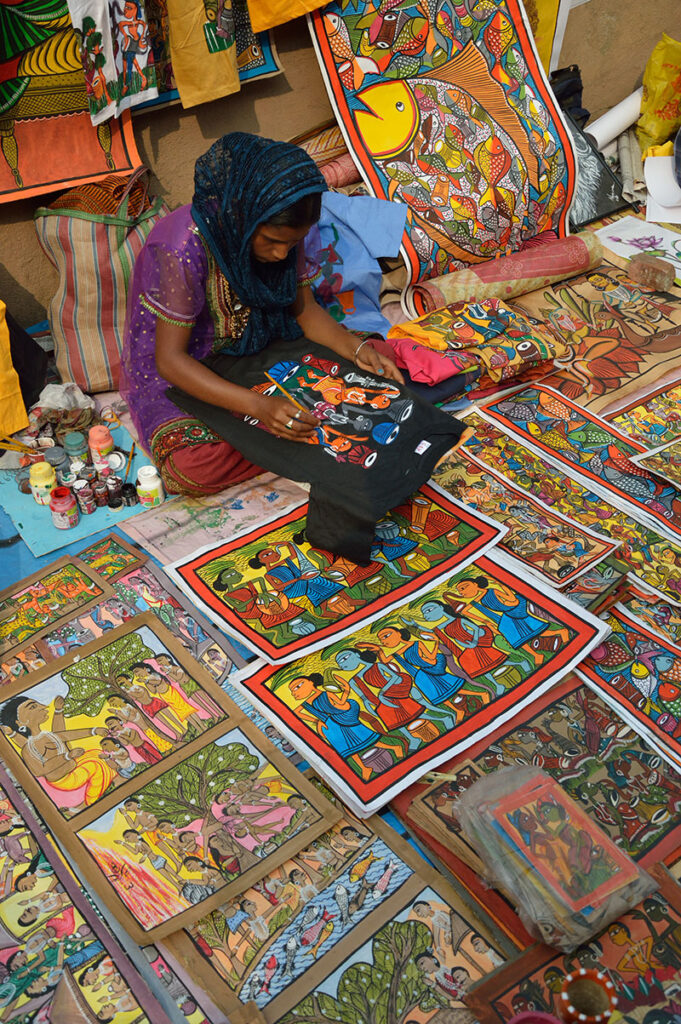
An artisanal community from the eastern states of the Indian subcontinent, primarily West Bengal, Odisha, Bihar and Jharkhand, as well as parts of Bangladesh, known for their visual and performative tradition of narrative scroll-painting. Patua paintings rose to prominence with urban migration and colonial patronage and eventually became a subset of the nineteenth-century Kalighat school. The term is also used for the artwork produced by this community.
More Definitions
Kirata
A Sanskrit term for people inhabiting areas in the Himalayas and the north-eastern regions of the Indian subcontinent. The term…
Siddi
Culturally and linguistically varied community of African descent in South Asia, mostly concentrated in the Sindh province of Pakistan —…
Digambara
Meaning “sky-robed” in Sanskrit, it is one of two major ideologies within Jainism, the other being Svetambara. The two streams…
Mahayana
The largest sect of Buddhism in the world, it is characterised by the reverence of bodhisattvas, coupled with the pursuit…
Ajivika Sect
An early sramana (ascetic) sect led by Makkhali Gosala in the fifth century BCE, it was a nastika (heterodox) school…
Rajput
A ethnic community from the north-west region of Rajasthan, which was historically known as Rajputana. Rajputs regard themselves as descendants…
Vaniya
A community, with historical roots in the precolonial Indian subcontinent and now predominantly based in India, consisting of merchants, bankers,…
Shaliya
A traditional Indian artisanal community of weavers, known for their skills in crafting cotton saris and — since the twentieth…