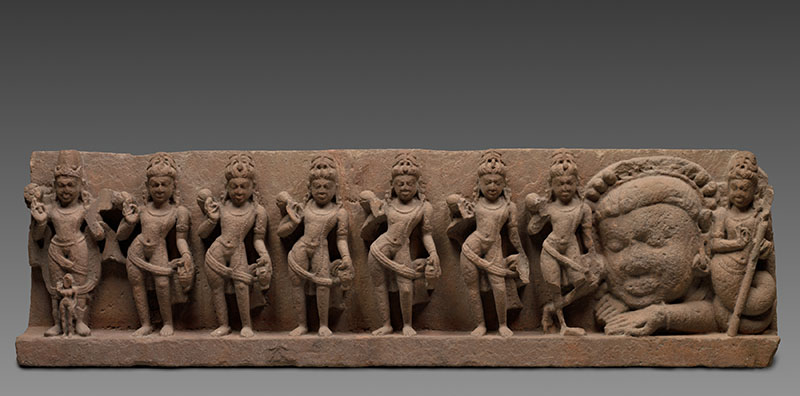
Meaning “nine planets” in Sanskrit, it is a grouping of astronomical bodies and their nine associated deities in Hinduism. These deities also find mention in Jaina texts, where they are included as Jyotiska Devas (“heavenly beings”). The nine deities are Ravi (Sun), Soma or Chandra (Moon), Mangala (Mars), Budha (Mercury), Brihaspati (Jupiter), Sukra (Venus), Sani (Saturn), Rahu (the ascending node of the Moon) and Ketu (the descending node of the Moon). They may be carved onto architectural elements, such as the doorways or niches of a temple, or may be worshipped in a separate shrine within the temple complex.
More Definitions
Mahayana
The largest sect of Buddhism in the world, it is characterised by the reverence of bodhisattvas, coupled with the pursuit…
Kamadahana Panel
A depiction of the mythological episode of the Kamadahana, which means “the incineration of Kama” in Sanskrit. It shows the…
Wei Buddhism
Also known as the Bei Wei ("Northern Wei") and Tabgatch or Tuoba and founded by tribesmen of Turkic origins, the…
Rigveda
Earliest extant text from the Vedic corpus, dated roughly between 1700 and 1200 BCE. Like the other Vedas, the Rigveda…
matrika
Any of a group of mother goddesses (matrika, Sanskrit, ‘divine mother’) mainly in Hinduism, especially in Shakta and Shaiva cults;…
Shakyamuni Buddha
An epithet used for the Buddha, the founder of Buddhism, who lived sometime between the fourth to sixth century BCE.…
Sundereshwara
A form of the Hindu deity Shiva worshipped as one of the principal deities of the Meenakshi Temple, Madurai, in…
Mahakapi Jataka
One of the Jataka tales, it tells the story of the bodhisattva's life as a monkey king who stretched his…