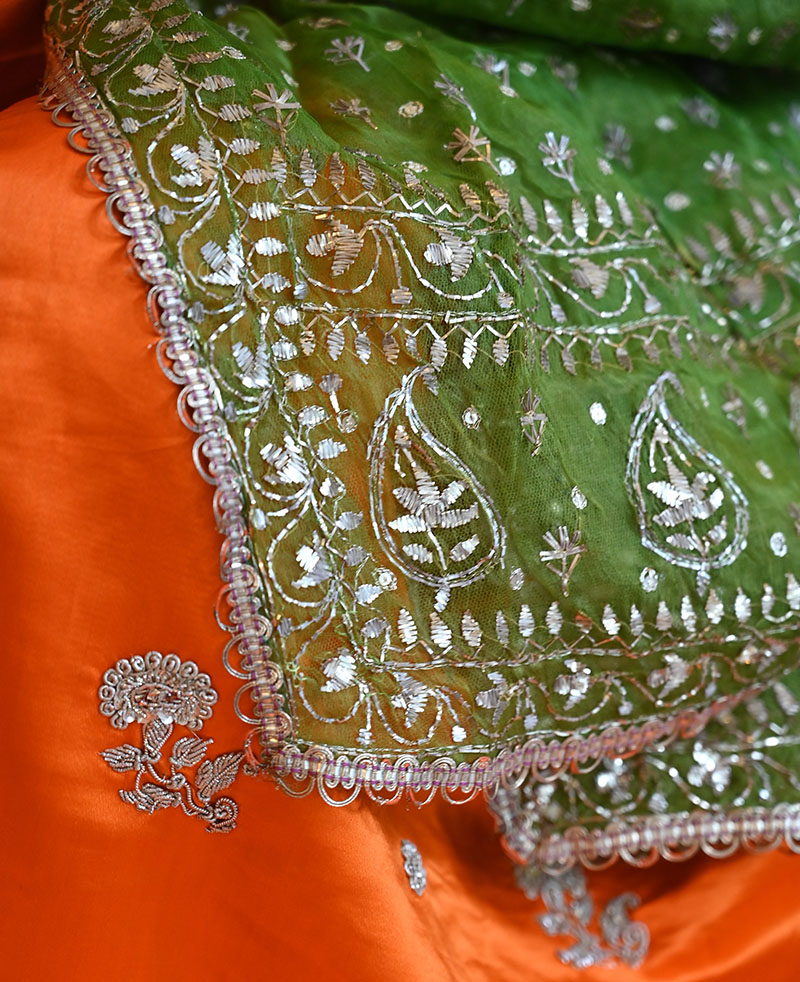
A variant of badla embroidery in which metallic wires are sewn onto the fabric with the help of a needle to create patterns that are finished by hammering and burnishing the metal. The technique gained popularity in the Awadh region during the Mughal era, particularly in the city of Lucknow. The two chief techniques within mukaish embroidery are kamdani and fardi ka kaam.
More Definitions
Fresco Buono
Literally meaning “true fresh” in Italian, it is a painting technique in which the paint is applied to wet plaster,…
Gelatin Dry Plate
A method of producing photographic negatives that emerged in the 1880s, using a glass plate coated with silver salts in…
Single-Spindle
A technique of spinning yarn that incorporates one spindle, as seen in the charkha used to spin khadi.
Slit Weave
Also known as slit tapestry, it is a weaving technique which uses multiple weft yarns through sections of the warp,…
Double Running Stitch
A form of running stitch that is even on both sides of the fabric, used in counted thread embroideries such…
chamfer
A slope or bevel, typically at 45º, at the intersection between planes in woodwork, architectural and engineering detailing, and other…
Counted-Thread Embroidery
A form of embroidery where the warp and weft are uniformly counted, resulting in a uniform, even pattern. It is…
Serigraphy
A stencil-based printing process which involves forcing ink through a fine screen, usually made of silk, polyester or nylon, onto…