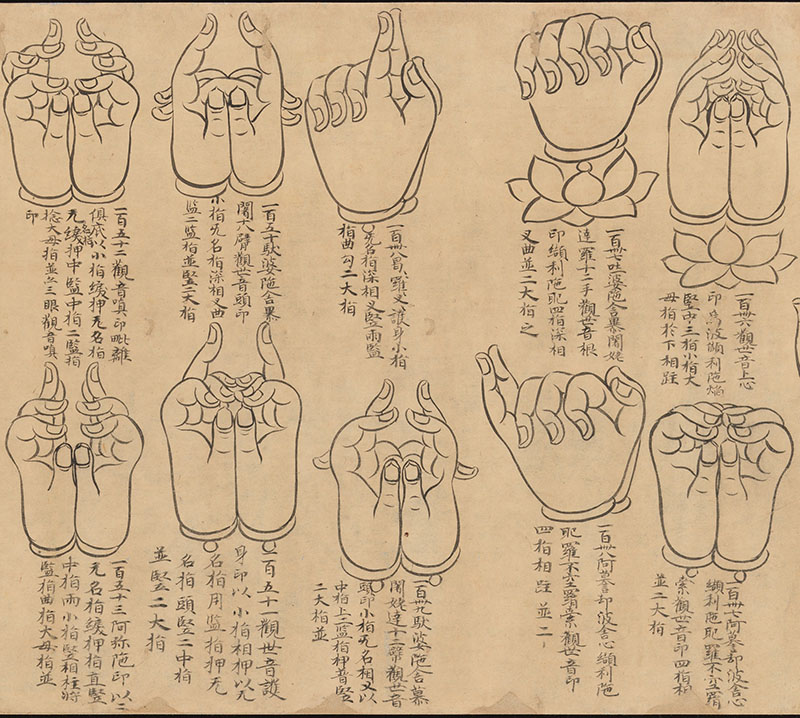
Originating from the Sanskrit word for “seal” or “mark,” it is a symbol or ritual gesture that is performed using the hands and fingers, though at times it may involve the entire body. Each mudra has a variety of meanings within the visual iconography and practises of Indian religions such as Hinduism and Buddhism. Mudras are also an important element in several traditional Indian dance forms and in yoga.
More Definitions
Devi-Bhagavata Purana
Also known as Devi Bhagavatam, it is often categorised as a Mahapurana and revolves around the figure of the Devi…
Kharoshthi
An ancient writing system used in parts of present-day central Asia, Afghanistan, Pakistan and India for official documents and commercial…
Karma
A philosophical concept in Hinduism, Buddhism, Jainism and Sikhism, and a spiritual principle of cause and effect wherein the actions…
Samsara
The concept of the continuous cycle of birth, death and rebirth, fundamentally seen in most Indian religions, including Buddhism and…
Tenjur
A sacred text belonging to the Tibetan Buddhist canon, comprising commentaries, treatises and a collection of abhidharma (ancient Buddhist texts).…
Laila Majnun
A seventh-century Arabic tale that narrates the love story of the poet Qays ibn al-Mulawwah and Layla bint Mahdi. Popularly…
Tarikh-i-Khandan-i-Timuriya
An illustrated manuscript that details the history of Timur and his descendants in Iran and India. It was commissioned by…
Vishnudharmottarapurana
An ancient Hindu encyclopaedic text consisting of three khandas (parts), it deals with a wide range of subjects, including cosmology,…