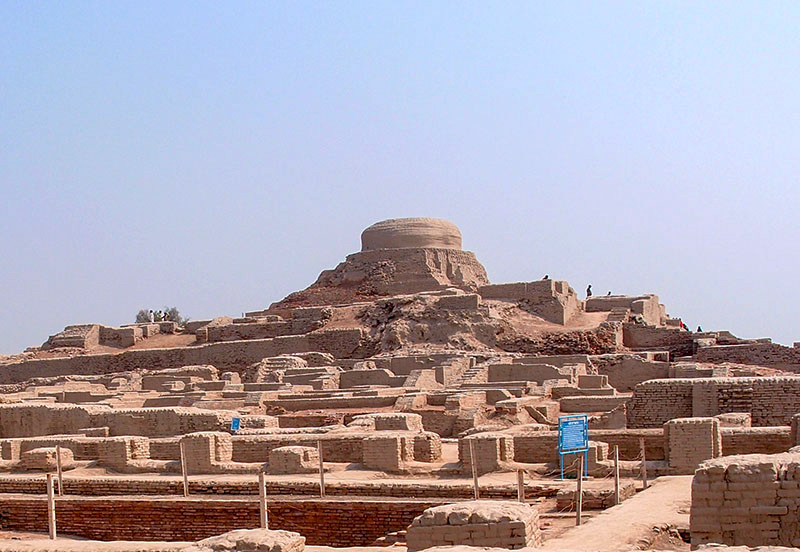
An archaeological site located in present-day Sindh, Pakistan, and dated to c. 2500 BCE. It was one of the largest settlements in the Indus Valley Civilisation. The site contains substantial evidence of urban planning, such as regular streets, uniform building sizes, supply and drainage of water and a grain storage facility. It was designated a UNESCO World Heritage Site in 1980.
More Definitions
Hampi
An ancient city in Karnataka, India, it was the capital of the Vijayanagara empire (1336–1646 CE). It is also an…
Mathura
A city in Uttar Pradesh that contains archaeological remains from the eleventh century BCE to the second century CE. The…
Chittoor
Located in the Poini river valley, it is a district in the Rayalaseema region of Andhra Pradesh, India. It is…
Pattadakal
Located in present-day Karnataka, it was a capital and coronation site of the Early Western Chalukyas. It is noted for…
qadamgah
Persian for ‘footstep site’, referring to a place rendered holy by the visit of a saint or a sacred object,…
Maski
An archaeological site in the district of Raichur, Karnataka, famous for a Minor Rock Edict etched on gneiss that identifies…
Vengi
Historic region of southern India comprising the fertile deltas of the Krishna and Godavari rivers, in present-day Andhra Pradesh, sometimes…
Tondai Nadu
Historic region of southern India spanning present-day northern Tamil Nadu and southern Andhra Pradesh, bounded by the Arni and Kotallaiyar…