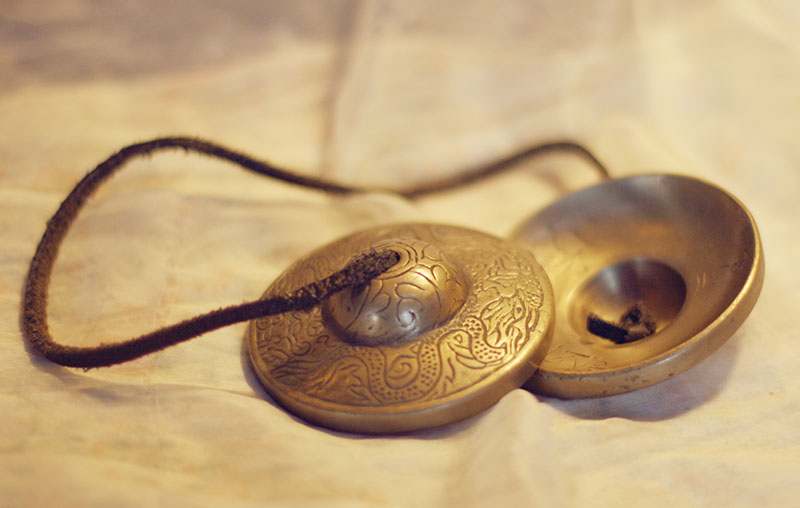
An Indian idiophonic instrument whose simplest form consists of a pair of small metal cymbals connected by a string. The cymbals may be made of bronze, brass, bell metal or copper zinc. Played as a handheld instrument, it is also known as karatala (kar meaning “hand” or “arm” and tala meaning “beat”) and is commonly used during performances of religious music such as bhajans or kirtans. It is also used as an accompaniment in performances of classical dances such as Bharatnatyam, Kuchipudi, Manipuri and Mohiniattam.
More Definitions
Reproduce
A collective of artists in New Delhi working on sound and music across physical and digital venues, with an emphasis…
Dhruva
A classification of songs from chapter thirty-two of the Natyashastra, which pertains to songs sung on stage during a performance.…
Taala
Meaning “clap" in Sanskrit, it is a measure of rhythm or metre in South Asian musical traditions. It works in…
Raga
A central element within Indian classical music, it is a melodic framework based on a given set of notes appearing…
Santoor
A South Asian stringed instrument, it is a hollow trapezoid wooden box which generally has twenty-five bridges, with four steel…
Chalan
A series of notes in a Hindustani raga that summarise its development by illustrating its musical treatment and melodic context.
Ektara
A South Asian stringed instrument, it consists of a single string, a gourd resonator and a bamboo neck. Though there…
Dafli
A percussion instrument, it is a smaller version of a Persian instrument known as daf. It consists of a circular…