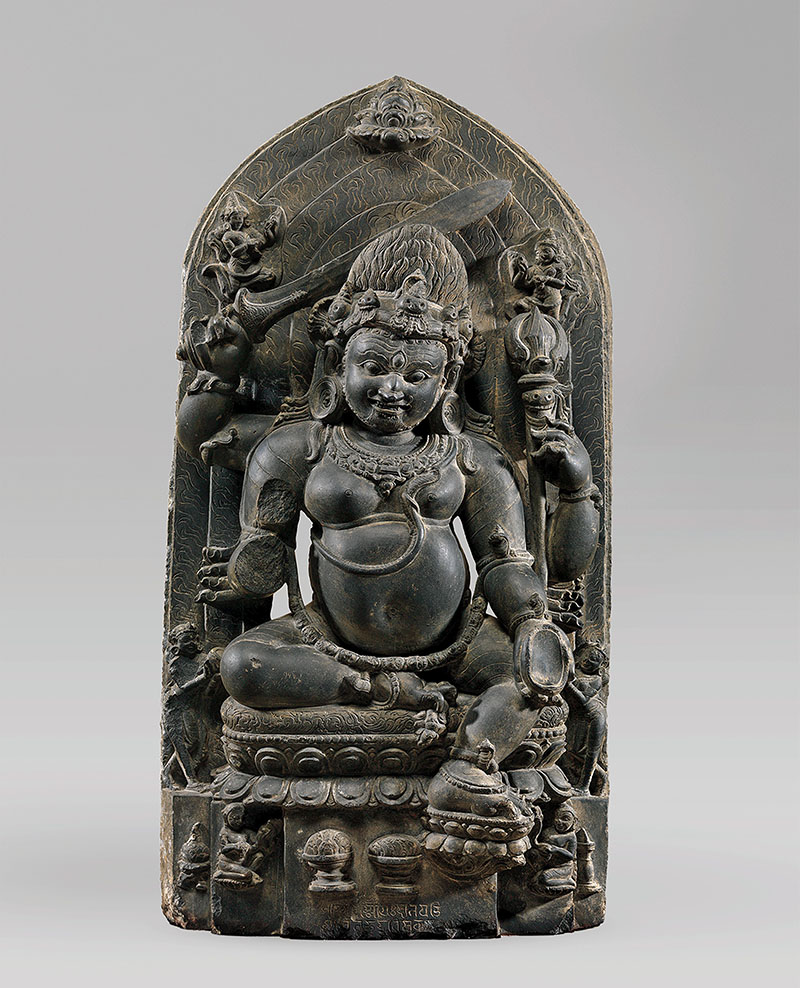
A deity common to Buddhism, Hinduism and Sikhism, whose name is composed of the Sanskrit maha, meaning “great,” and kala meaning “time” or death,” thus denoting “the one who is beyond time or death.” In Hinduism, he is considered to be a manifestation of the deities Shiva and Vishnu, as well as consort to the goddess Mahakali. Within Vajrayana Buddhism and Tibetan Buddhism, he is a protector deity and is also known as dharmapala, while in Sikhism, he is known by the name Kala.
More Definitions
Kalpavriksha
Also known as the kalpataru or kalpadruma, it is a sacred, wish-granting tree that is a recurring image in Hinduism,…
Gajendramoksha
An episode in Hindu mythology central to the Vaishnava sect, it narrates the tale of how Vishnu came down to…
Kali
Also known as Dakshina Kalika, she is a Hindu goddess and aspect of Shakti and is regarded as the destroyer…
Ekadasamukha
An epithet for one of Alokiteshwara’s forms, it is Sanskrit for "the one with eleven heads." The tenth face represents…
Manushi Buddhas
A Buddha in human form, they attain enlightenment once they perform their allotted task on Earth and are released from…
Padmavati
A sasana devi or protector goddess of Parshwanatha, the twenty third Tirthankara, she is one of the most revered yakshis…
Anantashayana
A representation of the Hindu god Vishnu, which shows him reclining atop a coiled form of the serpent Ananta, on…
Vittala
A Hindu deity who is considered to be a form of Vishnu and is popularly worshipped in present-day Maharashtra and…