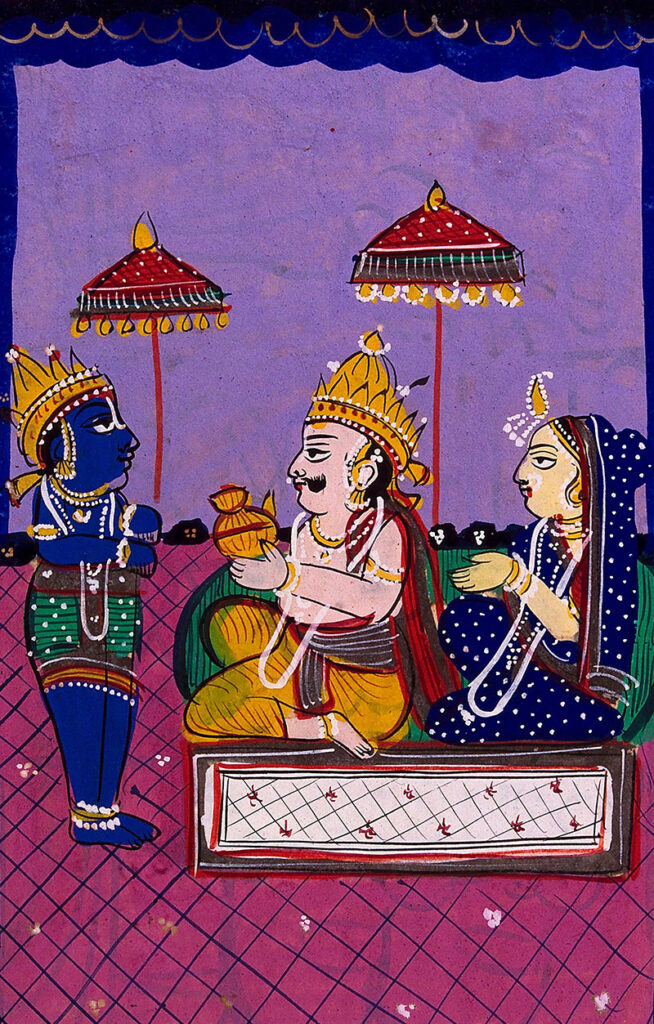
A Daitya king and the grandson of Prahalad, he is mentioned in a number of texts and myths within Buddhism, Hinduism and Jainism. He is a part of the Dashavatar legend of the Hindu god, Vishnu. Within Buddhism, he appears as an audience to the Buddha’s sermons and in a dialogue with the bodhisattva Avalokiteshvara. He is also one of the pravtivasudevas (anti-heroes) in Jain mythology. He is a prominent and celebrated figure in the southern Indian regions of Kerala and Tulunadu, particularly during the festival of Onam.
More Definitions
Arjuna
A mythical warrior and one of the five Pandava princes in the Mahabharata, Arjuna was the son of Kunti and…
Axis Mundi
A Latin phrase meaning “world axis” and referring to the centre of the earth or the point at which the…
Brahma
A deity in the Hindu pantheon regarded as the creator of the universe, he is a part of the trimurti…
Ayudhapurusha
The anthropomorphic representation of divine weapons in the Hindu pantheon. These personified weapons are depicted either in human form or…
Devi
A Sanskrit term used to denote a goddess or female deity. The word also refers to a cosmic goddess of…
Hinayana
A term coined by the Mahayana Buddhist tradition to denote followers of the contrasting, more orthodox school of Buddhism. Literally…
Gangadhara
An epithet for the Hindu deity Shiva, meaning "the one who carries Ganga" in Sanskrit. The name derives from the…
Shaivism
One of the largest and oldest sects of Hinduism, with Shiva and his consort Shakti as the supreme deities —…