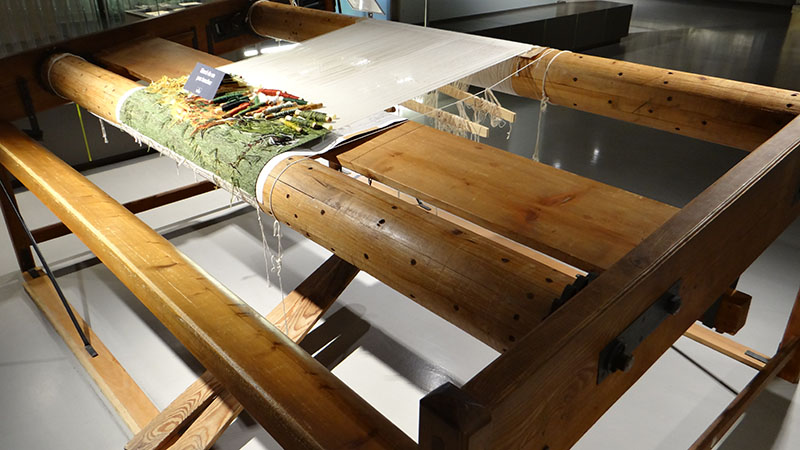
Handloom commonly used for traditional tapestry and carpet weaving, in which the warp threads are stretched parallel or nearly parallel to the ground between two rollers that help control the tension. The shed or gap for the weft threads to pass through is opened using treadles, leaving the weaver’s hands free and making the weaving process faster than with the hand-operated mechanism of the upright high-warp loom. The weaver works weft patterns into the back of the warp using a reference image placed underneath, typically viewed by tilting the frame or using a mirror.
More Definitions
fixer
In photography, a chemical solution used in the final stage of processing photographic film. It contains sodium or ammonium thiosulphate,…
Dobby
A mechanism attached to a loom that controls warp threads to allow for the weaving of small, usually geometric or…
photosensitive paper
Paper coated with a photosensitive emulsion, used for making photographic prints, usually in a darkroom. It is first exposed to…
Camera Lucida
An optical device and precedent to the camera, which was used as an aid for drawing and sketching. Developed in…
Flying Shuttle
Mechanical tool installed on a loom for textile weaving, which enables the weft thread to be drawn through the warp…
Schiffli
A multi-thread machine used to create machine embroidery and lace, invented in 1893 by Swiss inventor Isaak Grobli. The term…
ground glass
Glass that has been given a coarse surface finish, usually with a fine abrasive, to be used as the viewfinder…
Pinhole
A small circular hole used in optics and photography as an aperture for a light beam to pass through and…