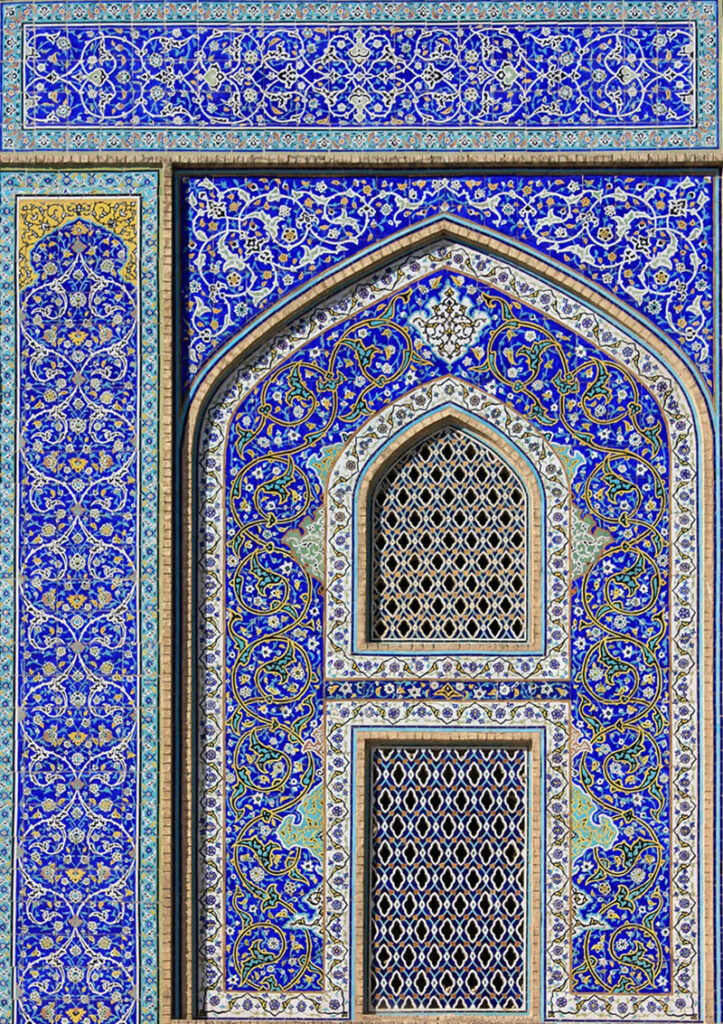
Painted and glazed ceramic ware, particularly tiles, common in the Islamic world, typically featuring colourful arabesques, floral and geometric motifs, and calligraphy on a white background. Shades of blue, green and yellow are commonly used. Kashikari (or simply Kashi) is widely seen on the cladding of buildings such as mosques, shrines and tombs in West, Central and parts of South Asia. The craft is thought to originate in Kashan, Iran — influenced by Egyptian and Chinese painted ceramics — from where it spread elsewhere, today being practised in Sindh, Punjab and Multan in Pakstan. It may derive its name from either Kashan, or kasi, Arabic for ‘glass’; Kashi artisans are known as kashigars — which is also adopted as a family name for ancestral practitioners of the craft.
More Definitions
Rib Weave
A variation of the plain weave, it is created by passing the weft over and under the warp threads in…
Dorukha
A textile with double-sided design, typically seen in Kani weaving and kantha embroidery. The embroidery is executed in a way…
lens-based practice
Any mode of communication or creative expression involving the use of cameras and related technology — spanning across photography, video,…
Cable-Edging
A motif with a raised surface, it is often found in textiles. Cables are created by knitting out of order,…
Relief Printing
A printmaking process in which the printing surface is cut or etched with the design to be printed. Methods of…
Glass Plate Negative
A photographic negative produced using a glass plate coated with a light-sensitive emulsion of silver compounds, in use in plate…
Weft
It refers to yarn or threads that pass horizontally over and under the fixed longitudinal warp to weave cloth and…
Chain Stitch
A decorative embroidery technique in which the stitch consists of consecutive, interconnected loops that resemble the links of a chain.…